

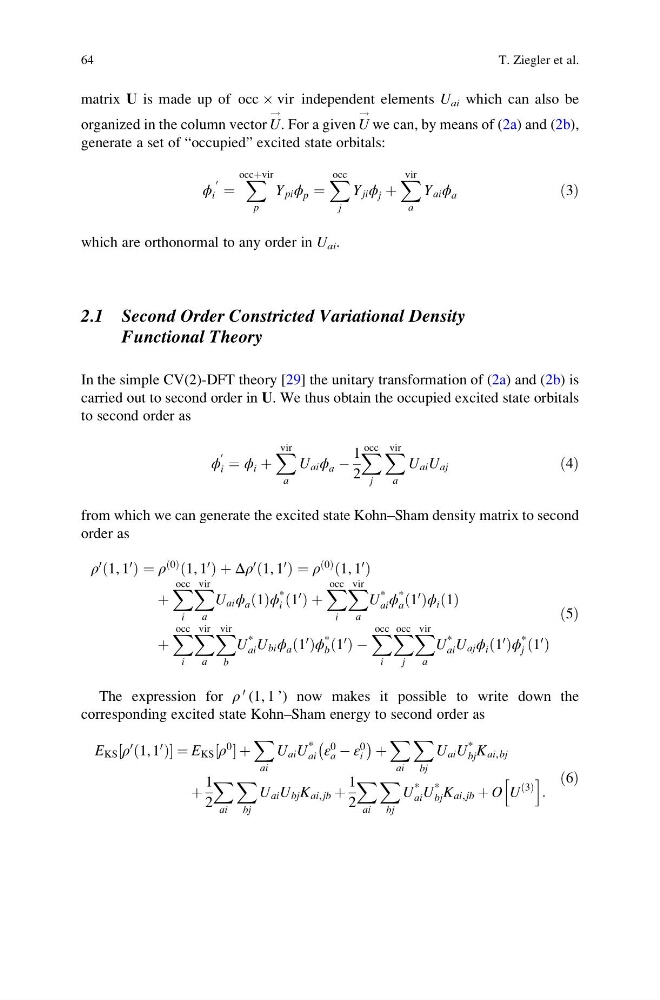
matrix U is made up of occ  vir independent elements U ai which can also be
organized in the column vector U
!
. For a given U
!
we can, by means of (2a) and (2b),
generate a set of “occupied” excited state orbitals:
ϕ i
0 ¼
X
occþvir
p
Y pi ϕ p ¼
X occ
j
Y ji ϕ j þ
X vir
a
Y ai ϕ a
ð3Þ
which are orthonormal to any order in U ai .
2.1 Second Order Constricted Variational Density
Functional Theory
In the simple CV(2)-DFT theory [29] the unitary transformation of (2a) and (2b) is
carried out to second order in U. We thus obtain the occupied excited state orbitals
to second order as
ϕ
0
i ¼ ϕ i þ
X vir
a
U ai ϕ a À
1
2
X occ
j
X vir
a
U ai U aj
ð4Þ
from which we can generate the excited state Kohn–Sham density matrix to second
order as
ρ
0 1, 1
0
ð
Þ ¼ ρ
0
ð Þ 1, 1
0
ð
ÞþΔρ
0 1, 1
0
ð
Þ ¼ ρ
0
ð Þ 1, 1
0
ð
Þ
þ
X occ
i
X vir
a
U ai ϕ a 1
ð Þϕ
*
i 1
0
ð Þ þ
X occ
i
X vir
a
U
*
ai ϕ
*
a 1
0
ð Þϕ i 1
ð Þ
þ
X occ
i
X vir
a
X vir
b
U
*
ai U bi ϕ a 1
0
ð Þϕ
*
b 1
0
ð Þ À
X occ
i
X occ
j
X vir
a
U
*
ai U aj ϕ i 1
0
ð Þϕ
*
j 1
0
ð Þ
ð5Þ
The expression for ρ
0 (1, 1 ’) now makes it possible to write down the
corresponding excited state Kohn–Sham energy to second order as
E KS ρ
0 1, 1
0
ð
Þ
½
¼E KS ρ
0
½ þ
X
ai
U ai U
*
ai ε
0
a À ε
0
i
À
Á þ
X
ai
X
bj
U ai U
*
bj K ai,bj
þ
1
2
X
ai
X
bj
U ai U bj K ai,jb þ
1
2
X
ai
X
bj
U
*
ai U
*
bj K ai,jb þ O U
3
ð Þ
h
i
:
ð6Þ
64
T. Ziegler et al.
organized in the column vector U
!
. For a given U
!
we can, by means of (2a) and (2b),
generate a set of “occupied” excited state orbitals:
ϕ i
0 ¼
X
occþvir
p
Y pi ϕ p ¼
X occ
j
Y ji ϕ j þ
X vir
a
Y ai ϕ a
ð3Þ
which are orthonormal to any order in U ai .
2.1 Second Order Constricted Variational Density
Functional Theory
In the simple CV(2)-DFT theory [29] the unitary transformation of (2a) and (2b) is
carried out to second order in U. We thus obtain the occupied excited state orbitals
to second order as
ϕ
0
i ¼ ϕ i þ
X vir
a
U ai ϕ a À
1
2
X occ
j
X vir
a
U ai U aj
ð4Þ
from which we can generate the excited state Kohn–Sham density matrix to second
order as
ρ
0 1, 1
0
ð
Þ ¼ ρ
0
ð Þ 1, 1
0
ð
ÞþΔρ
0 1, 1
0
ð
Þ ¼ ρ
0
ð Þ 1, 1
0
ð
Þ
þ
X occ
i
X vir
a
U ai ϕ a 1
ð Þϕ
*
i 1
0
ð Þ þ
X occ
i
X vir
a
U
*
ai ϕ
*
a 1
0
ð Þϕ i 1
ð Þ
þ
X occ
i
X vir
a
X vir
b
U
*
ai U bi ϕ a 1
0
ð Þϕ
*
b 1
0
ð Þ À
X occ
i
X occ
j
X vir
a
U
*
ai U aj ϕ i 1
0
ð Þϕ
*
j 1
0
ð Þ
ð5Þ
The expression for ρ
0 (1, 1 ’) now makes it possible to write down the
corresponding excited state Kohn–Sham energy to second order as
E KS ρ
0 1, 1
0
ð
Þ
½
¼E KS ρ
0
½ þ
X
ai
U ai U
*
ai ε
0
a À ε
0
i
À
Á þ
X
ai
X
bj
U ai U
*
bj K ai,bj
þ
1
2
X
ai
X
bj
U ai U bj K ai,jb þ
1
2
X
ai
X
bj
U
*
ai U
*
bj K ai,jb þ O U
3
ð Þ
h
i
:
ð6Þ
64
T. Ziegler et al.