

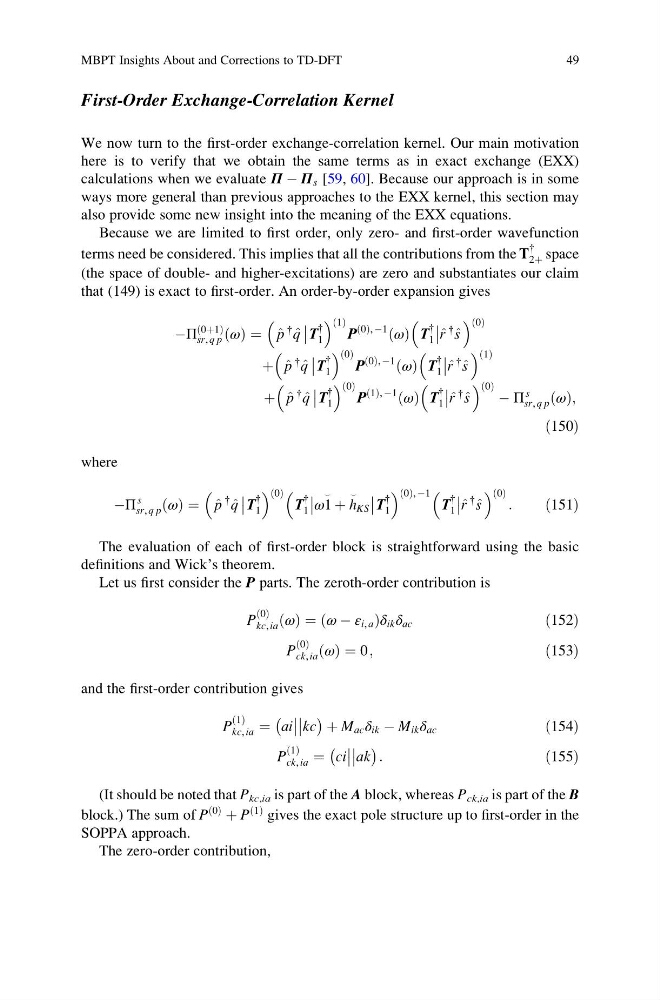
First-Order Exchange-Correlation Kernel
We now turn to the first-order exchange-correlation kernel. Our main motivation
here is to verify that we obtain the same terms as in exact exchange (EXX)
calculations when we evaluate Π À Π s [59, 60]. Because our approach is in some
ways more general than previous approaches to the EXX kernel, this section may
also provide some new insight into the meaning of the EXX equations.
Because we are limited to first order, only zero- and first-order wavefunction
terms need be considered. This implies that all the contributions from the T
{
2þ space
(the space of double- and higher-excitations) are zero and substantiates our claim
that (149) is exact to first-order. An order-by-order expansion gives
ÀΠ
0þ1
ð
Þ
sr, q p ω
ð Þ ¼ ^
p
{ ^
q
T
{
1
1
ð Þ P
0
ð Þ, À1
ω
ð Þ T
{
1
^
r
{ ^
s
0
ð Þ
þ ^
p
{ ^
q
T
{
1
0
ð Þ P
0
ð Þ, À1
ω
ð Þ T
{
1
^
r
{ ^
s
1
ð Þ
þ ^
p
{ ^
q
T
{
1
0
ð Þ P
1
ð Þ, À1
ω
ð Þ T
{
1
^
r
{ ^
s
0
ð Þ À Π
s
sr, q p ω
ð Þ;
ð150Þ
where
ÀΠ
s
sr, q p ω
ð Þ ¼ ^
p
{
^
q
T
{
1
0
ð Þ T
{
1
ω1
^ þ h
^
KS
T
{
1
0
ð Þ, À1 T
{
1
^
r
{
^
s
0
ð Þ :
ð151Þ
The evaluation of each of first-order block is straightforward using the basic
definitions and Wick’s theorem.
Let us first consider the P parts. The zeroth-order contribution is
P
0
ð Þ
kc, ia ω
ð Þ ¼ ω À ε i, a
ð
Þ δ ik δ ac
ð152Þ
P
0
ð Þ
ck, ia ω
ð Þ ¼ 0;
ð153Þ
and the first-order contribution gives
P
1
ð Þ
kc, ia ¼ ai
kc
À
Á þ M ac δ ik À M ik δ ac
ð154Þ
P
1
ð Þ
ck, ia ¼ ci
ak
À
Á :
ð155Þ
(It should be noted that P kc,ia is part of the A block, whereas P ck,ia is part of the B
block.) The sum of P
0
ð Þ
þ P
1
ð Þ gives the exact pole structure up to first-order in the
SOPPA approach.
The zero-order contribution,
MBPT Insights About and Corrections to TD-DFT
49
We now turn to the first-order exchange-correlation kernel. Our main motivation
here is to verify that we obtain the same terms as in exact exchange (EXX)
calculations when we evaluate Π À Π s [59, 60]. Because our approach is in some
ways more general than previous approaches to the EXX kernel, this section may
also provide some new insight into the meaning of the EXX equations.
Because we are limited to first order, only zero- and first-order wavefunction
terms need be considered. This implies that all the contributions from the T
{
2þ space
(the space of double- and higher-excitations) are zero and substantiates our claim
that (149) is exact to first-order. An order-by-order expansion gives
ÀΠ
0þ1
ð
Þ
sr, q p ω
ð Þ ¼ ^
p
{ ^
q
T
{
1
1
ð Þ P
0
ð Þ, À1
ω
ð Þ T
{
1
^
r
{ ^
s
0
ð Þ
þ ^
p
{ ^
q
T
{
1
0
ð Þ P
0
ð Þ, À1
ω
ð Þ T
{
1
^
r
{ ^
s
1
ð Þ
þ ^
p
{ ^
q
T
{
1
0
ð Þ P
1
ð Þ, À1
ω
ð Þ T
{
1
^
r
{ ^
s
0
ð Þ À Π
s
sr, q p ω
ð Þ;
ð150Þ
where
ÀΠ
s
sr, q p ω
ð Þ ¼ ^
p
{
^
q
T
{
1
0
ð Þ T
{
1
ω1
^ þ h
^
KS
T
{
1
0
ð Þ, À1 T
{
1
^
r
{
^
s
0
ð Þ :
ð151Þ
The evaluation of each of first-order block is straightforward using the basic
definitions and Wick’s theorem.
Let us first consider the P parts. The zeroth-order contribution is
P
0
ð Þ
kc, ia ω
ð Þ ¼ ω À ε i, a
ð
Þ δ ik δ ac
ð152Þ
P
0
ð Þ
ck, ia ω
ð Þ ¼ 0;
ð153Þ
and the first-order contribution gives
P
1
ð Þ
kc, ia ¼ ai
kc
À
Á þ M ac δ ik À M ik δ ac
ð154Þ
P
1
ð Þ
ck, ia ¼ ci
ak
À
Á :
ð155Þ
(It should be noted that P kc,ia is part of the A block, whereas P ck,ia is part of the B
block.) The sum of P
0
ð Þ
þ P
1
ð Þ gives the exact pole structure up to first-order in the
SOPPA approach.
The zero-order contribution,
MBPT Insights About and Corrections to TD-DFT
49