

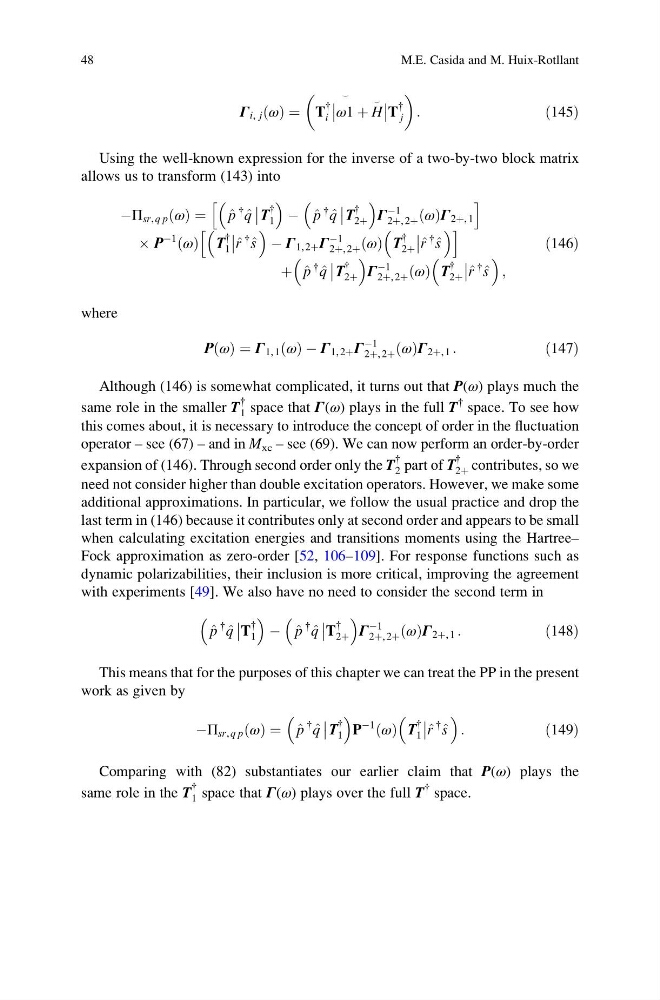
Γ i, j ω
ð Þ ¼ T
{
i
ω1
^
þ H
^
T
{
j
:
ð145Þ
Using the well-known expression for the inverse of a two-by-two block matrix
allows us to transform (143) into
ÀΠ sr, q p ω
ð Þ ¼
^
p
{ ^
q
T
{
1
À ^
p
{ ^
q
T
{
2þ
Γ
À1
2þ, 2þ ω
ð ÞΓ 2þ, 1
h
i
 P
À1
ω
ð Þ T
{
1
^
r
{ ^
s
À Γ 1, 2þ Γ
À1
2þ, 2þ ω
ð Þ T
{
2þ
^
r
{ ^
s
h
i
þ ^
p
{ ^
q
T
{
2þ
Γ
À1
2þ, 2þ ω
ð Þ T
{
2þ
^
r
{ ^
s
;
ð146Þ
where
P ω
ð Þ ¼ Γ 1, 1 ω
ð Þ À Γ 1, 2þ Γ
À1
2þ, 2þ ω
ð ÞΓ 2þ, 1 :
ð147Þ
Although (146) is somewhat complicated, it turns out that P(ω) plays much the
same role in the smaller T
{
1 space that Γ(ω) plays in the full T
{ space. To see how
this comes about, it is necessary to introduce the concept of order in the fluctuation
operator – see (67) – and in M xc – see (69). We can now perform an order-by-order
expansion of (146). Through second order only the T
{
2 part of T
{
2þ contributes, so we
need not consider higher than double excitation operators. However, we make some
additional approximations. In particular, we follow the usual practice and drop the
last term in (146) because it contributes only at second order and appears to be small
when calculating excitation energies and transitions moments using the Hartree–
Fock approximation as zero-order [52, 106–109]. For response functions such as
dynamic polarizabilities, their inclusion is more critical, improving the agreement
with experiments [49]. We also have no need to consider the second term in
^
p
{
^
q
T
{
1
À ^
p
{
^
q
T
{
2þ
Γ
À1
2þ, 2þ ω
ð ÞΓ 2þ, 1 :
ð148Þ
This means that for the purposes of this chapter we can treat the PP in the present
work as given by
ÀΠ sr, q p ω
ð Þ ¼ ^
p
{
^
q
T
{
1
P
À1
ω
ð Þ T
{
1
^
r
{
^
s
:
ð149Þ
Comparing with (82) substantiates our earlier claim that P(ω) plays the
same role in the T
{
1 space that Γ(ω) plays over the full T
{ space.
48
M.E. Casida and M. Huix-Rotllant
ð Þ ¼ T
{
i
ω1
^
þ H
^
T
{
j
:
ð145Þ
Using the well-known expression for the inverse of a two-by-two block matrix
allows us to transform (143) into
ÀΠ sr, q p ω
ð Þ ¼
^
p
{ ^
q
T
{
1
À ^
p
{ ^
q
T
{
2þ
Γ
À1
2þ, 2þ ω
ð ÞΓ 2þ, 1
h
i
 P
À1
ω
ð Þ T
{
1
^
r
{ ^
s
À Γ 1, 2þ Γ
À1
2þ, 2þ ω
ð Þ T
{
2þ
^
r
{ ^
s
h
i
þ ^
p
{ ^
q
T
{
2þ
Γ
À1
2þ, 2þ ω
ð Þ T
{
2þ
^
r
{ ^
s
;
ð146Þ
where
P ω
ð Þ ¼ Γ 1, 1 ω
ð Þ À Γ 1, 2þ Γ
À1
2þ, 2þ ω
ð ÞΓ 2þ, 1 :
ð147Þ
Although (146) is somewhat complicated, it turns out that P(ω) plays much the
same role in the smaller T
{
1 space that Γ(ω) plays in the full T
{ space. To see how
this comes about, it is necessary to introduce the concept of order in the fluctuation
operator – see (67) – and in M xc – see (69). We can now perform an order-by-order
expansion of (146). Through second order only the T
{
2 part of T
{
2þ contributes, so we
need not consider higher than double excitation operators. However, we make some
additional approximations. In particular, we follow the usual practice and drop the
last term in (146) because it contributes only at second order and appears to be small
when calculating excitation energies and transitions moments using the Hartree–
Fock approximation as zero-order [52, 106–109]. For response functions such as
dynamic polarizabilities, their inclusion is more critical, improving the agreement
with experiments [49]. We also have no need to consider the second term in
^
p
{
^
q
T
{
1
À ^
p
{
^
q
T
{
2þ
Γ
À1
2þ, 2þ ω
ð ÞΓ 2þ, 1 :
ð148Þ
This means that for the purposes of this chapter we can treat the PP in the present
work as given by
ÀΠ sr, q p ω
ð Þ ¼ ^
p
{
^
q
T
{
1
P
À1
ω
ð Þ T
{
1
^
r
{
^
s
:
ð149Þ
Comparing with (82) substantiates our earlier claim that P(ω) plays the
same role in the T
{
1 space that Γ(ω) plays over the full T
{ space.
48
M.E. Casida and M. Huix-Rotllant