

theory [97, 100, 101, 103–105] to attack difficult photochemical problems on a
routine basis. Key elements to make this happen are the right balance between rigor
and practicality, ease of automation, and last but not least ease of use if many users
are going to try these techniques and if they can be routinely applied at every time
step of a photochemical dynamics simulation.
Acknowledgements We thank Andrei Ipatov, Mathias Ljungberg, Hemanadhan Myneni, Valerio
Olevano, Giovanni Onica, Lucia Reining, Pina Romaniello, Angel Rubio, Davide Sangalli, Jochen
Schirmer, and Eric Shirley for useful discussions. M. H. R. would like to acknowledge an
Allocation de Recherche from the French Ministry of Education. Over the years, this work has
been carried out in the context of several programs: the French Rho ˆne-Alpes Re ´seau the ´matique de
recherche avance ´e (RTRA): Nanosciences aux limites de la nanoe ´lectronique, the Rho ˆne-Alpes
Associated Node of the European Theoretical Spectroscopy Facility (ETSF), and, most recently,
the grant ANR-12-MONU-0014-02 from the French Agence Nationale de la Recherche for the
ORGAVOLT project (ORGAnic solar cell VOLTage by numerical computation).
Appendix: Order Analysis
We have presented the superoperator PP procedure as if we simply manipulated
Feynman diagrams. In reality we expanded the matrices using Wick’s theorem with
the help of a home-made FORTRAN program. The result was a series of algebraic
expressions which were subsequently analyzed by drawing the corresponding
Feynman diagrams. This leads to about 200 diagrams which we ultimately resum
to give a more compact expression. It is the generation of this expression that we
now wish to discuss.
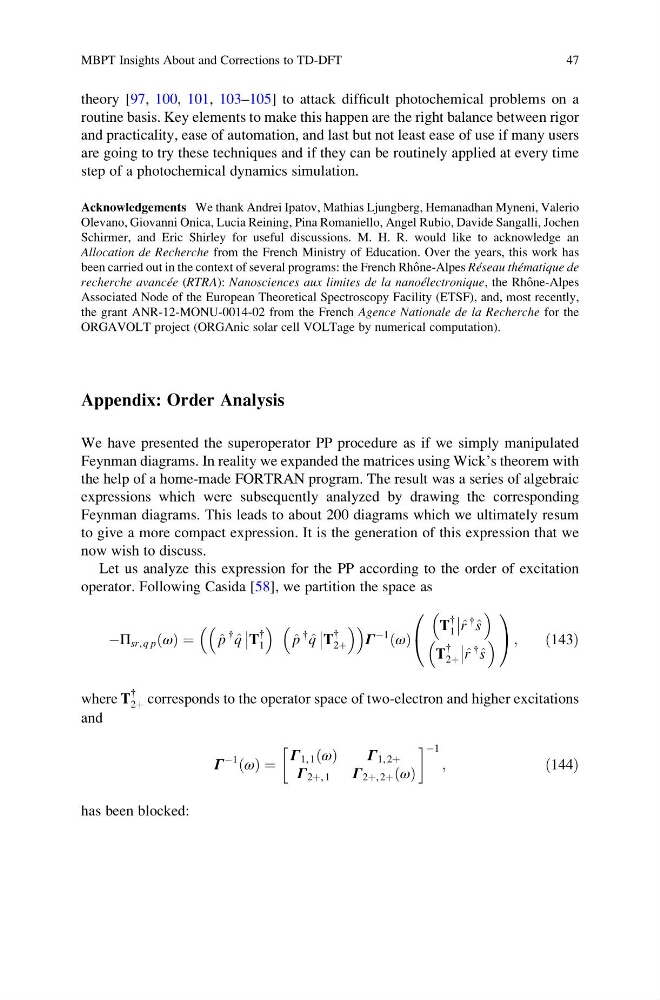
Let us analyze this expression for the PP according to the order of excitation
operator. Following Casida [58], we partition the space as
ÀΠ sr, q p ω
ð Þ ¼
^
p
{
^
q
T
{
1
^
p
{
^
q
T
{
2þ
Γ
À1
ω
ð Þ
T
{
1
^
r
{ ^
s
T
{
2þ
^
r
{ ^
s
0
@
1
A ;
ð143Þ
where T
{
2þ corresponds to the operator space of two-electron and higher excitations
and
Γ
À1
ω
ð Þ ¼
Γ 1, 1 ω
ð Þ
Γ 1, 2þ
Γ 2þ, 1
Γ 2þ, 2þ ω
ð Þ
! À1
;
ð144Þ
has been blocked:
MBPT Insights About and Corrections to TD-DFT
47
routine basis. Key elements to make this happen are the right balance between rigor
and practicality, ease of automation, and last but not least ease of use if many users
are going to try these techniques and if they can be routinely applied at every time
step of a photochemical dynamics simulation.
Acknowledgements We thank Andrei Ipatov, Mathias Ljungberg, Hemanadhan Myneni, Valerio
Olevano, Giovanni Onica, Lucia Reining, Pina Romaniello, Angel Rubio, Davide Sangalli, Jochen
Schirmer, and Eric Shirley for useful discussions. M. H. R. would like to acknowledge an
Allocation de Recherche from the French Ministry of Education. Over the years, this work has
been carried out in the context of several programs: the French Rho ˆne-Alpes Re ´seau the ´matique de
recherche avance ´e (RTRA): Nanosciences aux limites de la nanoe ´lectronique, the Rho ˆne-Alpes
Associated Node of the European Theoretical Spectroscopy Facility (ETSF), and, most recently,
the grant ANR-12-MONU-0014-02 from the French Agence Nationale de la Recherche for the
ORGAVOLT project (ORGAnic solar cell VOLTage by numerical computation).
Appendix: Order Analysis
We have presented the superoperator PP procedure as if we simply manipulated
Feynman diagrams. In reality we expanded the matrices using Wick’s theorem with
the help of a home-made FORTRAN program. The result was a series of algebraic
expressions which were subsequently analyzed by drawing the corresponding
Feynman diagrams. This leads to about 200 diagrams which we ultimately resum
to give a more compact expression. It is the generation of this expression that we
now wish to discuss.
Let us analyze this expression for the PP according to the order of excitation
operator. Following Casida [58], we partition the space as
ÀΠ sr, q p ω
ð Þ ¼
^
p
{
^
q
T
{
1
^
p
{
^
q
T
{
2þ
Γ
À1
ω
ð Þ
T
{
1
^
r
{ ^
s
T
{
2þ
^
r
{ ^
s
0
@
1
A ;
ð143Þ
where T
{
2þ corresponds to the operator space of two-electron and higher excitations
and
Γ
À1
ω
ð Þ ¼
Γ 1, 1 ω
ð Þ
Γ 1, 2þ
Γ 2þ, 1
Γ 2þ, 2þ ω
ð Þ
! À1
;
ð144Þ
has been blocked:
MBPT Insights About and Corrections to TD-DFT
47