

This agrees with a previous exact result obtained using G€ orling–Levy perturbation
theory [82, 86, 87].
5.1.3 Second Approximation
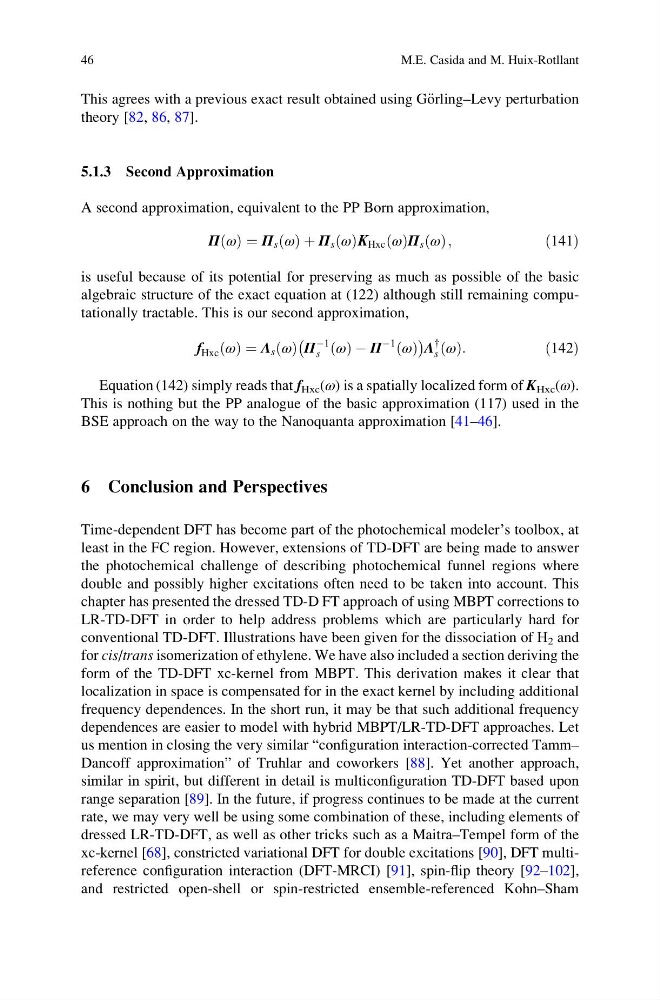
A second approximation, equivalent to the PP Born approximation,
Π ω
ð Þ ¼ Π s ω
ð Þ þ Π s ω
ð ÞK Hxc ω
ð ÞΠ s ω
ð Þ;
ð141Þ
is useful because of its potential for preserving as much as possible of the basic
algebraic structure of the exact equation at (122) although still remaining computationally tractable. This is our second approximation,
f Hxc ω
ð Þ ¼ Λ s ω
ð Þ Π
À1
s
ω
ð Þ À Π
À1
ω
ð Þ
À
Á Λ
{
s ω
ð Þ:
ð142Þ
Equation (142) simply reads that f Hxc (ω) is a spatially localized form of K Hxc (ω).
This is nothing but the PP analogue of the basic approximation (117) used in the
BSE approach on the way to the Nanoquanta approximation [41–46].
6 Conclusion and Perspectives
Time-dependent DFT has become part of the photochemical modeler’s toolbox, at
least in the FC region. However, extensions of TD-DFT are being made to answer
the photochemical challenge of describing photochemical funnel regions where
double and possibly higher excitations often need to be taken into account. This
chapter has presented the dressed TD-D FT approach of using MBPT corrections to
LR-TD-DFT in order to help address problems which are particularly hard for
conventional TD-DFT. Illustrations have been given for the dissociation of H 2 and
for cis/trans isomerization of ethylene. We have also included a section deriving the
form of the TD-DFT xc-kernel from MBPT. This derivation makes it clear that
localization in space is compensated for in the exact kernel by including additional
frequency dependences. In the short run, it may be that such additional frequency
dependences are easier to model with hybrid MBPT/LR-TD-DFT approaches. Let
us mention in closing the very similar “configuration interaction-corrected Tamm–
Dancoff approximation” of Truhlar and coworkers [88]. Yet another approach,
similar in spirit, but different in detail is multiconfiguration TD-DFT based upon
range separation [89]. In the future, if progress continues to be made at the current
rate, we may very well be using some combination of these, including elements of
dressed LR-TD-DFT, as well as other tricks such as a Maitra–Tempel form of the
xc-kernel [68], constricted variational DFT for double excitations [90], DFT multireference configuration interaction (DFT-MRCI) [91], spin-flip theory [92–102],
and restricted open-shell or spin-restricted ensemble-referenced Kohn–Sham
46
M.E. Casida and M. Huix-Rotllant
theory [82, 86, 87].
5.1.3 Second Approximation
A second approximation, equivalent to the PP Born approximation,
Π ω
ð Þ ¼ Π s ω
ð Þ þ Π s ω
ð ÞK Hxc ω
ð ÞΠ s ω
ð Þ;
ð141Þ
is useful because of its potential for preserving as much as possible of the basic
algebraic structure of the exact equation at (122) although still remaining computationally tractable. This is our second approximation,
f Hxc ω
ð Þ ¼ Λ s ω
ð Þ Π
À1
s
ω
ð Þ À Π
À1
ω
ð Þ
À
Á Λ
{
s ω
ð Þ:
ð142Þ
Equation (142) simply reads that f Hxc (ω) is a spatially localized form of K Hxc (ω).
This is nothing but the PP analogue of the basic approximation (117) used in the
BSE approach on the way to the Nanoquanta approximation [41–46].
6 Conclusion and Perspectives
Time-dependent DFT has become part of the photochemical modeler’s toolbox, at
least in the FC region. However, extensions of TD-DFT are being made to answer
the photochemical challenge of describing photochemical funnel regions where
double and possibly higher excitations often need to be taken into account. This
chapter has presented the dressed TD-D FT approach of using MBPT corrections to
LR-TD-DFT in order to help address problems which are particularly hard for
conventional TD-DFT. Illustrations have been given for the dissociation of H 2 and
for cis/trans isomerization of ethylene. We have also included a section deriving the
form of the TD-DFT xc-kernel from MBPT. This derivation makes it clear that
localization in space is compensated for in the exact kernel by including additional
frequency dependences. In the short run, it may be that such additional frequency
dependences are easier to model with hybrid MBPT/LR-TD-DFT approaches. Let
us mention in closing the very similar “configuration interaction-corrected Tamm–
Dancoff approximation” of Truhlar and coworkers [88]. Yet another approach,
similar in spirit, but different in detail is multiconfiguration TD-DFT based upon
range separation [89]. In the future, if progress continues to be made at the current
rate, we may very well be using some combination of these, including elements of
dressed LR-TD-DFT, as well as other tricks such as a Maitra–Tempel form of the
xc-kernel [68], constricted variational DFT for double excitations [90], DFT multireference configuration interaction (DFT-MRCI) [91], spin-flip theory [92–102],
and restricted open-shell or spin-restricted ensemble-referenced Kohn–Sham
46
M.E. Casida and M. Huix-Rotllant