

f xc ω
ð Þ ¼ ΥΠ s ω
ð ÞΥ
{
À
Á À1 Π ω
ð Þ À Π s ω
ð Þ
ð
ÞΥΠ s ω
ð ÞΥ
{
À
Á À1 :
ð137Þ
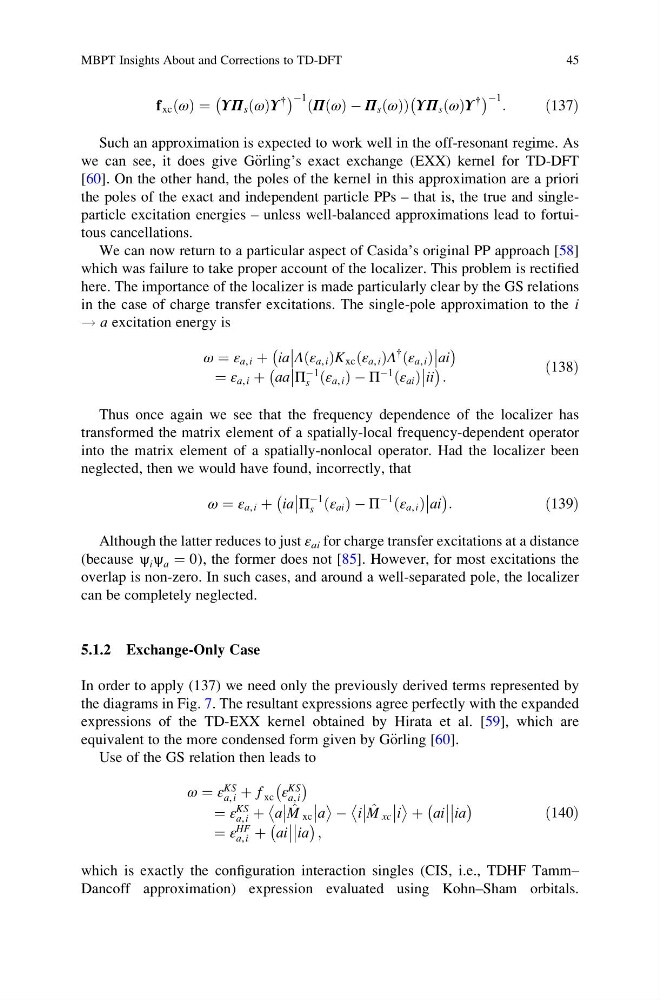
Such an approximation is expected to work well in the off-resonant regime. As
we can see, it does give G€ orling’s exact exchange (EXX) kernel for TD-DFT
[60]. On the other hand, the poles of the kernel in this approximation are a priori
the poles of the exact and independent particle PPs – that is, the true and singleparticle excitation energies – unless well-balanced approximations lead to fortuitous cancellations.
We can now return to a particular aspect of Casida’s original PP approach [58]
which was failure to take proper account of the localizer. This problem is rectified
here. The importance of the localizer is made particularly clear by the GS relations
in the case of charge transfer excitations. The single-pole approximation to the i
! a excitation energy is
ω ¼ ε a, i þ ia
Λ ε a, i
ð ÞK xc ε a, i
ð ÞΛ
{
ε a, i
ð Þ
ai
À
Á
¼ ε a, i þ aa
Π
À1
s
ε a, i
ð ÞÀΠ
À1
ε ai
ð Þ
ii
À
Á :
ð138Þ
Thus once again we see that the frequency dependence of the localizer has
transformed the matrix element of a spatially-local frequency-dependent operator
into the matrix element of a spatially-nonlocal operator. Had the localizer been
neglected, then we would have found, incorrectly, that
ω ¼ ε a, i þ ia
Π
À1
s
ε ai
ð Þ À Π
À1
ε a, i
ð Þ
ai
À
Á :
ð139Þ
Although the latter reduces to just ε ai for charge transfer excitations at a distance
(because ψ i ψ a ¼ 0), the former does not [85]. However, for most excitations the
overlap is non-zero. In such cases, and around a well-separated pole, the localizer
can be completely neglected.
5.1.2 Exchange-Only Case
In order to apply (137) we need only the previously derived terms represented by
the diagrams in Fig. 7. The resultant expressions agree perfectly with the expanded
expressions of the TD-EXX kernel obtained by Hirata et al. [59], which are
equivalent to the more condensed form given by G€ orling [60].
Use of the GS relation then leads to
ω ¼ ε
KS
a, i þ f xc ε
KS
a, i
À Á
¼ ε
KS
a, i þ a
^
M xc
a
À i
^
M xc
i
þ ai
ia
À
Á
¼ ε
HF
a, i þ ai
ia
À
Á ;
ð140Þ
which is exactly the configuration interaction singles (CIS, i.e., TDHF Tamm–
Dancoff approximation) expression evaluated using Kohn–Sham orbitals.
MBPT Insights About and Corrections to TD-DFT
45
ð Þ ¼ ΥΠ s ω
ð ÞΥ
{
À
Á À1 Π ω
ð Þ À Π s ω
ð Þ
ð
ÞΥΠ s ω
ð ÞΥ
{
À
Á À1 :
ð137Þ
Such an approximation is expected to work well in the off-resonant regime. As
we can see, it does give G€ orling’s exact exchange (EXX) kernel for TD-DFT
[60]. On the other hand, the poles of the kernel in this approximation are a priori
the poles of the exact and independent particle PPs – that is, the true and singleparticle excitation energies – unless well-balanced approximations lead to fortuitous cancellations.
We can now return to a particular aspect of Casida’s original PP approach [58]
which was failure to take proper account of the localizer. This problem is rectified
here. The importance of the localizer is made particularly clear by the GS relations
in the case of charge transfer excitations. The single-pole approximation to the i
! a excitation energy is
ω ¼ ε a, i þ ia
Λ ε a, i
ð ÞK xc ε a, i
ð ÞΛ
{
ε a, i
ð Þ
ai
À
Á
¼ ε a, i þ aa
Π
À1
s
ε a, i
ð ÞÀΠ
À1
ε ai
ð Þ
ii
À
Á :
ð138Þ
Thus once again we see that the frequency dependence of the localizer has
transformed the matrix element of a spatially-local frequency-dependent operator
into the matrix element of a spatially-nonlocal operator. Had the localizer been
neglected, then we would have found, incorrectly, that
ω ¼ ε a, i þ ia
Π
À1
s
ε ai
ð Þ À Π
À1
ε a, i
ð Þ
ai
À
Á :
ð139Þ
Although the latter reduces to just ε ai for charge transfer excitations at a distance
(because ψ i ψ a ¼ 0), the former does not [85]. However, for most excitations the
overlap is non-zero. In such cases, and around a well-separated pole, the localizer
can be completely neglected.
5.1.2 Exchange-Only Case
In order to apply (137) we need only the previously derived terms represented by
the diagrams in Fig. 7. The resultant expressions agree perfectly with the expanded
expressions of the TD-EXX kernel obtained by Hirata et al. [59], which are
equivalent to the more condensed form given by G€ orling [60].
Use of the GS relation then leads to
ω ¼ ε
KS
a, i þ f xc ε
KS
a, i
À Á
¼ ε
KS
a, i þ a
^
M xc
a
À i
^
M xc
i
þ ai
ia
À
Á
¼ ε
HF
a, i þ ai
ia
À
Á ;
ð140Þ
which is exactly the configuration interaction singles (CIS, i.e., TDHF Tamm–
Dancoff approximation) expression evaluated using Kohn–Sham orbitals.
MBPT Insights About and Corrections to TD-DFT
45