

A
AA
ð Þ
1, 1 þ K
NA
1, 1 ω
ð Þ
C 1 ¼ ωC 1
K
NA
1, 1 ω
ð Þ ¼ A 1, 0 A
1
ð Þ
1, 2
ω1
ÀA 0, 2
ÀA 2, 0 ω1 À A
0þ1
ð
Þ
2, 2
! À1 A 0, 1
A
1
ð Þ
2, 1
:
ð108Þ
The extension beyond the TDA is not obvious in this case.
4.3.1 Dissociation of Molecular Hydrogen
Molecular hydrogen dissociation is a prototypical case where doubly-excited configurations are essential for describing the potential energy surfaces of the lowestlying excited states. The three lowest singlet states of Σ
þ
g symmetry can be
essentially described by three CI configurations, namely (1σ
2
g 1σ
0
u 2σ
0
g ), (1σ
1
g 1σ
0
u 2σ
1
g ),
and (1σ
0
g 1σ
2
u 2σ
0
g ), referred to as ground, single, and double configuration,
respectively.
Obviously, the double configuration plays an essential role when a restricted
single-determinant is used as reference. On the one hand, the mixing of ground and
double configurations is necessary for describing the correct À1 Hartree dissociation energy of H 2 . On the other hand, the single and double configurations mix at
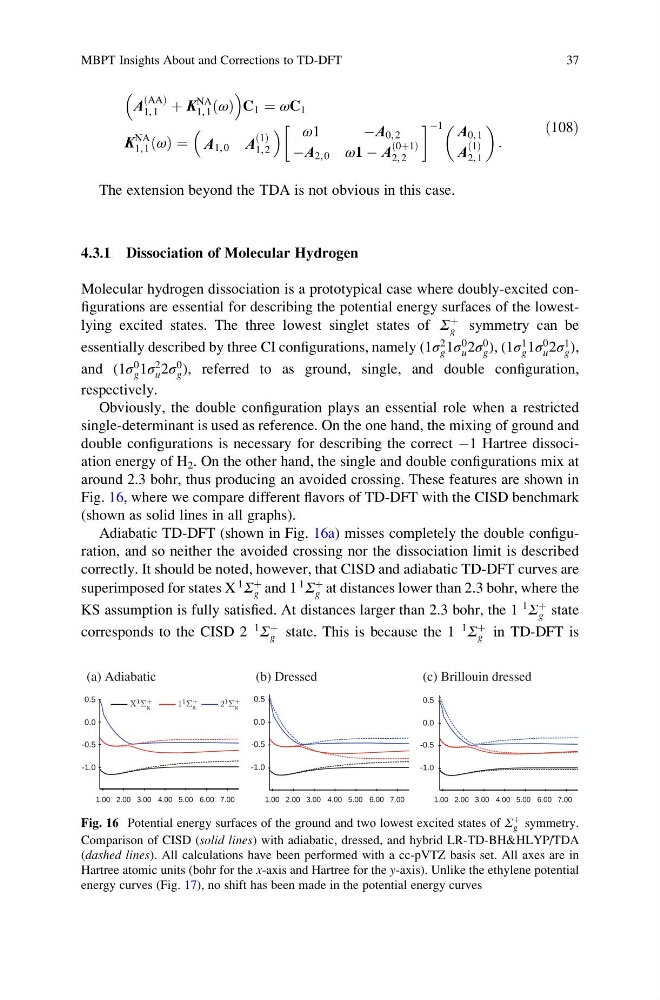
around 2.3 bohr, thus producing an avoided crossing. These features are shown in
Fig. 16, where we compare different flavors of TD-DFT with the CISD benchmark
(shown as solid lines in all graphs).
Adiabatic TD-DFT (shown in Fig. 16a) misses completely the double configuration, and so neither the avoided crossing nor the dissociation limit is described
correctly. It should be noted, however, that CISD and adiabatic TD-DFT curves are
superimposed for states X
1
Σ
þ
g and 1
1
Σ
þ
g at distances lower than 2.3 bohr, where the
KS assumption is fully satisfied. At distances larger than 2.3 bohr, the 1
1
Σ
þ
g state
corresponds to the CISD 2
1
Σ
þ
g state. This is because the 1
1
Σ
þ
g in TD-DFT is
Fig. 16 Potential energy surfaces of the ground and two lowest excited states of Σ
þ
g symmetry.
Comparison of CISD (solid lines) with adiabatic, dressed, and hybrid LR-TD-BH&HLYP/TDA
(dashed lines). All calculations have been performed with a cc-pVTZ basis set. All axes are in
Hartree atomic units (bohr for the x-axis and Hartree for the y-axis). Unlike the ethylene potential
energy curves (Fig. 17), no shift has been made in the potential energy curves
MBPT Insights About and Corrections to TD-DFT
37
AA
ð Þ
1, 1 þ K
NA
1, 1 ω
ð Þ
C 1 ¼ ωC 1
K
NA
1, 1 ω
ð Þ ¼ A 1, 0 A
1
ð Þ
1, 2
ω1
ÀA 0, 2
ÀA 2, 0 ω1 À A
0þ1
ð
Þ
2, 2
! À1 A 0, 1
A
1
ð Þ
2, 1
:
ð108Þ
The extension beyond the TDA is not obvious in this case.
4.3.1 Dissociation of Molecular Hydrogen
Molecular hydrogen dissociation is a prototypical case where doubly-excited configurations are essential for describing the potential energy surfaces of the lowestlying excited states. The three lowest singlet states of Σ
þ
g symmetry can be
essentially described by three CI configurations, namely (1σ
2
g 1σ
0
u 2σ
0
g ), (1σ
1
g 1σ
0
u 2σ
1
g ),
and (1σ
0
g 1σ
2
u 2σ
0
g ), referred to as ground, single, and double configuration,
respectively.
Obviously, the double configuration plays an essential role when a restricted
single-determinant is used as reference. On the one hand, the mixing of ground and
double configurations is necessary for describing the correct À1 Hartree dissociation energy of H 2 . On the other hand, the single and double configurations mix at
around 2.3 bohr, thus producing an avoided crossing. These features are shown in
Fig. 16, where we compare different flavors of TD-DFT with the CISD benchmark
(shown as solid lines in all graphs).
Adiabatic TD-DFT (shown in Fig. 16a) misses completely the double configuration, and so neither the avoided crossing nor the dissociation limit is described
correctly. It should be noted, however, that CISD and adiabatic TD-DFT curves are
superimposed for states X
1
Σ
þ
g and 1
1
Σ
þ
g at distances lower than 2.3 bohr, where the
KS assumption is fully satisfied. At distances larger than 2.3 bohr, the 1
1
Σ
þ
g state
corresponds to the CISD 2
1
Σ
þ
g state. This is because the 1
1
Σ
þ
g in TD-DFT is
Fig. 16 Potential energy surfaces of the ground and two lowest excited states of Σ
þ
g symmetry.
Comparison of CISD (solid lines) with adiabatic, dressed, and hybrid LR-TD-BH&HLYP/TDA
(dashed lines). All calculations have been performed with a cc-pVTZ basis set. All axes are in
Hartree atomic units (bohr for the x-axis and Hartree for the y-axis). Unlike the ethylene potential
energy curves (Fig. 17), no shift has been made in the potential energy curves
MBPT Insights About and Corrections to TD-DFT
37