

the same way that we include doubles contributions to excited states so that we may
describe, for example, the photochemical funnel between S 1 and S 0 in Fig. 1. It is
not clear how to do this in LR-TD-DFT where the excited-state potential energy
surfaces are just obtained by adding the excitation energies at each geometry to the
ground-state DFT energies. Not only does such a procedure lead to the excited
states inheriting the convergence difficulties of the ground state surface coming
from places with noninteracting v-representability difficulties, but also there is no
coupling between the ground state and singly excited states. This is similar to what
happens with Brillouin’s theorem in CIS calculations and leads to problems
describing conical intersections. However, adding in the missing nonzero terms
(which we call Brillouin corrections) to dressed LR-TD-DFT is easy in the TDA.
It is good to emphasize at this point that we are making an ad hoc correction,
albeit one which is eminently reasonable from a wavefunction point of view.
Formally correct approaches might include: (1) acknowledging that part of the
problem may lie in the fact that noninteracting v-representability in Kohn–Sham
DFT often breaks down at key places on ground-state potential energy surfaces
when bonds are formed or broken, so that conventional Kohn–Sham DFT may no
longer be a good starting point; (2) examining nonadiabatic xc-kernels which seem
to include some degree of multideterminantal ground-state character in their
response such as that of Maitra and Tempel [68]; (3) introducing explicit
multideterminantal character into the description of the Kohn–Sham DFT ground
state. We return to this in our final section, but for now we just try the ad hoc
approach of adding Brillouin corrections to TDA dressed LR-TD-DFT. Note that
this also has an indirect effect on interactions between excited states, though the
primary effect is between excited states and the ground state.
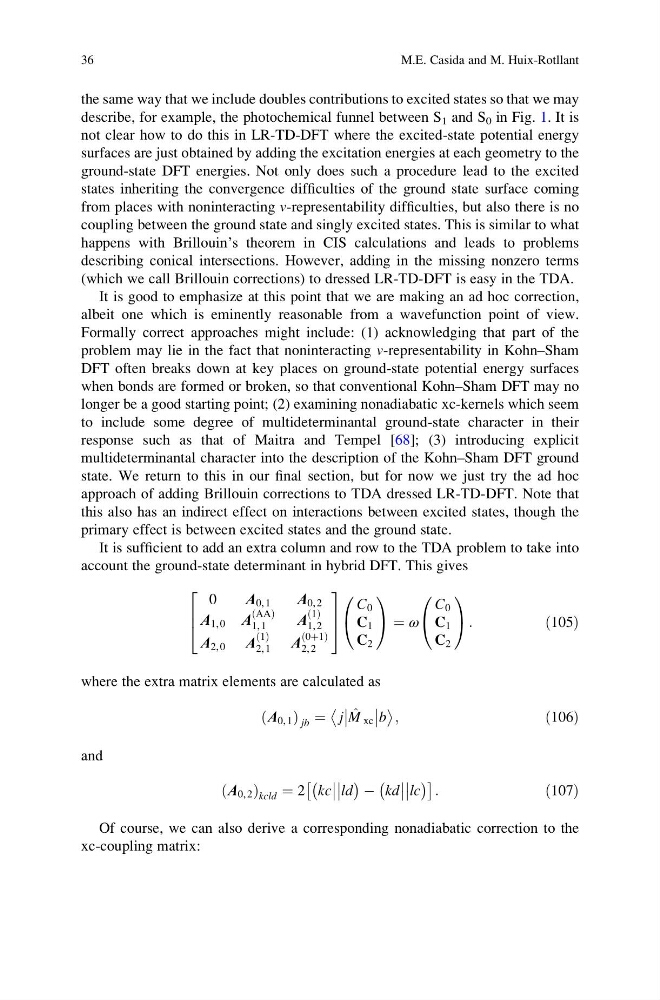
It is sufficient to add an extra column and row to the TDA problem to take into
account the ground-state determinant in hybrid DFT. This gives
0
A 0, 1
A 0, 2
A 1, 0 A
AA
ð Þ
1, 1
A
1
ð Þ
1, 2
A 2, 0 A
1
ð Þ
2, 1
A
0þ1
ð
Þ
2, 2
2
6
4
3
7
5
C 0
C 1
C 2
0
@
1
A ¼ ω
C 0
C 1
C 2
0
@
1
A :
ð105Þ
where the extra matrix elements are calculated as
A 0, 1
ð
Þ jb ¼ j
^
M xc
b
;
ð106Þ
and
A 0, 2
ð
Þ kcld ¼ 2 kc
ld
À
Á À kd
lc
À
Á
Â
à :
ð107Þ
Of course, we can also derive a corresponding nonadiabatic correction to the
xc-coupling matrix:
36
M.E. Casida and M. Huix-Rotllant
describe, for example, the photochemical funnel between S 1 and S 0 in Fig. 1. It is
not clear how to do this in LR-TD-DFT where the excited-state potential energy
surfaces are just obtained by adding the excitation energies at each geometry to the
ground-state DFT energies. Not only does such a procedure lead to the excited
states inheriting the convergence difficulties of the ground state surface coming
from places with noninteracting v-representability difficulties, but also there is no
coupling between the ground state and singly excited states. This is similar to what
happens with Brillouin’s theorem in CIS calculations and leads to problems
describing conical intersections. However, adding in the missing nonzero terms
(which we call Brillouin corrections) to dressed LR-TD-DFT is easy in the TDA.
It is good to emphasize at this point that we are making an ad hoc correction,
albeit one which is eminently reasonable from a wavefunction point of view.
Formally correct approaches might include: (1) acknowledging that part of the
problem may lie in the fact that noninteracting v-representability in Kohn–Sham
DFT often breaks down at key places on ground-state potential energy surfaces
when bonds are formed or broken, so that conventional Kohn–Sham DFT may no
longer be a good starting point; (2) examining nonadiabatic xc-kernels which seem
to include some degree of multideterminantal ground-state character in their
response such as that of Maitra and Tempel [68]; (3) introducing explicit
multideterminantal character into the description of the Kohn–Sham DFT ground
state. We return to this in our final section, but for now we just try the ad hoc
approach of adding Brillouin corrections to TDA dressed LR-TD-DFT. Note that
this also has an indirect effect on interactions between excited states, though the
primary effect is between excited states and the ground state.
It is sufficient to add an extra column and row to the TDA problem to take into
account the ground-state determinant in hybrid DFT. This gives
0
A 0, 1
A 0, 2
A 1, 0 A
AA
ð Þ
1, 1
A
1
ð Þ
1, 2
A 2, 0 A
1
ð Þ
2, 1
A
0þ1
ð
Þ
2, 2
2
6
4
3
7
5
C 0
C 1
C 2
0
@
1
A ¼ ω
C 0
C 1
C 2
0
@
1
A :
ð105Þ
where the extra matrix elements are calculated as
A 0, 1
ð
Þ jb ¼ j
^
M xc
b
;
ð106Þ
and
A 0, 2
ð
Þ kcld ¼ 2 kc
ld
À
Á À kd
lc
À
Á
Â
à :
ð107Þ
Of course, we can also derive a corresponding nonadiabatic correction to the
xc-coupling matrix:
36
M.E. Casida and M. Huix-Rotllant