

A
AA
ð Þ
1, 1
A
1
ð Þ
1, 2
A
1
ð Þ
2, 1
A
0þ1
ð
Þ
2, 2
"
#
C 1
C 2
¼ ω
C 1
C 2
:
ð103Þ
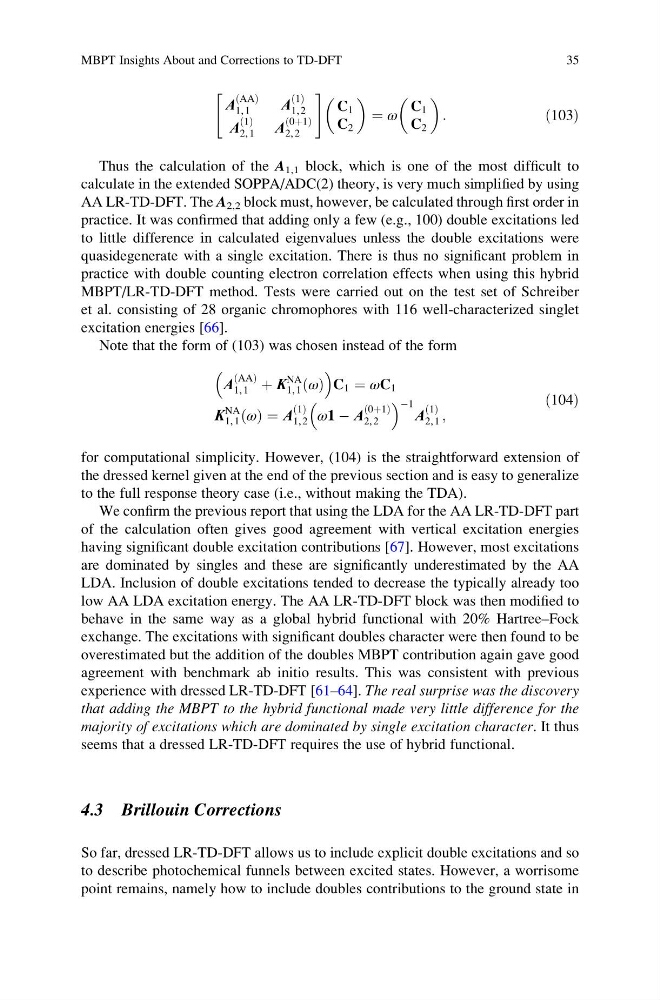
Thus the calculation of the A 1,1 block, which is one of the most difficult to
calculate in the extended SOPPA/ADC(2) theory, is very much simplified by using
AA LR-TD-DFT. The A 2,2 block must, however, be calculated through first order in
practice. It was confirmed that adding only a few (e.g., 100) double excitations led
to little difference in calculated eigenvalues unless the double excitations were
quasidegenerate with a single excitation. There is thus no significant problem in
practice with double counting electron correlation effects when using this hybrid
MBPT/LR-TD-DFT method. Tests were carried out on the test set of Schreiber
et al. consisting of 28 organic chromophores with 116 well-characterized singlet
excitation energies [66].
Note that the form of (103) was chosen instead of the form
A
AA
ð Þ
1, 1 þ K
NA
1, 1 ω
ð Þ
C 1 ¼ ωC 1
K
NA
1, 1 ω
ð Þ ¼ A
1
ð Þ
1, 2 ω1 À A
0þ1
ð
Þ
2, 2
À1 A
1
ð Þ
2, 1 ;
ð104Þ
for computational simplicity. However, (104) is the straightforward extension of
the dressed kernel given at the end of the previous section and is easy to generalize
to the full response theory case (i.e., without making the TDA).
We confirm the previous report that using the LDA for the AA LR-TD-DFT part
of the calculation often gives good agreement with vertical excitation energies
having significant double excitation contributions [67]. However, most excitations
are dominated by singles and these are significantly underestimated by the AA
LDA. Inclusion of double excitations tended to decrease the typically already too
low AA LDA excitation energy. The AA LR-TD-DFT block was then modified to
behave in the same way as a global hybrid functional with 20% Hartree–Fock
exchange. The excitations with significant doubles character were then found to be
overestimated but the addition of the doubles MBPT contribution again gave good
agreement with benchmark ab initio results. This was consistent with previous
experience with dressed LR-TD-DFT [61–64]. The real surprise was the discovery
that adding the MBPT to the hybrid functional made very little difference for the
majority of excitations which are dominated by single excitation character. It thus
seems that a dressed LR-TD-DFT requires the use of hybrid functional.
4.3 Brillouin Corrections
So far, dressed LR-TD-DFT allows us to include explicit double excitations and so
to describe photochemical funnels between excited states. However, a worrisome
point remains, namely how to include doubles contributions to the ground state in
MBPT Insights About and Corrections to TD-DFT
35
AA
ð Þ
1, 1
A
1
ð Þ
1, 2
A
1
ð Þ
2, 1
A
0þ1
ð
Þ
2, 2
"
#
C 1
C 2
¼ ω
C 1
C 2
:
ð103Þ
Thus the calculation of the A 1,1 block, which is one of the most difficult to
calculate in the extended SOPPA/ADC(2) theory, is very much simplified by using
AA LR-TD-DFT. The A 2,2 block must, however, be calculated through first order in
practice. It was confirmed that adding only a few (e.g., 100) double excitations led
to little difference in calculated eigenvalues unless the double excitations were
quasidegenerate with a single excitation. There is thus no significant problem in
practice with double counting electron correlation effects when using this hybrid
MBPT/LR-TD-DFT method. Tests were carried out on the test set of Schreiber
et al. consisting of 28 organic chromophores with 116 well-characterized singlet
excitation energies [66].
Note that the form of (103) was chosen instead of the form
A
AA
ð Þ
1, 1 þ K
NA
1, 1 ω
ð Þ
C 1 ¼ ωC 1
K
NA
1, 1 ω
ð Þ ¼ A
1
ð Þ
1, 2 ω1 À A
0þ1
ð
Þ
2, 2
À1 A
1
ð Þ
2, 1 ;
ð104Þ
for computational simplicity. However, (104) is the straightforward extension of
the dressed kernel given at the end of the previous section and is easy to generalize
to the full response theory case (i.e., without making the TDA).
We confirm the previous report that using the LDA for the AA LR-TD-DFT part
of the calculation often gives good agreement with vertical excitation energies
having significant double excitation contributions [67]. However, most excitations
are dominated by singles and these are significantly underestimated by the AA
LDA. Inclusion of double excitations tended to decrease the typically already too
low AA LDA excitation energy. The AA LR-TD-DFT block was then modified to
behave in the same way as a global hybrid functional with 20% Hartree–Fock
exchange. The excitations with significant doubles character were then found to be
overestimated but the addition of the doubles MBPT contribution again gave good
agreement with benchmark ab initio results. This was consistent with previous
experience with dressed LR-TD-DFT [61–64]. The real surprise was the discovery
that adding the MBPT to the hybrid functional made very little difference for the
majority of excitations which are dominated by single excitation character. It thus
seems that a dressed LR-TD-DFT requires the use of hybrid functional.
4.3 Brillouin Corrections
So far, dressed LR-TD-DFT allows us to include explicit double excitations and so
to describe photochemical funnels between excited states. However, a worrisome
point remains, namely how to include doubles contributions to the ground state in
MBPT Insights About and Corrections to TD-DFT
35