

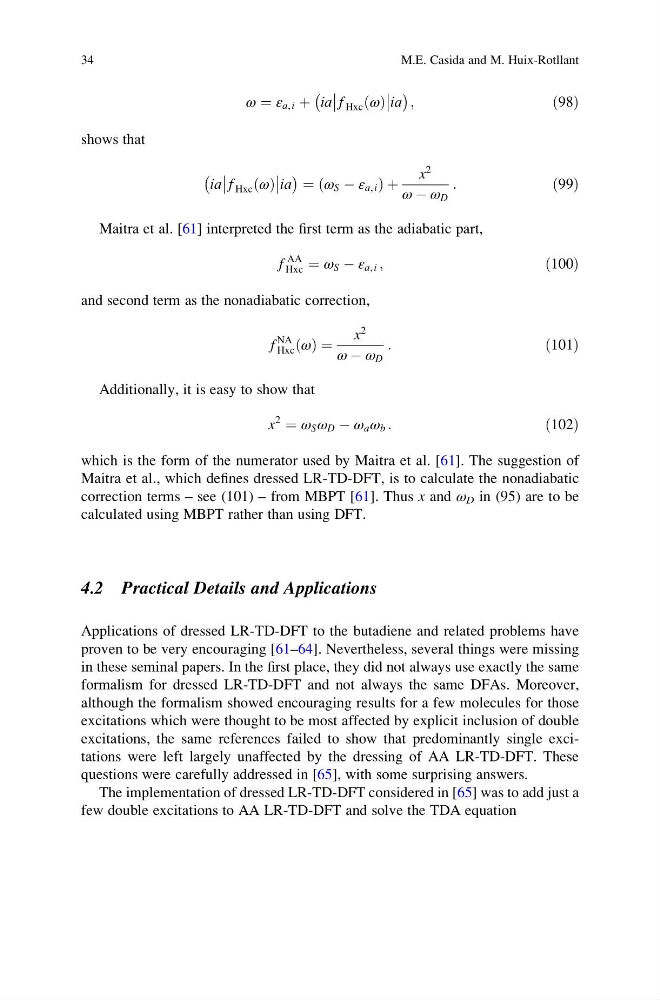
ω ¼ ε a, i þ ia
f Hxc ω
ð Þ
ia
À
Á ;
ð98Þ
shows that
ia
f Hxc ω
ð Þ
ia
À
Á ¼ ω S À ε a, i
ð
Þþ
x
2
ω À ω D
:
ð99Þ
Maitra et al. [61] interpreted the first term as the adiabatic part,
f
AA
Hxc ¼ ω S À ε a, i ;
ð100Þ
and second term as the nonadiabatic correction,
f
NA
Hxc ω
ð Þ ¼
x
2
ω À ω D
:
ð101Þ
Additionally, it is easy to show that
x
2
¼ ω S ω D À ω a ω b :
ð102Þ
which is the form of the numerator used by Maitra et al. [61]. The suggestion of
Maitra et al., which defines dressed LR-TD-DFT, is to calculate the nonadiabatic
correction terms – see (101) – from MBPT [61]. Thus x and ω D in (95) are to be
calculated using MBPT rather than using DFT.
4.2 Practical Details and Applications
Applications of dressed LR-TD-DFT to the butadiene and related problems have
proven to be very encouraging [61–64]. Nevertheless, several things were missing
in these seminal papers. In the first place, they did not always use exactly the same
formalism for dressed LR-TD-DFT and not always the same DFAs. Moreover,
although the formalism showed encouraging results for a few molecules for those
excitations which were thought to be most affected by explicit inclusion of double
excitations, the same references failed to show that predominantly single excitations were left largely unaffected by the dressing of AA LR-TD-DFT. These
questions were carefully addressed in [65], with some surprising answers.
The implementation of dressed LR-TD-DFT considered in [65] was to add just a
few double excitations to AA LR-TD-DFT and solve the TDA equation
34
M.E. Casida and M. Huix-Rotllant
f Hxc ω
ð Þ
ia
À
Á ;
ð98Þ
shows that
ia
f Hxc ω
ð Þ
ia
À
Á ¼ ω S À ε a, i
ð
Þþ
x
2
ω À ω D
:
ð99Þ
Maitra et al. [61] interpreted the first term as the adiabatic part,
f
AA
Hxc ¼ ω S À ε a, i ;
ð100Þ
and second term as the nonadiabatic correction,
f
NA
Hxc ω
ð Þ ¼
x
2
ω À ω D
:
ð101Þ
Additionally, it is easy to show that
x
2
¼ ω S ω D À ω a ω b :
ð102Þ
which is the form of the numerator used by Maitra et al. [61]. The suggestion of
Maitra et al., which defines dressed LR-TD-DFT, is to calculate the nonadiabatic
correction terms – see (101) – from MBPT [61]. Thus x and ω D in (95) are to be
calculated using MBPT rather than using DFT.
4.2 Practical Details and Applications
Applications of dressed LR-TD-DFT to the butadiene and related problems have
proven to be very encouraging [61–64]. Nevertheless, several things were missing
in these seminal papers. In the first place, they did not always use exactly the same
formalism for dressed LR-TD-DFT and not always the same DFAs. Moreover,
although the formalism showed encouraging results for a few molecules for those
excitations which were thought to be most affected by explicit inclusion of double
excitations, the same references failed to show that predominantly single excitations were left largely unaffected by the dressing of AA LR-TD-DFT. These
questions were carefully addressed in [65], with some surprising answers.
The implementation of dressed LR-TD-DFT considered in [65] was to add just a
few double excitations to AA LR-TD-DFT and solve the TDA equation
34
M.E. Casida and M. Huix-Rotllant