

diabatic, as it does not contain the doubly-excited configuration. The dissociation
limit is also overestimated as it is usual from RKS with common xc functionals.
Dressed TD-DFT (Fig. 16b) includes the double configuration. On the one hand,
the avoided crossing is represented correctly. However, the gap between the 1
1
Σ
þ
g
and the 2
1
Σ
þ
g is smaller than the CISD crossing. The dissociation limit, however, is
not correctly represented, as dressed TD-DFT does not include the ground- to
excited-state interaction. Therefore, the double configuration dissociates at the
same limit as the ground configuration.
Brillouin dressed TD-DFT (Fig. 16b) also includes the ground- and double
configuration mixture additional to the single- and double mixing of dressed
TD-DFT. On the one hand, the avoided crossing is represented more precisely,
with a gap closer to that of CISD. Now the dissociation limit is more correctly
described. Still there is a slight error in the dissociation energy limit, probably
because of the double counting of correlation. This could be alleviated by a
parameterization of the Brillouin-corrected dressed TD-DFT functional.
4.3.2 Ethylene Torsion
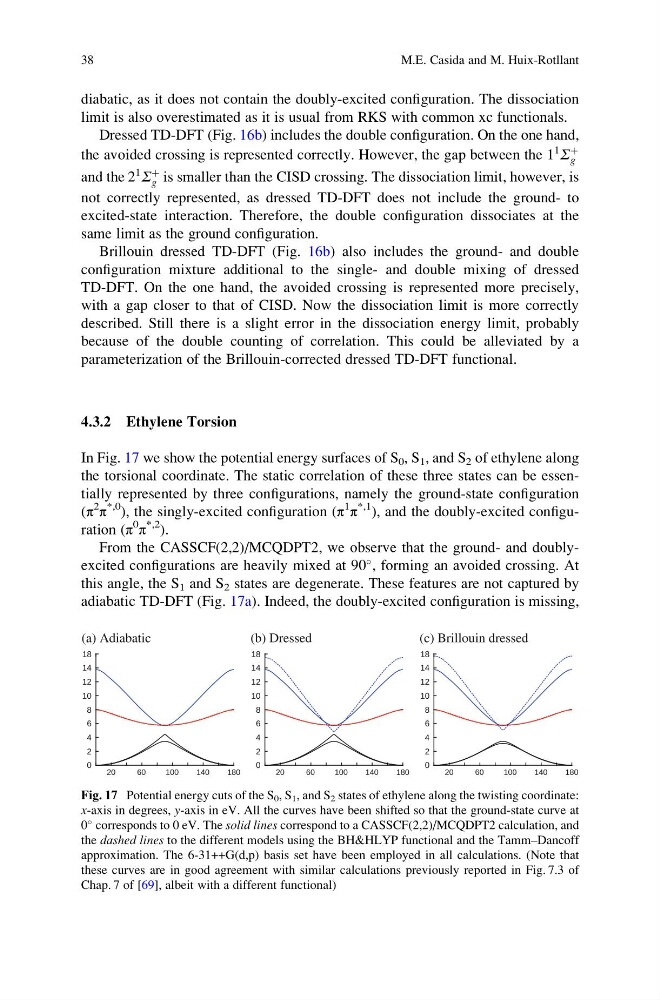
In Fig. 17 we show the potential energy surfaces of S 0 , S 1 , and S 2 of ethylene along
the torsional coordinate. The static correlation of these three states can be essentially represented by three configurations, namely the ground-state configuration
(π
2
π
*,0 ), the singly-excited configuration (π
1
π
*,1 ), and the doubly-excited configuration (π
0
π
*,2 ).
From the CASSCF(2,2)/MCQDPT2, we observe that the ground- and doublyexcited configurations are heavily mixed at 90
, forming an avoided crossing. At
this angle, the S 1 and S 2 states are degenerate. These features are not captured by
adiabatic TD-DFT (Fig. 17a). Indeed, the doubly-excited configuration is missing,
Fig. 17 Potential energy cuts of the S 0 , S 1 , and S 2 states of ethylene along the twisting coordinate:
x-axis in degrees, y-axis in eV. All the curves have been shifted so that the ground-state curve at
0
corresponds to 0 eV. The solid lines correspond to a CASSCF(2,2)/MCQDPT2 calculation, and
the dashed lines to the different models using the BH&HLYP functional and the Tamm–Dancoff
approximation. The 6-31++G(d,p) basis set have been employed in all calculations. (Note that
these curves are in good agreement with similar calculations previously reported in Fig. 7.3 of
Chap. 7 of [69], albeit with a different functional)
38
M.E. Casida and M. Huix-Rotllant
limit is also overestimated as it is usual from RKS with common xc functionals.
Dressed TD-DFT (Fig. 16b) includes the double configuration. On the one hand,
the avoided crossing is represented correctly. However, the gap between the 1
1
Σ
þ
g
and the 2
1
Σ
þ
g is smaller than the CISD crossing. The dissociation limit, however, is
not correctly represented, as dressed TD-DFT does not include the ground- to
excited-state interaction. Therefore, the double configuration dissociates at the
same limit as the ground configuration.
Brillouin dressed TD-DFT (Fig. 16b) also includes the ground- and double
configuration mixture additional to the single- and double mixing of dressed
TD-DFT. On the one hand, the avoided crossing is represented more precisely,
with a gap closer to that of CISD. Now the dissociation limit is more correctly
described. Still there is a slight error in the dissociation energy limit, probably
because of the double counting of correlation. This could be alleviated by a
parameterization of the Brillouin-corrected dressed TD-DFT functional.
4.3.2 Ethylene Torsion
In Fig. 17 we show the potential energy surfaces of S 0 , S 1 , and S 2 of ethylene along
the torsional coordinate. The static correlation of these three states can be essentially represented by three configurations, namely the ground-state configuration
(π
2
π
*,0 ), the singly-excited configuration (π
1
π
*,1 ), and the doubly-excited configuration (π
0
π
*,2 ).
From the CASSCF(2,2)/MCQDPT2, we observe that the ground- and doublyexcited configurations are heavily mixed at 90
, forming an avoided crossing. At
this angle, the S 1 and S 2 states are degenerate. These features are not captured by
adiabatic TD-DFT (Fig. 17a). Indeed, the doubly-excited configuration is missing,
Fig. 17 Potential energy cuts of the S 0 , S 1 , and S 2 states of ethylene along the twisting coordinate:
x-axis in degrees, y-axis in eV. All the curves have been shifted so that the ground-state curve at
0
corresponds to 0 eV. The solid lines correspond to a CASSCF(2,2)/MCQDPT2 calculation, and
the dashed lines to the different models using the BH&HLYP functional and the Tamm–Dancoff
approximation. The 6-31++G(d,p) basis set have been employed in all calculations. (Note that
these curves are in good agreement with similar calculations previously reported in Fig. 7.3 of
Chap. 7 of [69], albeit with a different functional)
38
M.E. Casida and M. Huix-Rotllant