

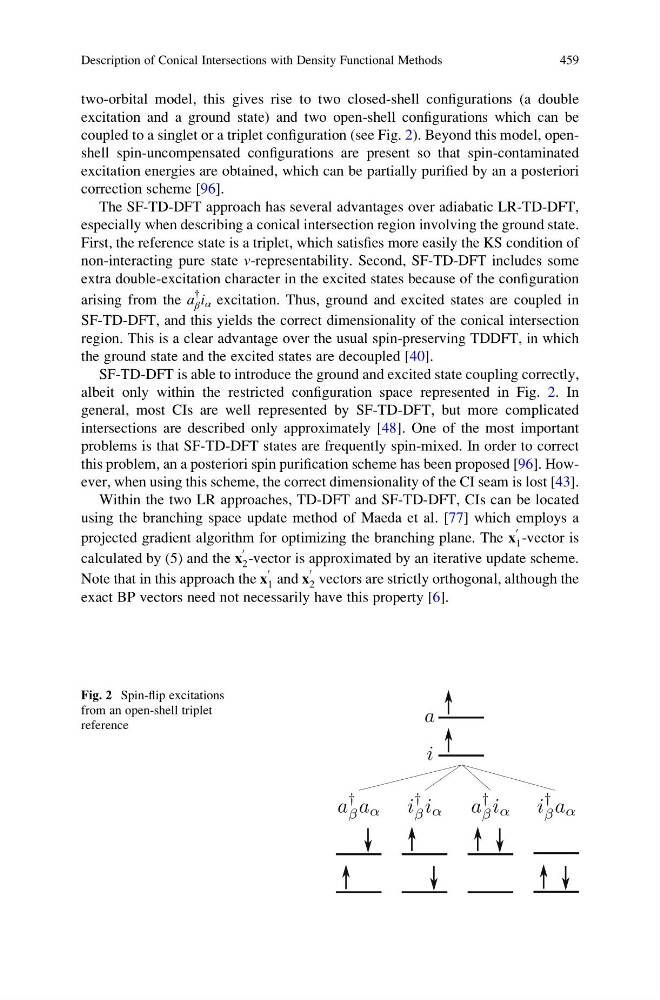
two-orbital model, this gives rise to two closed-shell configurations (a double
excitation and a ground state) and two open-shell configurations which can be
coupled to a singlet or a triplet configuration (see Fig. 2). Beyond this model, openshell spin-uncompensated configurations are present so that spin-contaminated
excitation energies are obtained, which can be partially purified by an a posteriori
correction scheme [96].
The SF-TD-DFT approach has several advantages over adiabatic LR-TD-DFT,
especially when describing a conical intersection region involving the ground state.
First, the reference state is a triplet, which satisfies more easily the KS condition of
non-interacting pure state v-representability. Second, SF-TD-DFT includes some
extra double-excitation character in the excited states because of the configuration
arising from the a
{
β i α excitation. Thus, ground and excited states are coupled in
SF-TD-DFT, and this yields the correct dimensionality of the conical intersection
region. This is a clear advantage over the usual spin-preserving TDDFT, in which
the ground state and the excited states are decoupled [40].
SF-TD-DFT is able to introduce the ground and excited state coupling correctly,
albeit only within the restricted configuration space represented in Fig. 2. In
general, most CIs are well represented by SF-TD-DFT, but more complicated
intersections are described only approximately [48]. One of the most important
problems is that SF-TD-DFT states are frequently spin-mixed. In order to correct
this problem, an a posteriori spin purification scheme has been proposed [96]. However, when using this scheme, the correct dimensionality of the CI seam is lost [43].
Within the two LR approaches, TD-DFT and SF-TD-DFT, CIs can be located
using the branching space update method of Maeda et al. [77] which employs a
projected gradient algorithm for optimizing the branching plane. The x
0
1 -vector is
calculated by (5) and the x
0
2 -vector is approximated by an iterative update scheme.
Note that in this approach the x
0
1 and x
0
2 vectors are strictly orthogonal, although the
exact BP vectors need not necessarily have this property [6].
Fig. 2 Spin-flip excitations
from an open-shell triplet
reference
Description of Conical Intersections with Density Functional Methods
459
excitation and a ground state) and two open-shell configurations which can be
coupled to a singlet or a triplet configuration (see Fig. 2). Beyond this model, openshell spin-uncompensated configurations are present so that spin-contaminated
excitation energies are obtained, which can be partially purified by an a posteriori
correction scheme [96].
The SF-TD-DFT approach has several advantages over adiabatic LR-TD-DFT,
especially when describing a conical intersection region involving the ground state.
First, the reference state is a triplet, which satisfies more easily the KS condition of
non-interacting pure state v-representability. Second, SF-TD-DFT includes some
extra double-excitation character in the excited states because of the configuration
arising from the a
{
β i α excitation. Thus, ground and excited states are coupled in
SF-TD-DFT, and this yields the correct dimensionality of the conical intersection
region. This is a clear advantage over the usual spin-preserving TDDFT, in which
the ground state and the excited states are decoupled [40].
SF-TD-DFT is able to introduce the ground and excited state coupling correctly,
albeit only within the restricted configuration space represented in Fig. 2. In
general, most CIs are well represented by SF-TD-DFT, but more complicated
intersections are described only approximately [48]. One of the most important
problems is that SF-TD-DFT states are frequently spin-mixed. In order to correct
this problem, an a posteriori spin purification scheme has been proposed [96]. However, when using this scheme, the correct dimensionality of the CI seam is lost [43].
Within the two LR approaches, TD-DFT and SF-TD-DFT, CIs can be located
using the branching space update method of Maeda et al. [77] which employs a
projected gradient algorithm for optimizing the branching plane. The x
0
1 -vector is
calculated by (5) and the x
0
2 -vector is approximated by an iterative update scheme.
Note that in this approach the x
0
1 and x
0
2 vectors are strictly orthogonal, although the
exact BP vectors need not necessarily have this property [6].
Fig. 2 Spin-flip excitations
from an open-shell triplet
reference
Description of Conical Intersections with Density Functional Methods
459