

4 Application of DFT Methods to Conical Intersections
In this section we discuss the application of the computational methods described
above to study Cls in a number of organic molecules and organic and biological
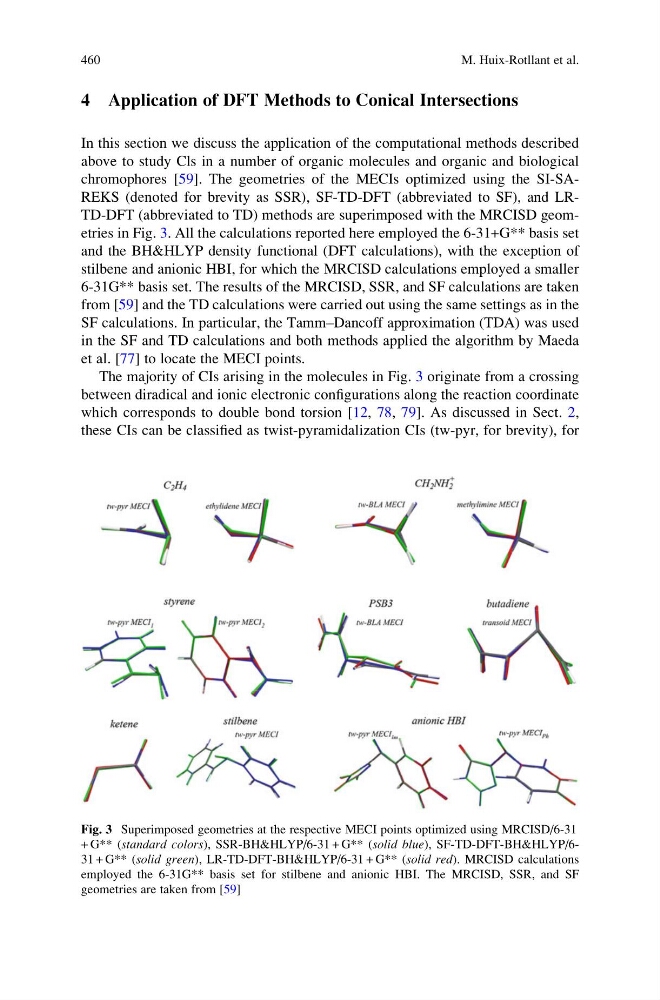
chromophores [59]. The geometries of the MECIs optimized using the SI-SAREKS (denoted for brevity as SSR), SF-TD-DFT (abbreviated to SF), and LRTD-DFT (abbreviated to TD) methods are superimposed with the MRCISD geometries in Fig. 3. All the calculations reported here employed the 6-31+G** basis set
and the BH&HLYP density functional (DFT calculations), with the exception of
stilbene and anionic HBI, for which the MRCISD calculations employed a smaller
6-31G** basis set. The results of the MRCISD, SSR, and SF calculations are taken
from [59] and the TD calculations were carried out using the same settings as in the
SF calculations. In particular, the Tamm–Dancoff approximation (TDA) was used
in the SF and TD calculations and both methods applied the algorithm by Maeda
et al. [77] to locate the MECI points.
The majority of CIs arising in the molecules in Fig. 3 originate from a crossing
between diradical and ionic electronic configurations along the reaction coordinate
which corresponds to double bond torsion [12, 78, 79]. As discussed in Sect. 2,
these CIs can be classified as twist-pyramidalization CIs (tw-pyr, for brevity), for
Fig. 3 Superimposed geometries at the respective MECI points optimized using MRCISD/6-31
+ G** (standard colors), SSR-BH&HLYP/6-31 + G** (solid blue), SF-TD-DFT-BH&HLYP/631 + G** (solid green), LR-TD-DFT-BH&HLYP/6-31 + G** (solid red). MRCISD calculations
employed the 6-31G** basis set for stilbene and anionic HBI. The MRCISD, SSR, and SF
geometries are taken from [59]
460
M. Huix-Rotllant et al.
In this section we discuss the application of the computational methods described
above to study Cls in a number of organic molecules and organic and biological
chromophores [59]. The geometries of the MECIs optimized using the SI-SAREKS (denoted for brevity as SSR), SF-TD-DFT (abbreviated to SF), and LRTD-DFT (abbreviated to TD) methods are superimposed with the MRCISD geometries in Fig. 3. All the calculations reported here employed the 6-31+G** basis set
and the BH&HLYP density functional (DFT calculations), with the exception of
stilbene and anionic HBI, for which the MRCISD calculations employed a smaller
6-31G** basis set. The results of the MRCISD, SSR, and SF calculations are taken
from [59] and the TD calculations were carried out using the same settings as in the
SF calculations. In particular, the Tamm–Dancoff approximation (TDA) was used
in the SF and TD calculations and both methods applied the algorithm by Maeda
et al. [77] to locate the MECI points.
The majority of CIs arising in the molecules in Fig. 3 originate from a crossing
between diradical and ionic electronic configurations along the reaction coordinate
which corresponds to double bond torsion [12, 78, 79]. As discussed in Sect. 2,
these CIs can be classified as twist-pyramidalization CIs (tw-pyr, for brevity), for
Fig. 3 Superimposed geometries at the respective MECI points optimized using MRCISD/6-31
+ G** (standard colors), SSR-BH&HLYP/6-31 + G** (solid blue), SF-TD-DFT-BH&HLYP/631 + G** (solid green), LR-TD-DFT-BH&HLYP/6-31 + G** (solid red). MRCISD calculations
employed the 6-31G** basis set for stilbene and anionic HBI. The MRCISD, SSR, and SF
geometries are taken from [59]
460
M. Huix-Rotllant et al.