

highly-conjugated systems [94]. Recent advances in LR-TD-DFT beyond the
adiabatic approximation are surveyed in another chapter of this book.
4
When using the conventional closed-shell KS reference state, the LR-TD-DFT
description in the adiabatic approximation breaks down near an S 0 /S 1 conical
intersection. Indeed, the assumption of pure-state v-representability employed in
the traditional KS theory fails near the surface crossing points where the two
electronic states become (nearly) degenerate. This is usually reflected in severe
convergence problems of the KS self-consistent field iterations, which can be
alleviated by either allowing holes below the Fermi level [82] or using a more
general density Ansatz, such as in ensemble DFT [53, 82]. Furthermore, the
interaction between the ground and the excited states is missing in adiabatic
LR-TD-DFT, which results in a linear crossing instead of a conical intersection
[40]. Surprisingly, it was observed by Levine et al. [40] and by Cordova et al. [95]
that, even though the PESs are defective, the geometries and branching planes of
minimal energy crossing points may look reasonable in comparison with other,
theoretically justified, methods. The topography of conical intersections between
different excited states is expected to be correct even at the adiabatic LR-TD-DFT
level; however because of the missing effect of doubly-excited configurations its
geometry and energy level may be incorrect [40].
3.2.2 Spin-Flip TD-DFT
Several schemes have been developed that attempt to ameliorate some of the
problems arising in the adiabatic LR-TD-DFT description of S 0 /S 1 conical intersections. Among them, one of the most successful is the spin-flip time-dependent
DFT, SF-TD-DFT. In SF-TD-DFT, electronic configurations arising from the
excitation operators with ΔM s ¼ Æ1 are coupled, unlike the usual formulation of
TD-DFT in which only spin-preserving excitation operators with ΔM s ¼ 0 are
allowed. Several formulations of SF-TD-DFT appear in the literature [44–
47]. Ziegler and Wang’s formulation of SF-TD-DFT [45] relies on the
non-collinear spin DFT framework, which operates with the KS spinors, rather
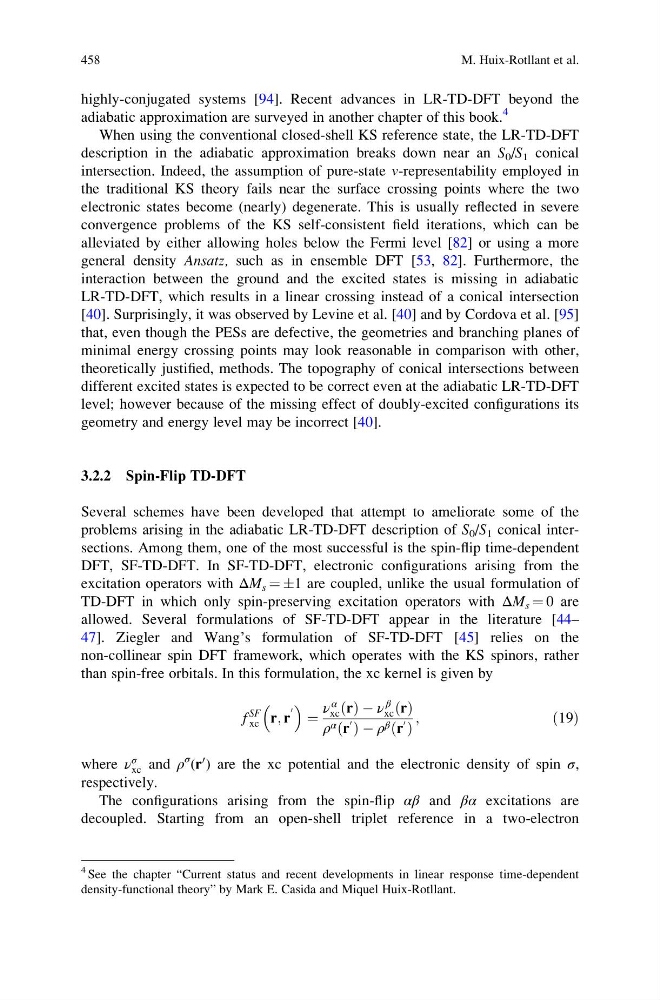
than spin-free orbitals. In this formulation, the xc kernel is given by
f
SF
xc r; r
0
¼
ν
α
xc r
ð Þ À ν
β
xc r
ð Þ
ρ α r
0
ð Þ À ρ β r
0
ð Þ
;
ð19Þ
where ν
σ
xc and ρ
σ (r
0 ) are the xc potential and the electronic density of spin σ,
respectively.
The configurations arising from the spin-flip αβ and βα excitations are
decoupled. Starting from an open-shell triplet reference in a two-electron
4 See the chapter “Current status and recent developments in linear response time-dependent
density-functional theory” by Mark E. Casida and Miquel Huix-Rotllant.
458
M. Huix-Rotllant et al.
adiabatic approximation are surveyed in another chapter of this book.
4
When using the conventional closed-shell KS reference state, the LR-TD-DFT
description in the adiabatic approximation breaks down near an S 0 /S 1 conical
intersection. Indeed, the assumption of pure-state v-representability employed in
the traditional KS theory fails near the surface crossing points where the two
electronic states become (nearly) degenerate. This is usually reflected in severe
convergence problems of the KS self-consistent field iterations, which can be
alleviated by either allowing holes below the Fermi level [82] or using a more
general density Ansatz, such as in ensemble DFT [53, 82]. Furthermore, the
interaction between the ground and the excited states is missing in adiabatic
LR-TD-DFT, which results in a linear crossing instead of a conical intersection
[40]. Surprisingly, it was observed by Levine et al. [40] and by Cordova et al. [95]
that, even though the PESs are defective, the geometries and branching planes of
minimal energy crossing points may look reasonable in comparison with other,
theoretically justified, methods. The topography of conical intersections between
different excited states is expected to be correct even at the adiabatic LR-TD-DFT
level; however because of the missing effect of doubly-excited configurations its
geometry and energy level may be incorrect [40].
3.2.2 Spin-Flip TD-DFT
Several schemes have been developed that attempt to ameliorate some of the
problems arising in the adiabatic LR-TD-DFT description of S 0 /S 1 conical intersections. Among them, one of the most successful is the spin-flip time-dependent
DFT, SF-TD-DFT. In SF-TD-DFT, electronic configurations arising from the
excitation operators with ΔM s ¼ Æ1 are coupled, unlike the usual formulation of
TD-DFT in which only spin-preserving excitation operators with ΔM s ¼ 0 are
allowed. Several formulations of SF-TD-DFT appear in the literature [44–
47]. Ziegler and Wang’s formulation of SF-TD-DFT [45] relies on the
non-collinear spin DFT framework, which operates with the KS spinors, rather
than spin-free orbitals. In this formulation, the xc kernel is given by
f
SF
xc r; r
0
¼
ν
α
xc r
ð Þ À ν
β
xc r
ð Þ
ρ α r
0
ð Þ À ρ β r
0
ð Þ
;
ð19Þ
where ν
σ
xc and ρ
σ (r
0 ) are the xc potential and the electronic density of spin σ,
respectively.
The configurations arising from the spin-flip αβ and βα excitations are
decoupled. Starting from an open-shell triplet reference in a two-electron
4 See the chapter “Current status and recent developments in linear response time-dependent
density-functional theory” by Mark E. Casida and Miquel Huix-Rotllant.
458
M. Huix-Rotllant et al.