

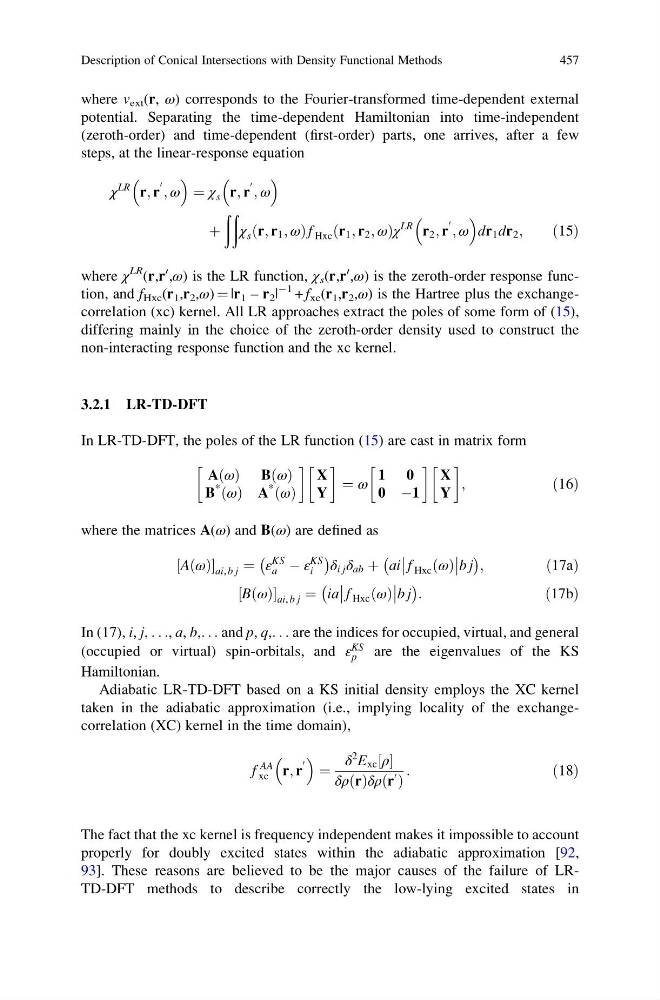
where v ext (r, ω) corresponds to the Fourier-transformed time-dependent external
potential. Separating the time-dependent Hamiltonian into time-independent
(zeroth-order) and time-dependent (first-order) parts, one arrives, after a few
steps, at the linear-response equation
χ
LR r; r
0 ; ω
¼ χ s r; r
0 ; ω
þ
ðð
χ s r; r 1 ; ω
ð
Þf Hxc r 1 ; r 2 ; ω
ð
Þ χ
LR r 2 ; r
0 ; ω
dr 1 dr 2 ;
ð15Þ
where χ
LR
(r,r
0 ,ω) is the LR function, χ s (r,r
0 ,ω) is the zeroth-order response function, and f Hxc (r 1 ,r 2 ,ω) ¼ |r 1 – r 2 |
À1 + f xc (r 1 ,r 2 ,ω) is the Hartree plus the exchangecorrelation (xc) kernel. All LR approaches extract the poles of some form of (15),
differing mainly in the choice of the zeroth-order density used to construct the
non-interacting response function and the xc kernel.
3.2.1 LR-TD-DFT
In LR-TD-DFT, the poles of the LR function (15) are cast in matrix form
A ω
ð Þ B ω
ð Þ
B
*
ω
ð Þ A
*
ω
ð Þ
!
X
Y
!
¼ ω
1 0
0 À1
!
X
Y
!
;
ð16Þ
where the matrices A(ω) and B(ω) are defined as
A ω
ð Þ
½
ai, b j ¼ ε
KS
a À ε
KS
i
À
Á δ i j δ ab þ ai
f Hxc ω
ð Þ
b j
À
Á ;
ð17aÞ
B ω
ð Þ
½
ai, b j ¼ ia
f Hxc ω
ð Þ
b j
À
Á :
ð17bÞ
In (17), i, j, . . ., a, b,. . . and p, q,. . . are the indices for occupied, virtual, and general
(occupied or virtual) spin-orbitals, and ε
KS
p
are the eigenvalues of the KS
Hamiltonian.
Adiabatic LR-TD-DFT based on a KS initial density employs the XC kernel
taken in the adiabatic approximation (i.e., implying locality of the exchangecorrelation (XC) kernel in the time domain),
f
AA
xc r; r
0
¼
δ
2 E xc ρ
½
δρ r
ð Þδρ r
0
ð Þ
:
ð18Þ
The fact that the xc kernel is frequency independent makes it impossible to account
properly for doubly excited states within the adiabatic approximation [92,
93]. These reasons are believed to be the major causes of the failure of LRTD-DFT methods to describe correctly the low-lying excited states in
Description of Conical Intersections with Density Functional Methods
457
potential. Separating the time-dependent Hamiltonian into time-independent
(zeroth-order) and time-dependent (first-order) parts, one arrives, after a few
steps, at the linear-response equation
χ
LR r; r
0 ; ω
¼ χ s r; r
0 ; ω
þ
ðð
χ s r; r 1 ; ω
ð
Þf Hxc r 1 ; r 2 ; ω
ð
Þ χ
LR r 2 ; r
0 ; ω
dr 1 dr 2 ;
ð15Þ
where χ
LR
(r,r
0 ,ω) is the LR function, χ s (r,r
0 ,ω) is the zeroth-order response function, and f Hxc (r 1 ,r 2 ,ω) ¼ |r 1 – r 2 |
À1 + f xc (r 1 ,r 2 ,ω) is the Hartree plus the exchangecorrelation (xc) kernel. All LR approaches extract the poles of some form of (15),
differing mainly in the choice of the zeroth-order density used to construct the
non-interacting response function and the xc kernel.
3.2.1 LR-TD-DFT
In LR-TD-DFT, the poles of the LR function (15) are cast in matrix form
A ω
ð Þ B ω
ð Þ
B
*
ω
ð Þ A
*
ω
ð Þ
!
X
Y
!
¼ ω
1 0
0 À1
!
X
Y
!
;
ð16Þ
where the matrices A(ω) and B(ω) are defined as
A ω
ð Þ
½
ai, b j ¼ ε
KS
a À ε
KS
i
À
Á δ i j δ ab þ ai
f Hxc ω
ð Þ
b j
À
Á ;
ð17aÞ
B ω
ð Þ
½
ai, b j ¼ ia
f Hxc ω
ð Þ
b j
À
Á :
ð17bÞ
In (17), i, j, . . ., a, b,. . . and p, q,. . . are the indices for occupied, virtual, and general
(occupied or virtual) spin-orbitals, and ε
KS
p
are the eigenvalues of the KS
Hamiltonian.
Adiabatic LR-TD-DFT based on a KS initial density employs the XC kernel
taken in the adiabatic approximation (i.e., implying locality of the exchangecorrelation (XC) kernel in the time domain),
f
AA
xc r; r
0
¼
δ
2 E xc ρ
½
δρ r
ð Þδρ r
0
ð Þ
:
ð18Þ
The fact that the xc kernel is frequency independent makes it impossible to account
properly for doubly excited states within the adiabatic approximation [92,
93]. These reasons are believed to be the major causes of the failure of LRTD-DFT methods to describe correctly the low-lying excited states in
Description of Conical Intersections with Density Functional Methods
457