

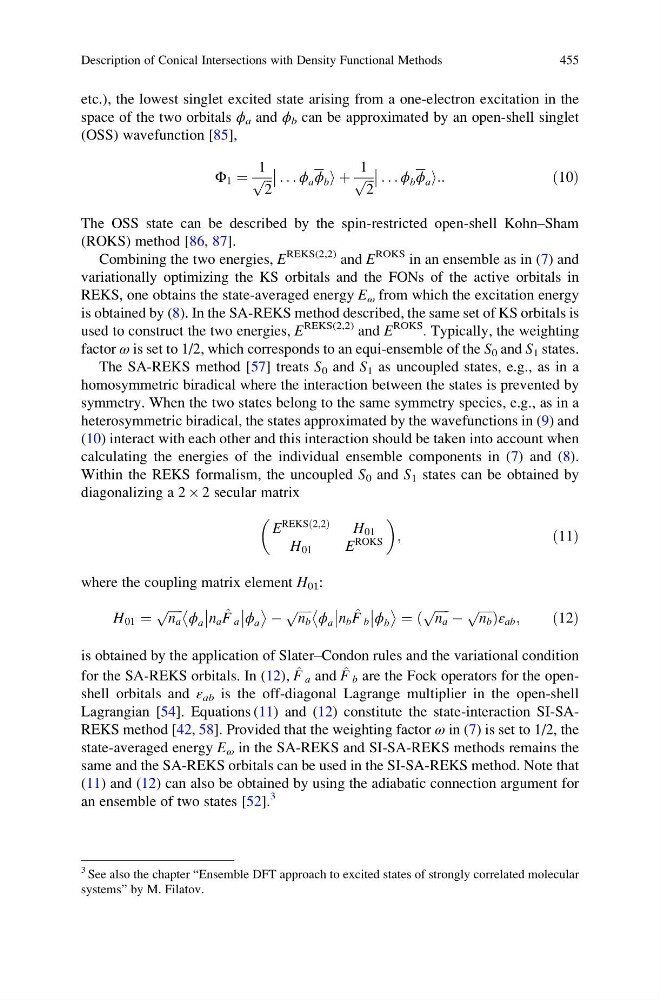
etc.), the lowest singlet excited state arising from a one-electron excitation in the
space of the two orbitals ϕ a and ϕ b can be approximated by an open-shell singlet
(OSS) wavefunction [85],
Φ 1 ¼
1
ffiffi ffi
2
p
. . . ϕ a ϕ b i þ
1
ffiffi ffi
2
p
. . . ϕ b ϕ a i::
ð10Þ
The OSS state can be described by the spin-restricted open-shell Kohn–Sham
(ROKS) method [86, 87].
Combining the two energies, E
REKS(2,2) and E
ROKS in an ensemble as in (7) and
variationally optimizing the KS orbitals and the FONs of the active orbitals in
REKS, one obtains the state-averaged energy E ω from which the excitation energy
is obtained by (8). In the SA-REKS method described, the same set of KS orbitals is
used to construct the two energies, E
REKS(2,2) and E
ROKS . Typically, the weighting
factor ω is set to 1/2, which corresponds to an equi-ensemble of the S 0 and S 1 states.
The SA-REKS method [57] treats S 0 and S 1 as uncoupled states, e.g., as in a
homosymmetric biradical where the interaction between the states is prevented by
symmetry. When the two states belong to the same symmetry species, e.g., as in a
heterosymmetric biradical, the states approximated by the wavefunctions in (9) and
(10) interact with each other and this interaction should be taken into account when
calculating the energies of the individual ensemble components in (7) and (8).
Within the REKS formalism, the uncoupled S 0 and S 1 states can be obtained by
diagonalizing a 2 Â 2 secular matrix
E
REKS 2;2
ð Þ
H 01
H 01
E
ROKS
;
ð11Þ
where the coupling matrix element H 01 :
H 01 ¼
ffiffiffiffi ffi
n a
p ϕ a
n a ^
F a
ϕ a
À
ffiffiffiffi ffi
n b
p ϕ a
n b ^
F b
ϕ b
¼
ffiffiffiffi ffi
n a
p À
ffiffiffiffi ffi
n b
p
ð
Þ ε ab ;
ð12Þ
is obtained by the application of Slater–Condon rules and the variational condition
for the SA-REKS orbitals. In (12), ^
F a and ^
F b are the Fock operators for the openshell orbitals and ε ab is the off-diagonal Lagrange multiplier in the open-shell
Lagrangian [54]. Equations (11) and (12) constitute the state-interaction SI-SAREKS method [42, 58]. Provided that the weighting factor ω in (7) is set to 1/2, the
state-averaged energy E ω in the SA-REKS and SI-SA-REKS methods remains the
same and the SA-REKS orbitals can be used in the SI-SA-REKS method. Note that
(11) and (12) can also be obtained by using the adiabatic connection argument for
an ensemble of two states [52].
3
3 See also the chapter “Ensemble DFT approach to excited states of strongly correlated molecular
systems” by M. Filatov.
Description of Conical Intersections with Density Functional Methods
455
space of the two orbitals ϕ a and ϕ b can be approximated by an open-shell singlet
(OSS) wavefunction [85],
Φ 1 ¼
1
ffiffi ffi
2
p
. . . ϕ a ϕ b i þ
1
ffiffi ffi
2
p
. . . ϕ b ϕ a i::
ð10Þ
The OSS state can be described by the spin-restricted open-shell Kohn–Sham
(ROKS) method [86, 87].
Combining the two energies, E
REKS(2,2) and E
ROKS in an ensemble as in (7) and
variationally optimizing the KS orbitals and the FONs of the active orbitals in
REKS, one obtains the state-averaged energy E ω from which the excitation energy
is obtained by (8). In the SA-REKS method described, the same set of KS orbitals is
used to construct the two energies, E
REKS(2,2) and E
ROKS . Typically, the weighting
factor ω is set to 1/2, which corresponds to an equi-ensemble of the S 0 and S 1 states.
The SA-REKS method [57] treats S 0 and S 1 as uncoupled states, e.g., as in a
homosymmetric biradical where the interaction between the states is prevented by
symmetry. When the two states belong to the same symmetry species, e.g., as in a
heterosymmetric biradical, the states approximated by the wavefunctions in (9) and
(10) interact with each other and this interaction should be taken into account when
calculating the energies of the individual ensemble components in (7) and (8).
Within the REKS formalism, the uncoupled S 0 and S 1 states can be obtained by
diagonalizing a 2 Â 2 secular matrix
E
REKS 2;2
ð Þ
H 01
H 01
E
ROKS
;
ð11Þ
where the coupling matrix element H 01 :
H 01 ¼
ffiffiffiffi ffi
n a
p ϕ a
n a ^
F a
ϕ a
À
ffiffiffiffi ffi
n b
p ϕ a
n b ^
F b
ϕ b
¼
ffiffiffiffi ffi
n a
p À
ffiffiffiffi ffi
n b
p
ð
Þ ε ab ;
ð12Þ
is obtained by the application of Slater–Condon rules and the variational condition
for the SA-REKS orbitals. In (12), ^
F a and ^
F b are the Fock operators for the openshell orbitals and ε ab is the off-diagonal Lagrange multiplier in the open-shell
Lagrangian [54]. Equations (11) and (12) constitute the state-interaction SI-SAREKS method [42, 58]. Provided that the weighting factor ω in (7) is set to 1/2, the
state-averaged energy E ω in the SA-REKS and SI-SA-REKS methods remains the
same and the SA-REKS orbitals can be used in the SI-SA-REKS method. Note that
(11) and (12) can also be obtained by using the adiabatic connection argument for
an ensemble of two states [52].
3
3 See also the chapter “Ensemble DFT approach to excited states of strongly correlated molecular
systems” by M. Filatov.
Description of Conical Intersections with Density Functional Methods
455