

correlated fermionic system is to be exactly represented by a weighted sum
(ensemble) of the densities (and energies) of several electronic configurations
(ensemble components). In the REKS method, the ensemble representation of the
non-interacting Kohn–Sham reference system is used to describe the non-dynamic
correlation arising because of near degeneracy of several electronic configurations;
such as in situations with dissociating chemical bonds, near transition states of
symmetry-forbidden reactions, biradicaloid species, etc. The ensemble representation leads to fractional occupation numbers (FONs) of several frontier Kohn–Sham
orbitals, which are obtained simultaneously with the orbitals from the variational
optimization of the total ground-state energy.
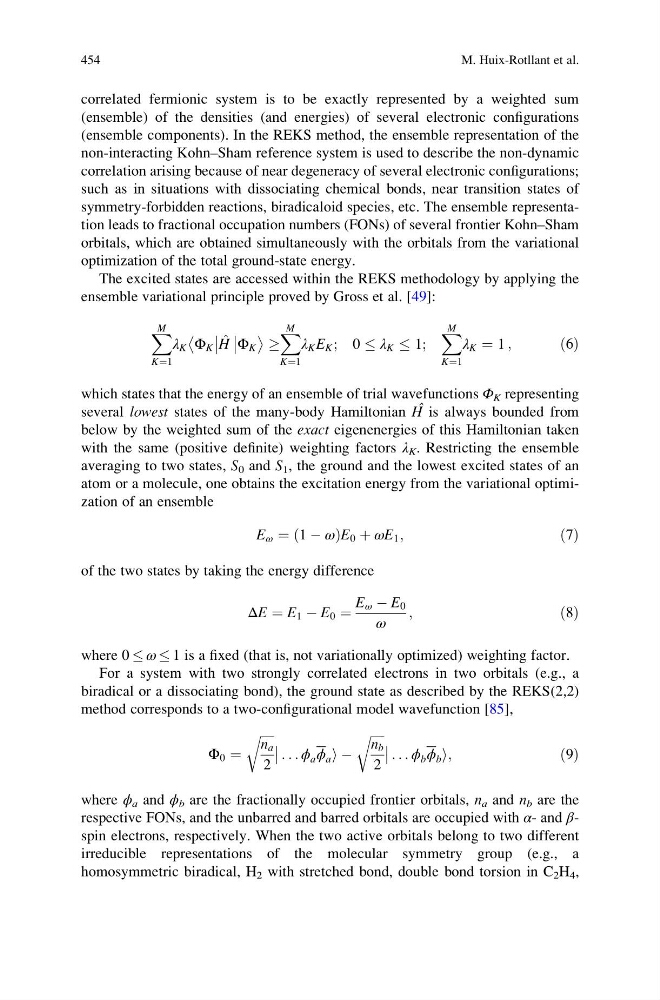
The excited states are accessed within the REKS methodology by applying the
ensemble variational principle proved by Gross et al. [49]:
X M
K¼1
λ K Φ K
^
H
Φ K
!
X M
K¼1
λ K E K ; 0 λ K 1;
X M
K¼1
λ K ¼ 1 ;
ð6Þ
which states that the energy of an ensemble of trial wavefunctions Φ K representing
several lowest states of the many-body Hamiltonian H ˆ is always bounded from
below by the weighted sum of the exact eigenenergies of this Hamiltonian taken
with the same (positive definite) weighting factors λ K . Restricting the ensemble
averaging to two states, S 0 and S 1 , the ground and the lowest excited states of an
atom or a molecule, one obtains the excitation energy from the variational optimization of an ensemble
E ω ¼ 1 À ω
ð
ÞE 0 þ ωE 1 ;
ð7Þ
of the two states by taking the energy difference
ΔE ¼ E 1 À E 0 ¼
E ω À E 0
ω
;
ð8Þ
where 0 ω 1 is a fixed (that is, not variationally optimized) weighting factor.
For a system with two strongly correlated electrons in two orbitals (e.g., a
biradical or a dissociating bond), the ground state as described by the REKS(2,2)
method corresponds to a two-configurational model wavefunction [85],
Φ 0 ¼
ffiffiffiffi ffi
n a
2
r
. . . ϕ a ϕ a i À
ffiffiffiffi ffi
n b
2
r
. . . ϕ b ϕ b i;
ð9Þ
where ϕ a and ϕ b are the fractionally occupied frontier orbitals, n a and n b are the
respective FONs, and the unbarred and barred orbitals are occupied with α- and βspin electrons, respectively. When the two active orbitals belong to two different
irreducible representations of the molecular symmetry group (e.g., a
homosymmetric biradical, H 2 with stretched bond, double bond torsion in C 2 H 4 ,
454
M. Huix-Rotllant et al.
(ensemble) of the densities (and energies) of several electronic configurations
(ensemble components). In the REKS method, the ensemble representation of the
non-interacting Kohn–Sham reference system is used to describe the non-dynamic
correlation arising because of near degeneracy of several electronic configurations;
such as in situations with dissociating chemical bonds, near transition states of
symmetry-forbidden reactions, biradicaloid species, etc. The ensemble representation leads to fractional occupation numbers (FONs) of several frontier Kohn–Sham
orbitals, which are obtained simultaneously with the orbitals from the variational
optimization of the total ground-state energy.
The excited states are accessed within the REKS methodology by applying the
ensemble variational principle proved by Gross et al. [49]:
X M
K¼1
λ K Φ K
^
H
Φ K
!
X M
K¼1
λ K E K ; 0 λ K 1;
X M
K¼1
λ K ¼ 1 ;
ð6Þ
which states that the energy of an ensemble of trial wavefunctions Φ K representing
several lowest states of the many-body Hamiltonian H ˆ is always bounded from
below by the weighted sum of the exact eigenenergies of this Hamiltonian taken
with the same (positive definite) weighting factors λ K . Restricting the ensemble
averaging to two states, S 0 and S 1 , the ground and the lowest excited states of an
atom or a molecule, one obtains the excitation energy from the variational optimization of an ensemble
E ω ¼ 1 À ω
ð
ÞE 0 þ ωE 1 ;
ð7Þ
of the two states by taking the energy difference
ΔE ¼ E 1 À E 0 ¼
E ω À E 0
ω
;
ð8Þ
where 0 ω 1 is a fixed (that is, not variationally optimized) weighting factor.
For a system with two strongly correlated electrons in two orbitals (e.g., a
biradical or a dissociating bond), the ground state as described by the REKS(2,2)
method corresponds to a two-configurational model wavefunction [85],
Φ 0 ¼
ffiffiffiffi ffi
n a
2
r
. . . ϕ a ϕ a i À
ffiffiffiffi ffi
n b
2
r
. . . ϕ b ϕ b i;
ð9Þ
where ϕ a and ϕ b are the fractionally occupied frontier orbitals, n a and n b are the
respective FONs, and the unbarred and barred orbitals are occupied with α- and βspin electrons, respectively. When the two active orbitals belong to two different
irreducible representations of the molecular symmetry group (e.g., a
homosymmetric biradical, H 2 with stretched bond, double bond torsion in C 2 H 4 ,
454
M. Huix-Rotllant et al.