

into the practical details which are needed to make a useful implementation of
dressed LR-TD-DFT. Finally, we introduce the notion of Brillouin corrections
which are undoubtedly important for photochemistry.
4.1 Basic Idea
As emphasized in Sect. 2, simple counting arguments show that the AA limits LRTD-DFT to single excitations, albeit dressed to include some electron correlation.
However, explicit double excitations are sometimes needed when describing
excited states. This was discussed in the introduction in the context of photochemistry (Fig. 1). It is well known in ab initio quantum chemistry that double
excitations can be important when describing vertical excitations and the best
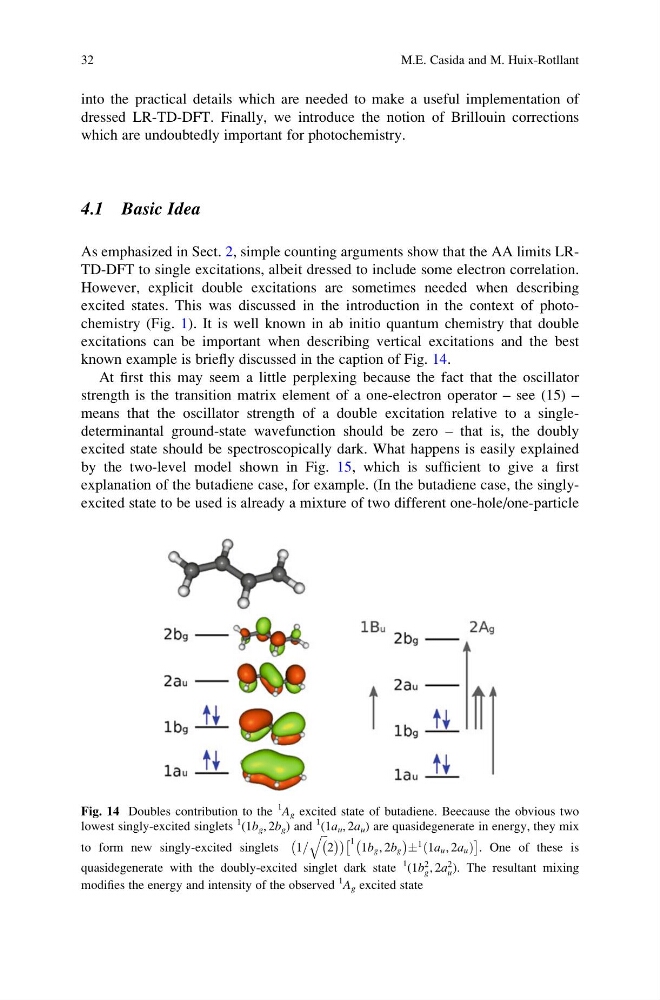
known example is briefly discussed in the caption of Fig. 14.
At first this may seem a little perplexing because the fact that the oscillator
strength is the transition matrix element of a one-electron operator – see (15) –
means that the oscillator strength of a double excitation relative to a singledeterminantal ground-state wavefunction should be zero – that is, the doubly
excited state should be spectroscopically dark. What happens is easily explained
by the two-level model shown in Fig. 15, which is sufficient to give a first
explanation of the butadiene case, for example. (In the butadiene case, the singlyexcited state to be used is already a mixture of two different one-hole/one-particle
Fig. 14 Doubles contribution to the
1
A g excited state of butadiene. Beecause the obvious two
lowest singly-excited singlets
1
(1b g , 2b g ) and
1
(1a u , 2a u ) are quasidegenerate in energy, they mix
to form new singly-excited singlets
À
1=
ffiffi ffi
À
q
2
ÁÁÂ 1 1b g , 2b g
À
Á
Æ
1 1a u , 2a u
ð
Þ
Ã
. One of these is
quasidegenerate with the doubly-excited singlet dark state
1
(1b
2
g , 2a
2
u ). The resultant mixing
modifies the energy and intensity of the observed
1
A g excited state
32
M.E. Casida and M. Huix-Rotllant
dressed LR-TD-DFT. Finally, we introduce the notion of Brillouin corrections
which are undoubtedly important for photochemistry.
4.1 Basic Idea
As emphasized in Sect. 2, simple counting arguments show that the AA limits LRTD-DFT to single excitations, albeit dressed to include some electron correlation.
However, explicit double excitations are sometimes needed when describing
excited states. This was discussed in the introduction in the context of photochemistry (Fig. 1). It is well known in ab initio quantum chemistry that double
excitations can be important when describing vertical excitations and the best
known example is briefly discussed in the caption of Fig. 14.
At first this may seem a little perplexing because the fact that the oscillator
strength is the transition matrix element of a one-electron operator – see (15) –
means that the oscillator strength of a double excitation relative to a singledeterminantal ground-state wavefunction should be zero – that is, the doubly
excited state should be spectroscopically dark. What happens is easily explained
by the two-level model shown in Fig. 15, which is sufficient to give a first
explanation of the butadiene case, for example. (In the butadiene case, the singlyexcited state to be used is already a mixture of two different one-hole/one-particle
Fig. 14 Doubles contribution to the
1
A g excited state of butadiene. Beecause the obvious two
lowest singly-excited singlets
1
(1b g , 2b g ) and
1
(1a u , 2a u ) are quasidegenerate in energy, they mix
to form new singly-excited singlets
À
1=
ffiffi ffi
À
q
2
ÁÁÂ 1 1b g , 2b g
À
Á
Æ
1 1a u , 2a u
ð
Þ
Ã
. One of these is
quasidegenerate with the doubly-excited singlet dark state
1
(1b
2
g , 2a
2
u ). The resultant mixing
modifies the energy and intensity of the observed
1
A g excited state
32
M.E. Casida and M. Huix-Rotllant