

A
0þ1þ2
ð
Þ
1, 1
kc, ia
¼ δ i, k F
0þ1þ2
ð
Þ
a, c
À δ a, c F
0þ1þ2
ð
Þ
i, k
þ ai
kc
À
Á
A
1
ð Þ
2, 1
kc, jbia
¼ Àδ i, k bc
a j
À
Á þ δ j, k bc
ai
À
Á
À δ b, c ai
k j
À
Á þ δ k, j bi
k j
À
Á
A
0
ð Þ
2, 2
ldkc, jbia
¼ δ i, k δ c, a δ d, b ε ab, i j ;
ð91Þ
where F
0þ1
ð
Þ
r, s
¼ δ r, s ε r þ M
xc
r, s is the matrix of the Hartree–Fock operator constructed
with Kohn–Sham orbitals and
F
0þ1þ2
ð
Þ
a, c
¼ F
0þ1
ð
Þ
a, c
þ
X
l
M l, a M l, c
ε l, a
À
1
2
X
l, m, d
ld
mc
À
Á
dl
am
À
Á
ε lm, ad
F
0þ1þ2
ð
Þ
i, k
¼ F
0þ1
ð
Þ
i, k
þ
X
d
M k, d M d, i
ε i, d
À
1
2
X
l, d, e
le
kd
À
Á
dl
ei
À
Á
ε im, de
;
ð92Þ
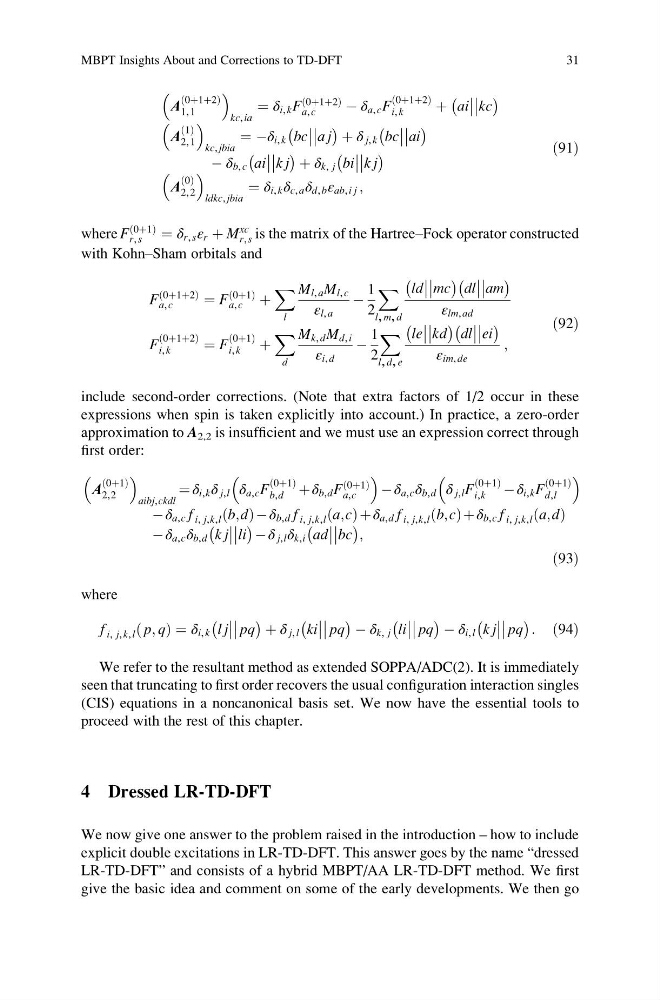
include second-order corrections. (Note that extra factors of 1/2 occur in these
expressions when spin is taken explicitly into account.) In practice, a zero-order
approximation to A 2,2 is insufficient and we must use an expression correct through
first order:
A
0þ1
ð
Þ
2,2
aibj,ckdl
¼ δ i,k δ j,l δ a,c F
0þ1
ð
Þ
b,d þ δ b,d F
0þ1
ð
Þ
a,c
À δ a,c δ b,d δ j,l F
0þ1
ð
Þ
i,k
À δ i,k F
0þ1
ð
Þ
d,l
À δ a,c f i, j,k,l b;d
ð ÞÀδ b,d f i, j,k,l a;c
ð Þþδ a,d f i, j,k,l b;c
ð Þþδ b,c f i, j,k,l a;d
ð Þ
À δ a,c δ b,d k j
li
À
Á À δ j,l δ k,i ad
bc
À
Á ;
ð93Þ
where
f i, j, k, l p; q
ð
Þ ¼ δ i, k l j
pq
À
Á þ δ j, l ki
pq
À
Á À δ k, j li
pq
À
Á À δ i, l k j
pq
À
Á : ð94Þ
We refer to the resultant method as extended SOPPA/ADC(2). It is immediately
seen that truncating to first order recovers the usual configuration interaction singles
(CIS) equations in a noncanonical basis set. We now have the essential tools to
proceed with the rest of this chapter.
4 Dressed LR-TD-DFT
We now give one answer to the problem raised in the introduction – how to include
explicit double excitations in LR-TD-DFT. This answer goes by the name “dressed
LR-TD-DFT” and consists of a hybrid MBPT/AA LR-TD-DFT method. We first
give the basic idea and comment on some of the early developments. We then go
MBPT Insights About and Corrections to TD-DFT
31
0þ1þ2
ð
Þ
1, 1
kc, ia
¼ δ i, k F
0þ1þ2
ð
Þ
a, c
À δ a, c F
0þ1þ2
ð
Þ
i, k
þ ai
kc
À
Á
A
1
ð Þ
2, 1
kc, jbia
¼ Àδ i, k bc
a j
À
Á þ δ j, k bc
ai
À
Á
À δ b, c ai
k j
À
Á þ δ k, j bi
k j
À
Á
A
0
ð Þ
2, 2
ldkc, jbia
¼ δ i, k δ c, a δ d, b ε ab, i j ;
ð91Þ
where F
0þ1
ð
Þ
r, s
¼ δ r, s ε r þ M
xc
r, s is the matrix of the Hartree–Fock operator constructed
with Kohn–Sham orbitals and
F
0þ1þ2
ð
Þ
a, c
¼ F
0þ1
ð
Þ
a, c
þ
X
l
M l, a M l, c
ε l, a
À
1
2
X
l, m, d
ld
mc
À
Á
dl
am
À
Á
ε lm, ad
F
0þ1þ2
ð
Þ
i, k
¼ F
0þ1
ð
Þ
i, k
þ
X
d
M k, d M d, i
ε i, d
À
1
2
X
l, d, e
le
kd
À
Á
dl
ei
À
Á
ε im, de
;
ð92Þ
include second-order corrections. (Note that extra factors of 1/2 occur in these
expressions when spin is taken explicitly into account.) In practice, a zero-order
approximation to A 2,2 is insufficient and we must use an expression correct through
first order:
A
0þ1
ð
Þ
2,2
aibj,ckdl
¼ δ i,k δ j,l δ a,c F
0þ1
ð
Þ
b,d þ δ b,d F
0þ1
ð
Þ
a,c
À δ a,c δ b,d δ j,l F
0þ1
ð
Þ
i,k
À δ i,k F
0þ1
ð
Þ
d,l
À δ a,c f i, j,k,l b;d
ð ÞÀδ b,d f i, j,k,l a;c
ð Þþδ a,d f i, j,k,l b;c
ð Þþδ b,c f i, j,k,l a;d
ð Þ
À δ a,c δ b,d k j
li
À
Á À δ j,l δ k,i ad
bc
À
Á ;
ð93Þ
where
f i, j, k, l p; q
ð
Þ ¼ δ i, k l j
pq
À
Á þ δ j, l ki
pq
À
Á À δ k, j li
pq
À
Á À δ i, l k j
pq
À
Á : ð94Þ
We refer to the resultant method as extended SOPPA/ADC(2). It is immediately
seen that truncating to first order recovers the usual configuration interaction singles
(CIS) equations in a noncanonical basis set. We now have the essential tools to
proceed with the rest of this chapter.
4 Dressed LR-TD-DFT
We now give one answer to the problem raised in the introduction – how to include
explicit double excitations in LR-TD-DFT. This answer goes by the name “dressed
LR-TD-DFT” and consists of a hybrid MBPT/AA LR-TD-DFT method. We first
give the basic idea and comment on some of the early developments. We then go
MBPT Insights About and Corrections to TD-DFT
31