

Ω pr, pr Ω pr, ps
Ω ps, pr Ω ps, ps
!
F 1
F 2
!
¼ ω
2 F 1
F 2
!
:
ð23Þ
The eigenvalues of this Hermitian problem are
ω
2
2, 1 ¼
Ω pr, pr þ Ω ps, ps
2
Æ
ffiffiffiffiffiffiffiffiffiffiffiffiffiffiffiffiffiffiffiffiffiffiffiffiffiffiffiffiffiffiffiffiffiffiffiffiffiffiffiffiffiffiffiffiffiffiffiffiffiffiffiffiffiffi ffi
Ω pr, pr À Ω ps, ps
2
2
þ Ω
2
pr, ps
s
:
ð24Þ
If the nondiagonal terms of Ω are null (which occurs when K pr, ps ¼ K ps, pr ¼ 0,
see (26)), the excitations energies are simply
ω 1 ¼ Ω
1=2
pr, pr
ω 2 ¼ Ω
1=2
ps, ps ;
ð25Þ
implying that the energy of each state is associated with a unique singly-excited
determinant (for instance, p ! r) and independent from the remaining
determinants.
The matrix elements of Ω can be explicitly written as (see Eq. (4.33) of [54])
Ω ia, jb ¼ δ ij δ ab Δε
2
jb þ 2
ffiffiffiffiffiffiffiffi ffi
Δε ia
p
K ia, jb
ffiffiffiffiffiffiffiffi ffi
Δε jb
p
:
ð26Þ
With (26), the lowest excitation energy in (25) becomes
ω 1 ¼
ffiffiffiffiffiffiffiffiffiffiffiffiffiffiffiffiffiffiffiffiffiffiffiffiffiffiffiffiffiffiffiffiffiffiffiffiffi ffi
Δε 2
pr þ 2Δε pr K pr, pr
q
:
ð27Þ
An equivalent equation holds for ω 2 caused by p ! s excitation. If K pr, pr ( Δε pr ,
the excitation energy can be approximated by
ω 1 ’ Δε pr þ K pr, pr :
ð28Þ
This result corresponds to the excitation energy computed with density functional
perturbation theory to the first order [58] and it is also directly obtained with TDA
(B ¼ 0).
If K pr,pr is completely neglected, the excitation energy is given simply by the
bare energy gap between orbitals
p
r
s
GS
p→ r
p→ s
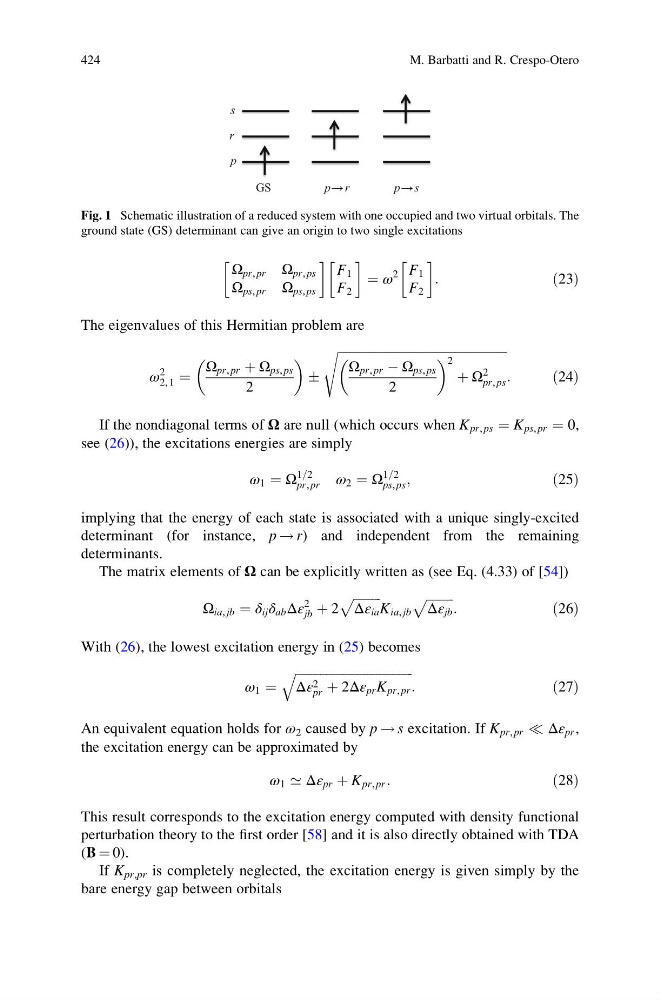
Fig. 1 Schematic illustration of a reduced system with one occupied and two virtual orbitals. The
ground state (GS) determinant can give an origin to two single excitations
424
M. Barbatti and R. Crespo-Otero
Ω ps, pr Ω ps, ps
!
F 1
F 2
!
¼ ω
2 F 1
F 2
!
:
ð23Þ
The eigenvalues of this Hermitian problem are
ω
2
2, 1 ¼
Ω pr, pr þ Ω ps, ps
2
Æ
ffiffiffiffiffiffiffiffiffiffiffiffiffiffiffiffiffiffiffiffiffiffiffiffiffiffiffiffiffiffiffiffiffiffiffiffiffiffiffiffiffiffiffiffiffiffiffiffiffiffiffiffiffiffi ffi
Ω pr, pr À Ω ps, ps
2
2
þ Ω
2
pr, ps
s
:
ð24Þ
If the nondiagonal terms of Ω are null (which occurs when K pr, ps ¼ K ps, pr ¼ 0,
see (26)), the excitations energies are simply
ω 1 ¼ Ω
1=2
pr, pr
ω 2 ¼ Ω
1=2
ps, ps ;
ð25Þ
implying that the energy of each state is associated with a unique singly-excited
determinant (for instance, p ! r) and independent from the remaining
determinants.
The matrix elements of Ω can be explicitly written as (see Eq. (4.33) of [54])
Ω ia, jb ¼ δ ij δ ab Δε
2
jb þ 2
ffiffiffiffiffiffiffiffi ffi
Δε ia
p
K ia, jb
ffiffiffiffiffiffiffiffi ffi
Δε jb
p
:
ð26Þ
With (26), the lowest excitation energy in (25) becomes
ω 1 ¼
ffiffiffiffiffiffiffiffiffiffiffiffiffiffiffiffiffiffiffiffiffiffiffiffiffiffiffiffiffiffiffiffiffiffiffiffiffi ffi
Δε 2
pr þ 2Δε pr K pr, pr
q
:
ð27Þ
An equivalent equation holds for ω 2 caused by p ! s excitation. If K pr, pr ( Δε pr ,
the excitation energy can be approximated by
ω 1 ’ Δε pr þ K pr, pr :
ð28Þ
This result corresponds to the excitation energy computed with density functional
perturbation theory to the first order [58] and it is also directly obtained with TDA
(B ¼ 0).
If K pr,pr is completely neglected, the excitation energy is given simply by the
bare energy gap between orbitals
p
r
s
GS
p→ r
p→ s
Fig. 1 Schematic illustration of a reduced system with one occupied and two virtual orbitals. The
ground state (GS) determinant can give an origin to two single excitations
424
M. Barbatti and R. Crespo-Otero