

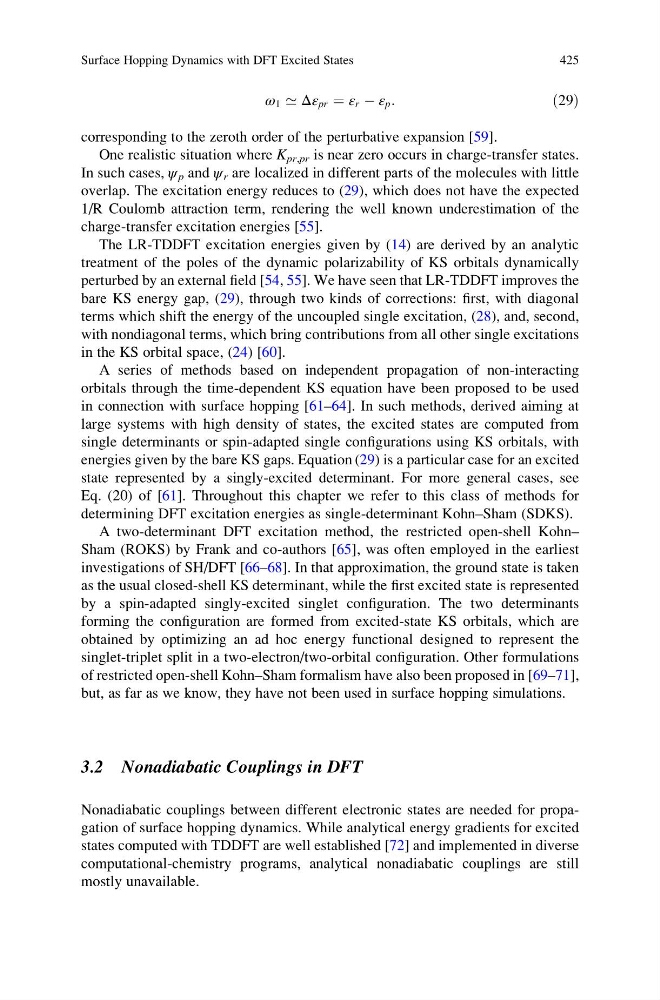
ω 1 ’ Δε pr ¼ ε r À ε p :
ð29Þ
corresponding to the zeroth order of the perturbative expansion [59].
One realistic situation where K pr,pr is near zero occurs in charge-transfer states.
In such cases, ψ p and ψ r are localized in different parts of the molecules with little
overlap. The excitation energy reduces to (29), which does not have the expected
1/R Coulomb attraction term, rendering the well known underestimation of the
charge-transfer excitation energies [55].
The LR-TDDFT excitation energies given by (14) are derived by an analytic
treatment of the poles of the dynamic polarizability of KS orbitals dynamically
perturbed by an external field [54, 55]. We have seen that LR-TDDFT improves the
bare KS energy gap, (29), through two kinds of corrections: first, with diagonal
terms which shift the energy of the uncoupled single excitation, (28), and, second,
with nondiagonal terms, which bring contributions from all other single excitations
in the KS orbital space, (24) [60].
A series of methods based on independent propagation of non-interacting
orbitals through the time-dependent KS equation have been proposed to be used
in connection with surface hopping [61–64]. In such methods, derived aiming at
large systems with high density of states, the excited states are computed from
single determinants or spin-adapted single configurations using KS orbitals, with
energies given by the bare KS gaps. Equation (29) is a particular case for an excited
state represented by a singly-excited determinant. For more general cases, see
Eq. (20) of [61]. Throughout this chapter we refer to this class of methods for
determining DFT excitation energies as single-determinant Kohn–Sham (SDKS).
A two-determinant DFT excitation method, the restricted open-shell Kohn–
Sham (ROKS) by Frank and co-authors [65], was often employed in the earliest
investigations of SH/DFT [66–68]. In that approximation, the ground state is taken
as the usual closed-shell KS determinant, while the first excited state is represented
by a spin-adapted singly-excited singlet configuration. The two determinants
forming the configuration are formed from excited-state KS orbitals, which are
obtained by optimizing an ad hoc energy functional designed to represent the
singlet-triplet split in a two-electron/two-orbital configuration. Other formulations
of restricted open-shell Kohn–Sham formalism have also been proposed in [69–71],
but, as far as we know, they have not been used in surface hopping simulations.
3.2 Nonadiabatic Couplings in DFT
Nonadiabatic couplings between different electronic states are needed for propagation of surface hopping dynamics. While analytical energy gradients for excited
states computed with TDDFT are well established [72] and implemented in diverse
computational-chemistry programs, analytical nonadiabatic couplings are still
mostly unavailable.
Surface Hopping Dynamics with DFT Excited States
425
ð29Þ
corresponding to the zeroth order of the perturbative expansion [59].
One realistic situation where K pr,pr is near zero occurs in charge-transfer states.
In such cases, ψ p and ψ r are localized in different parts of the molecules with little
overlap. The excitation energy reduces to (29), which does not have the expected
1/R Coulomb attraction term, rendering the well known underestimation of the
charge-transfer excitation energies [55].
The LR-TDDFT excitation energies given by (14) are derived by an analytic
treatment of the poles of the dynamic polarizability of KS orbitals dynamically
perturbed by an external field [54, 55]. We have seen that LR-TDDFT improves the
bare KS energy gap, (29), through two kinds of corrections: first, with diagonal
terms which shift the energy of the uncoupled single excitation, (28), and, second,
with nondiagonal terms, which bring contributions from all other single excitations
in the KS orbital space, (24) [60].
A series of methods based on independent propagation of non-interacting
orbitals through the time-dependent KS equation have been proposed to be used
in connection with surface hopping [61–64]. In such methods, derived aiming at
large systems with high density of states, the excited states are computed from
single determinants or spin-adapted single configurations using KS orbitals, with
energies given by the bare KS gaps. Equation (29) is a particular case for an excited
state represented by a singly-excited determinant. For more general cases, see
Eq. (20) of [61]. Throughout this chapter we refer to this class of methods for
determining DFT excitation energies as single-determinant Kohn–Sham (SDKS).
A two-determinant DFT excitation method, the restricted open-shell Kohn–
Sham (ROKS) by Frank and co-authors [65], was often employed in the earliest
investigations of SH/DFT [66–68]. In that approximation, the ground state is taken
as the usual closed-shell KS determinant, while the first excited state is represented
by a spin-adapted singly-excited singlet configuration. The two determinants
forming the configuration are formed from excited-state KS orbitals, which are
obtained by optimizing an ad hoc energy functional designed to represent the
singlet-triplet split in a two-electron/two-orbital configuration. Other formulations
of restricted open-shell Kohn–Sham formalism have also been proposed in [69–71],
but, as far as we know, they have not been used in surface hopping simulations.
3.2 Nonadiabatic Couplings in DFT
Nonadiabatic couplings between different electronic states are needed for propagation of surface hopping dynamics. While analytical energy gradients for excited
states computed with TDDFT are well established [72] and implemented in diverse
computational-chemistry programs, analytical nonadiabatic couplings are still
mostly unavailable.
Surface Hopping Dynamics with DFT Excited States
425