

S LM t
ð Þ ¼
X
J
D
η L t À Δt
ð
Þ
η J t
ð Þ
E
T JM t
ð Þ:
ð9Þ
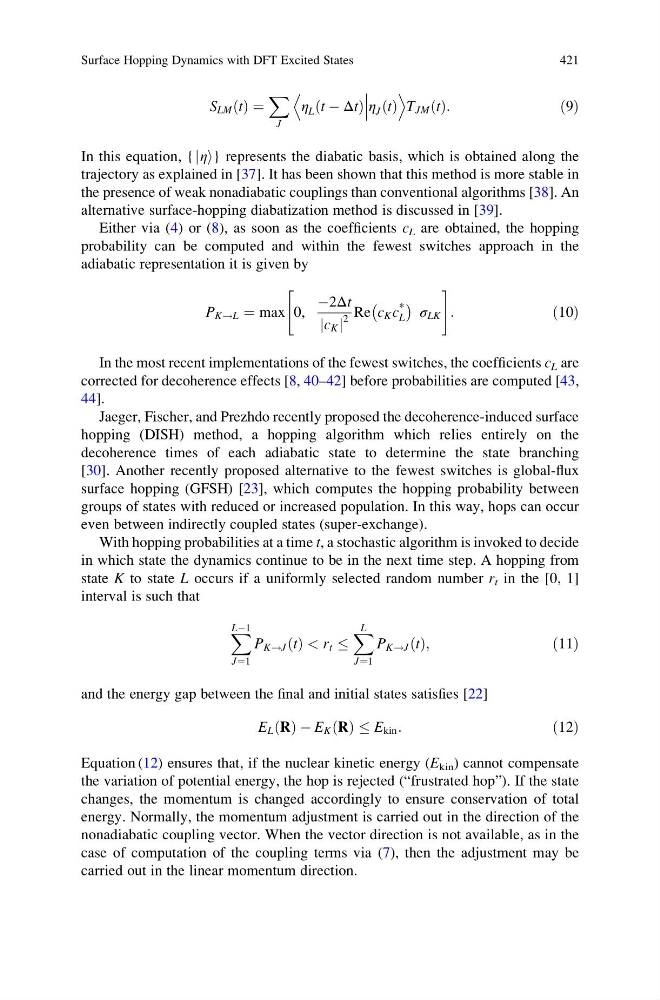
In this equation, {jηi} represents the diabatic basis, which is obtained along the
trajectory as explained in [37]. It has been shown that this method is more stable in
the presence of weak nonadiabatic couplings than conventional algorithms [38]. An
alternative surface-hopping diabatization method is discussed in [39].
Either via (4) or (8), as soon as the coefficients c L are obtained, the hopping
probability can be computed and within the fewest switches approach in the
adiabatic representation it is given by
P K!L ¼ max 0,
À2Δt
c K
j j
2
Re c K c
*
L
À
Á σ LK
"
#
:
ð10Þ
In the most recent implementations of the fewest switches, the coefficients c L are
corrected for decoherence effects [8, 40–42] before probabilities are computed [43,
44].
Jaeger, Fischer, and Prezhdo recently proposed the decoherence-induced surface
hopping (DISH) method, a hopping algorithm which relies entirely on the
decoherence times of each adiabatic state to determine the state branching
[30]. Another recently proposed alternative to the fewest switches is global-flux
surface hopping (GFSH) [23], which computes the hopping probability between
groups of states with reduced or increased population. In this way, hops can occur
even between indirectly coupled states (super-exchange).
With hopping probabilities at a time t, a stochastic algorithm is invoked to decide
in which state the dynamics continue to be in the next time step. A hopping from
state K to state L occurs if a uniformly selected random number r t in the [0, 1]
interval is such that
X LÀ1
J¼1
P K!J t
ð Þ < r t
X L
J¼1
P K!J t
ð Þ;
ð11Þ
and the energy gap between the final and initial states satisfies [22]
E L R
ð Þ À E K R
ð Þ E kin :
ð12Þ
Equation (12) ensures that, if the nuclear kinetic energy (E kin ) cannot compensate
the variation of potential energy, the hop is rejected (“frustrated hop”). If the state
changes, the momentum is changed accordingly to ensure conservation of total
energy. Normally, the momentum adjustment is carried out in the direction of the
nonadiabatic coupling vector. When the vector direction is not available, as in the
case of computation of the coupling terms via (7), then the adjustment may be
carried out in the linear momentum direction.
Surface Hopping Dynamics with DFT Excited States
421
ð Þ ¼
X
J
D
η L t À Δt
ð
Þ
η J t
ð Þ
E
T JM t
ð Þ:
ð9Þ
In this equation, {jηi} represents the diabatic basis, which is obtained along the
trajectory as explained in [37]. It has been shown that this method is more stable in
the presence of weak nonadiabatic couplings than conventional algorithms [38]. An
alternative surface-hopping diabatization method is discussed in [39].
Either via (4) or (8), as soon as the coefficients c L are obtained, the hopping
probability can be computed and within the fewest switches approach in the
adiabatic representation it is given by
P K!L ¼ max 0,
À2Δt
c K
j j
2
Re c K c
*
L
À
Á σ LK
"
#
:
ð10Þ
In the most recent implementations of the fewest switches, the coefficients c L are
corrected for decoherence effects [8, 40–42] before probabilities are computed [43,
44].
Jaeger, Fischer, and Prezhdo recently proposed the decoherence-induced surface
hopping (DISH) method, a hopping algorithm which relies entirely on the
decoherence times of each adiabatic state to determine the state branching
[30]. Another recently proposed alternative to the fewest switches is global-flux
surface hopping (GFSH) [23], which computes the hopping probability between
groups of states with reduced or increased population. In this way, hops can occur
even between indirectly coupled states (super-exchange).
With hopping probabilities at a time t, a stochastic algorithm is invoked to decide
in which state the dynamics continue to be in the next time step. A hopping from
state K to state L occurs if a uniformly selected random number r t in the [0, 1]
interval is such that
X LÀ1
J¼1
P K!J t
ð Þ < r t
X L
J¼1
P K!J t
ð Þ;
ð11Þ
and the energy gap between the final and initial states satisfies [22]
E L R
ð Þ À E K R
ð Þ E kin :
ð12Þ
Equation (12) ensures that, if the nuclear kinetic energy (E kin ) cannot compensate
the variation of potential energy, the hop is rejected (“frustrated hop”). If the state
changes, the momentum is changed accordingly to ensure conservation of total
energy. Normally, the momentum adjustment is carried out in the direction of the
nonadiabatic coupling vector. When the vector direction is not available, as in the
case of computation of the coupling terms via (7), then the adjustment may be
carried out in the linear momentum direction.
Surface Hopping Dynamics with DFT Excited States
421