

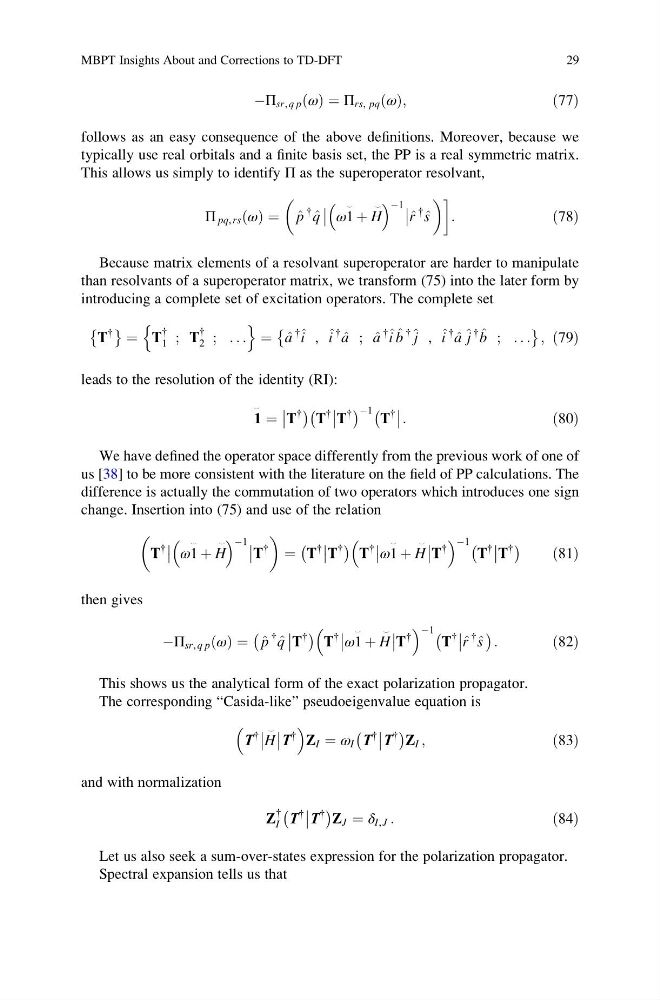
ÀΠ sr, q p ω
ð Þ ¼ Π rs, pq ω
ð Þ;
ð77Þ
follows as an easy consequence of the above definitions. Moreover, because we
typically use real orbitals and a finite basis set, the PP is a real symmetric matrix.
This allows us simply to identify Π as the superoperator resolvant,
Π pq, rs ω
ð Þ ¼ ^
p
{
^
q
ω1
^ þ H
^
À1
^
r
{
^
s
!
:
ð78Þ
Because matrix elements of a resolvant superoperator are harder to manipulate
than resolvants of a superoperator matrix, we transform (75) into the later form by
introducing a complete set of excitation operators. The complete set
T
{
È É ¼ T
{
1 ; T
{
2 ; ...
n
o
¼ ^
a
{ ^ i , ^ i
{
^
a ; ^
a
{ ^ i ^
b
{ ^ j , ^ i
{
^
a ^ j
{ ^
b ; . . .
È
É ; ð79Þ
leads to the resolution of the identity (RI):
1
^ ¼
T
{
Á
T
{
T
{
À
Á À1 À
T
{
:
ð80Þ
We have defined the operator space differently from the previous work of one of
us [38] to be more consistent with the literature on the field of PP calculations. The
difference is actually the commutation of two operators which introduces one sign
change. Insertion into (75) and use of the relation
T
{
ω1
^ þ H
^
À1
T
{
¼ T
{
T
{
À
Á
T
{
ω1
^ þ H
^
T
{
À1
T
{
T
{
À
Á
ð81Þ
then gives
ÀΠ sr, q p ω
ð Þ ¼ ^
p
{
^
q
T
{
À
Á
T
{
ω1
^ þ H
^
T
{
À1
T
{
^
r
{
^
s
À
Á :
ð82Þ
This shows us the analytical form of the exact polarization propagator.
The corresponding “Casida-like” pseudoeigenvalue equation is
T
{
H
^
T
{
Z I ¼ ω I T
{
T
{
À
Á
Z I ;
ð83Þ
and with normalization
Z
{
I T
{
T
{
À
Á
Z J ¼ δ I, J :
ð84Þ
Let us also seek a sum-over-states expression for the polarization propagator.
Spectral expansion tells us that
MBPT Insights About and Corrections to TD-DFT
29
ð Þ ¼ Π rs, pq ω
ð Þ;
ð77Þ
follows as an easy consequence of the above definitions. Moreover, because we
typically use real orbitals and a finite basis set, the PP is a real symmetric matrix.
This allows us simply to identify Π as the superoperator resolvant,
Π pq, rs ω
ð Þ ¼ ^
p
{
^
q
ω1
^ þ H
^
À1
^
r
{
^
s
!
:
ð78Þ
Because matrix elements of a resolvant superoperator are harder to manipulate
than resolvants of a superoperator matrix, we transform (75) into the later form by
introducing a complete set of excitation operators. The complete set
T
{
È É ¼ T
{
1 ; T
{
2 ; ...
n
o
¼ ^
a
{ ^ i , ^ i
{
^
a ; ^
a
{ ^ i ^
b
{ ^ j , ^ i
{
^
a ^ j
{ ^
b ; . . .
È
É ; ð79Þ
leads to the resolution of the identity (RI):
1
^ ¼
T
{
Á
T
{
T
{
À
Á À1 À
T
{
:
ð80Þ
We have defined the operator space differently from the previous work of one of
us [38] to be more consistent with the literature on the field of PP calculations. The
difference is actually the commutation of two operators which introduces one sign
change. Insertion into (75) and use of the relation
T
{
ω1
^ þ H
^
À1
T
{
¼ T
{
T
{
À
Á
T
{
ω1
^ þ H
^
T
{
À1
T
{
T
{
À
Á
ð81Þ
then gives
ÀΠ sr, q p ω
ð Þ ¼ ^
p
{
^
q
T
{
À
Á
T
{
ω1
^ þ H
^
T
{
À1
T
{
^
r
{
^
s
À
Á :
ð82Þ
This shows us the analytical form of the exact polarization propagator.
The corresponding “Casida-like” pseudoeigenvalue equation is
T
{
H
^
T
{
Z I ¼ ω I T
{
T
{
À
Á
Z I ;
ð83Þ
and with normalization
Z
{
I T
{
T
{
À
Á
Z J ¼ δ I, J :
ð84Þ
Let us also seek a sum-over-states expression for the polarization propagator.
Spectral expansion tells us that
MBPT Insights About and Corrections to TD-DFT
29