

upon the time difference, t À t
0 , we can shift the origin of the time scale so that t
0
¼ 0
without loss of generality.
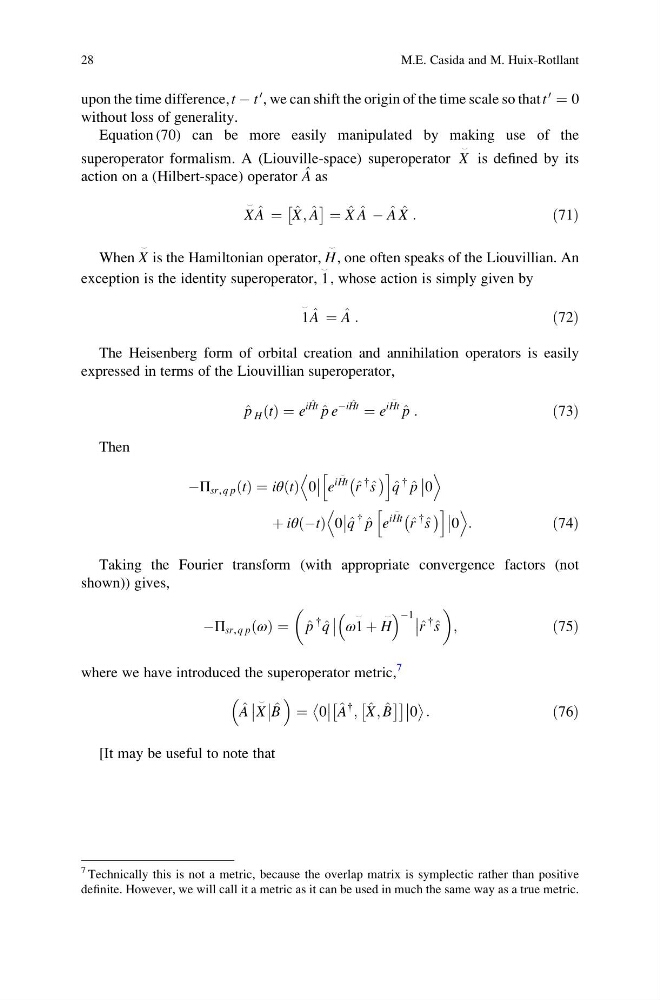
Equation (70) can be more easily manipulated by making use of the
superoperator formalism. A (Liouville-space) superoperator X
^
is defined by its
action on a (Hilbert-space) operator A ˆ as
X
^ ^
A ¼ ^
X; ^
A
Â
à ¼ ^
X ^
A À ^
A ^
X :
ð71Þ
When X
^
is the Hamiltonian operator, H
^
, one often speaks of the Liouvillian. An
exception is the identity superoperator, 1
^
, whose action is simply given by
1
^ ^
A ¼ ^
A :
ð72Þ
The Heisenberg form of orbital creation and annihilation operators is easily
expressed in terms of the Liouvillian superoperator,
^
p H t
ð Þ ¼ e
i ^
Ht
^
p e
Ài ^
Ht
¼ e
iH
^
t
^
p :
ð73Þ
Then
ÀΠ sr, q p t
ð Þ ¼ iθ t
ð Þ 0
e
iH
^
t
^
r
{
^
s
À
Á
h
i
^
q
{
^
p
0
D
E
þ iθ Àt
ð Þ 0
^
q
{
^
p e
iH
^
t
^
r
{
^
s
À
Á
h
i
0
D
E
:
ð74Þ
Taking the Fourier transform (with appropriate convergence factors (not
shown)) gives,
ÀΠ sr, q p ω
ð Þ ¼ ^
p
{
^
q
ω1
^ þ H
^
À1
^
r
{
^
s
;
ð75Þ
where we have introduced the superoperator metric,
7
^
A
X
^
^
B
¼ 0
^
A
{
; ^
X; ^
B
Â
Ã
Â
Ã
0
:
ð76Þ
[It may be useful to note that
7 Technically this is not a metric, because the overlap matrix is symplectic rather than positive
definite. However, we will call it a metric as it can be used in much the same way as a true metric.
28
M.E. Casida and M. Huix-Rotllant
0 , we can shift the origin of the time scale so that t
0
¼ 0
without loss of generality.
Equation (70) can be more easily manipulated by making use of the
superoperator formalism. A (Liouville-space) superoperator X
^
is defined by its
action on a (Hilbert-space) operator A ˆ as
X
^ ^
A ¼ ^
X; ^
A
Â
à ¼ ^
X ^
A À ^
A ^
X :
ð71Þ
When X
^
is the Hamiltonian operator, H
^
, one often speaks of the Liouvillian. An
exception is the identity superoperator, 1
^
, whose action is simply given by
1
^ ^
A ¼ ^
A :
ð72Þ
The Heisenberg form of orbital creation and annihilation operators is easily
expressed in terms of the Liouvillian superoperator,
^
p H t
ð Þ ¼ e
i ^
Ht
^
p e
Ài ^
Ht
¼ e
iH
^
t
^
p :
ð73Þ
Then
ÀΠ sr, q p t
ð Þ ¼ iθ t
ð Þ 0
e
iH
^
t
^
r
{
^
s
À
Á
h
i
^
q
{
^
p
0
D
E
þ iθ Àt
ð Þ 0
^
q
{
^
p e
iH
^
t
^
r
{
^
s
À
Á
h
i
0
D
E
:
ð74Þ
Taking the Fourier transform (with appropriate convergence factors (not
shown)) gives,
ÀΠ sr, q p ω
ð Þ ¼ ^
p
{
^
q
ω1
^ þ H
^
À1
^
r
{
^
s
;
ð75Þ
where we have introduced the superoperator metric,
7
^
A
X
^
^
B
¼ 0
^
A
{
; ^
X; ^
B
Â
Ã
Â
Ã
0
:
ð76Þ
[It may be useful to note that
7 Technically this is not a metric, because the overlap matrix is symplectic rather than positive
definite. However, we will call it a metric as it can be used in much the same way as a true metric.
28
M.E. Casida and M. Huix-Rotllant