

where ϕ i and ϕ f are the initial and final electronic states, respectively, Ω i is a matrix
that contains vibrational frequencies of the initial state, and G(t) is a time-dependent
correlation function which contains information about the vibrational frequencies
and normal coordinates of the initial and final states.
The SOC matrix of 144 Â 144 dimension generated by the 16 lowest electronic
states in each multiplicity contains nearly 4,500 non-zero elements. This illustrates
the complexity of the spin-orbit interactions in transition metal complexes characterized by a high density of various electronic states. The
1 MLCT/
3 MLCT and
1 MLCT/
3 MC SOC do not exceed 200 cm
À1 and the
3 MLCT/
5 T 2g is very small
(~6 cm
À1 ). In contrast, the
3 MC/
5 T 2g and
3 MC/
1 A 1g are characterized by large
values (~500 cm
À1 ). The calculated
1 MLCT !
3 MLCT and
1 MLCT !
3 MC ISC
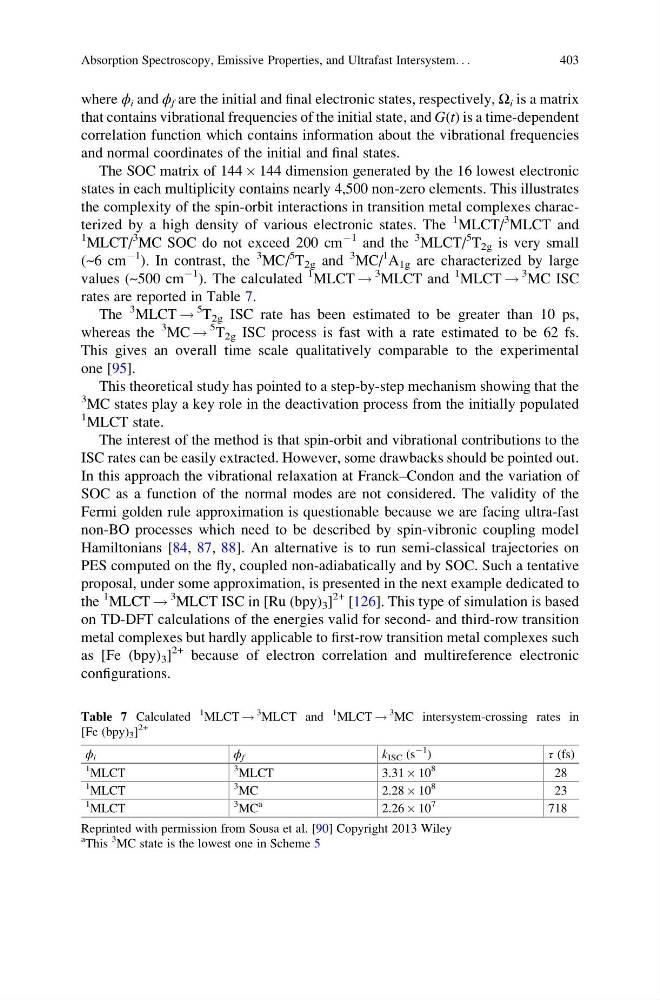
rates are reported in Table 7.
The
3 MLCT !
5 T 2g ISC rate has been estimated to be greater than 10 ps,
whereas the
3 MC !
5 T 2g ISC process is fast with a rate estimated to be 62 fs.
This gives an overall time scale qualitatively comparable to the experimental
one [95].
This theoretical study has pointed to a step-by-step mechanism showing that the
3 MC states play a key role in the deactivation process from the initially populated
1 MLCT state.
The interest of the method is that spin-orbit and vibrational contributions to the
ISC rates can be easily extracted. However, some drawbacks should be pointed out.
In this approach the vibrational relaxation at Franck–Condon and the variation of
SOC as a function of the normal modes are not considered. The validity of the
Fermi golden rule approximation is questionable because we are facing ultra-fast
non-BO processes which need to be described by spin-vibronic coupling model
Hamiltonians [84, 87, 88]. An alternative is to run semi-classical trajectories on
PES computed on the fly, coupled non-adiabatically and by SOC. Such a tentative
proposal, under some approximation, is presented in the next example dedicated to
the
1 MLCT !
3 MLCT ISC in [Ru (bpy) 3 ]
2+ [126]. This type of simulation is based
on TD-DFT calculations of the energies valid for second- and third-row transition
metal complexes but hardly applicable to first-row transition metal complexes such
as [Fe (bpy) 3 ]
2+ because of electron correlation and multireference electronic
configurations.
Table 7 Calculated
1
MLCT !
3
MLCT and
1
MLCT !
3
MC intersystem-crossing rates in
[Fe (bpy) 3 ]
2+
ϕ i
ϕ f
k ISC (s
À1
)
τ (fs)
1
MLCT
3
MLCT
3.31 Â 10
8
28
1
MLCT
3
MC
2.28 Â 10
8
23
1
MLCT
3
MC
a
2.26 Â 10
7
718
Reprinted with permission from Sousa et al. [90] Copyright 2013 Wiley
a
This
3
MC state is the lowest one in Scheme 5
Absorption Spectroscopy, Emissive Properties, and Ultrafast Intersystem. . .
403
that contains vibrational frequencies of the initial state, and G(t) is a time-dependent
correlation function which contains information about the vibrational frequencies
and normal coordinates of the initial and final states.
The SOC matrix of 144 Â 144 dimension generated by the 16 lowest electronic
states in each multiplicity contains nearly 4,500 non-zero elements. This illustrates
the complexity of the spin-orbit interactions in transition metal complexes characterized by a high density of various electronic states. The
1 MLCT/
3 MLCT and
1 MLCT/
3 MC SOC do not exceed 200 cm
À1 and the
3 MLCT/
5 T 2g is very small
(~6 cm
À1 ). In contrast, the
3 MC/
5 T 2g and
3 MC/
1 A 1g are characterized by large
values (~500 cm
À1 ). The calculated
1 MLCT !
3 MLCT and
1 MLCT !
3 MC ISC
rates are reported in Table 7.
The
3 MLCT !
5 T 2g ISC rate has been estimated to be greater than 10 ps,
whereas the
3 MC !
5 T 2g ISC process is fast with a rate estimated to be 62 fs.
This gives an overall time scale qualitatively comparable to the experimental
one [95].
This theoretical study has pointed to a step-by-step mechanism showing that the
3 MC states play a key role in the deactivation process from the initially populated
1 MLCT state.
The interest of the method is that spin-orbit and vibrational contributions to the
ISC rates can be easily extracted. However, some drawbacks should be pointed out.
In this approach the vibrational relaxation at Franck–Condon and the variation of
SOC as a function of the normal modes are not considered. The validity of the
Fermi golden rule approximation is questionable because we are facing ultra-fast
non-BO processes which need to be described by spin-vibronic coupling model
Hamiltonians [84, 87, 88]. An alternative is to run semi-classical trajectories on
PES computed on the fly, coupled non-adiabatically and by SOC. Such a tentative
proposal, under some approximation, is presented in the next example dedicated to
the
1 MLCT !
3 MLCT ISC in [Ru (bpy) 3 ]
2+ [126]. This type of simulation is based
on TD-DFT calculations of the energies valid for second- and third-row transition
metal complexes but hardly applicable to first-row transition metal complexes such
as [Fe (bpy) 3 ]
2+ because of electron correlation and multireference electronic
configurations.
Table 7 Calculated
1
MLCT !
3
MLCT and
1
MLCT !
3
MC intersystem-crossing rates in
[Fe (bpy) 3 ]
2+
ϕ i
ϕ f
k ISC (s
À1
)
τ (fs)
1
MLCT
3
MLCT
3.31 Â 10
8
28
1
MLCT
3
MC
2.28 Â 10
8
23
1
MLCT
3
MC
a
2.26 Â 10
7
718
Reprinted with permission from Sousa et al. [90] Copyright 2013 Wiley
a
This
3
MC state is the lowest one in Scheme 5
Absorption Spectroscopy, Emissive Properties, and Ultrafast Intersystem. . .
403