

5.2 Ultra-Fast Relaxation Processes in [Ru (bpy) 3 ]
2+
Complex
The first simulation based on TD-DFT energies and forces (gradient and Hessian)
computed on-the-fly and introducing both vibronic and SO coupling effects has
been able to reproduce semi-quantitatively the ultra-fast relaxation of the photo
excited
1 MLCT state of [Ru (bpy) 3 ]
2+ (bpy ¼ 2,2
0 -bipyridine) followed by ISC to
the lowest
3 MLCT state [126].
This study focuses on the ultra-fast excited states dynamics of [Ru (bpy]
2+ in
water with emphasis on the ISC processes through the seven low-lying singlet and
triplet states. Time-resolved spectroscopy [127, 128] has shown a fast decay within
less than 100 fs after absorption leading to a long-lived
3 MLCT state during a few
hundreds of ps.
The non-adiabatic dynamics of the early events (50 fs) is simulated on the fly by
means of linear response TD-DFT-based trajectories surface hopping according to
the Tully algorithm [129]. SOC between qualitatively selected singlet and triplet
states is obtained from a perturbative approach [130].
In order to take into account the solvent effects, the initial system constituted of
the Ru(II) complex surrounded by 3,298 water molecules and the counter ions Cl
À
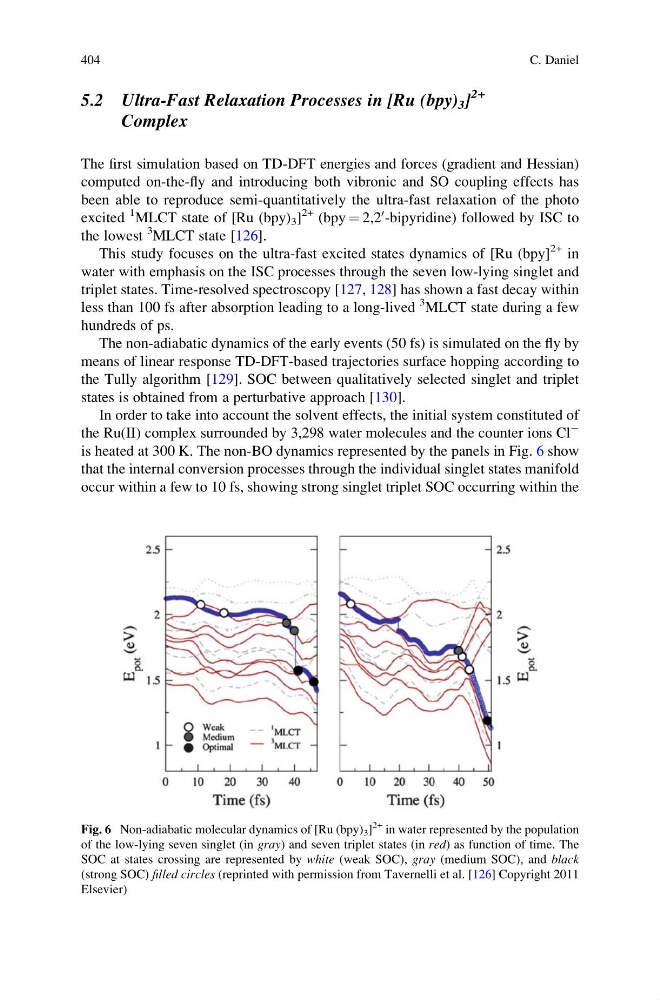
is heated at 300 K. The non-BO dynamics represented by the panels in Fig. 6 show
that the internal conversion processes through the individual singlet states manifold
occur within a few to 10 fs, showing strong singlet triplet SOC occurring within the
Fig. 6 Non-adiabatic molecular dynamics of [Ru (bpy) 3 ]
2+ in water represented by the population
of the low-lying seven singlet (in gray) and seven triplet states (in red) as function of time. The
SOC at states crossing are represented by white (weak SOC), gray (medium SOC), and black
(strong SOC) filled circles (reprinted with permission from Tavernelli et al. [126] Copyright 2011
Elsevier)
404
C. Daniel
2+
Complex
The first simulation based on TD-DFT energies and forces (gradient and Hessian)
computed on-the-fly and introducing both vibronic and SO coupling effects has
been able to reproduce semi-quantitatively the ultra-fast relaxation of the photo
excited
1 MLCT state of [Ru (bpy) 3 ]
2+ (bpy ¼ 2,2
0 -bipyridine) followed by ISC to
the lowest
3 MLCT state [126].
This study focuses on the ultra-fast excited states dynamics of [Ru (bpy]
2+ in
water with emphasis on the ISC processes through the seven low-lying singlet and
triplet states. Time-resolved spectroscopy [127, 128] has shown a fast decay within
less than 100 fs after absorption leading to a long-lived
3 MLCT state during a few
hundreds of ps.
The non-adiabatic dynamics of the early events (50 fs) is simulated on the fly by
means of linear response TD-DFT-based trajectories surface hopping according to
the Tully algorithm [129]. SOC between qualitatively selected singlet and triplet
states is obtained from a perturbative approach [130].
In order to take into account the solvent effects, the initial system constituted of
the Ru(II) complex surrounded by 3,298 water molecules and the counter ions Cl
À
is heated at 300 K. The non-BO dynamics represented by the panels in Fig. 6 show
that the internal conversion processes through the individual singlet states manifold
occur within a few to 10 fs, showing strong singlet triplet SOC occurring within the
Fig. 6 Non-adiabatic molecular dynamics of [Ru (bpy) 3 ]
2+ in water represented by the population
of the low-lying seven singlet (in gray) and seven triplet states (in red) as function of time. The
SOC at states crossing are represented by white (weak SOC), gray (medium SOC), and black
(strong SOC) filled circles (reprinted with permission from Tavernelli et al. [126] Copyright 2011
Elsevier)
404
C. Daniel