

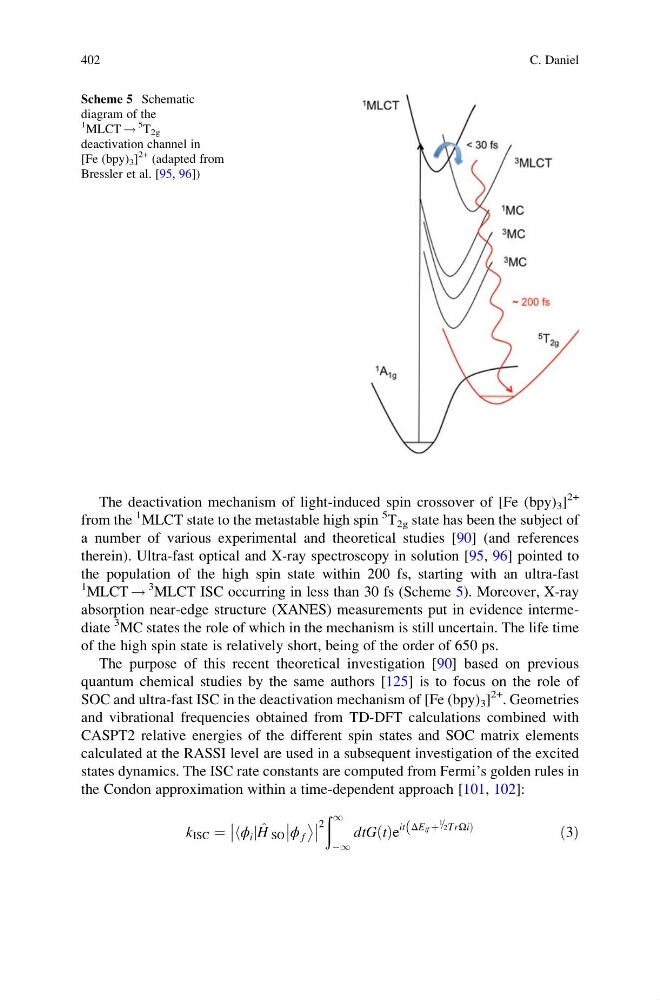
The deactivation mechanism of light-induced spin crossover of [Fe (bpy) 3 ]
2+
from the
1 MLCT state to the metastable high spin
5 T 2g state has been the subject of
a number of various experimental and theoretical studies [90] (and references
therein). Ultra-fast optical and X-ray spectroscopy in solution [95, 96] pointed to
the population of the high spin state within 200 fs, starting with an ultra-fast
1 MLCT !
3 MLCT ISC occurring in less than 30 fs (Scheme 5). Moreover, X-ray
absorption near-edge structure (XANES) measurements put in evidence intermediate
3 MC states the role of which in the mechanism is still uncertain. The life time
of the high spin state is relatively short, being of the order of 650 ps.
The purpose of this recent theoretical investigation [90] based on previous
quantum chemical studies by the same authors [125] is to focus on the role of
SOC and ultra-fast ISC in the deactivation mechanism of [Fe (bpy) 3 ]
2+ . Geometries
and vibrational frequencies obtained from TD-DFT calculations combined with
CASPT2 relative energies of the different spin states and SOC matrix elements
calculated at the RASSI level are used in a subsequent investigation of the excited
states dynamics. The ISC rate constants are computed from Fermi’s golden rules in
the Condon approximation within a time-dependent approach [101, 102]:
k ISC ¼ ϕ i
h j ^
H SO ϕ f
2
ð 1
À1
dtG t
ð Þe
it ΔE if þ
1 = 2 TrΩiÞ
ð
ð3Þ
Scheme 5 Schematic
diagram of the
1
MLCT !
5
T 2g
deactivation channel in
[Fe (bpy) 3 ]
2+ (adapted from
Bressler et al. [95, 96])
402
C. Daniel
2+
from the
1 MLCT state to the metastable high spin
5 T 2g state has been the subject of
a number of various experimental and theoretical studies [90] (and references
therein). Ultra-fast optical and X-ray spectroscopy in solution [95, 96] pointed to
the population of the high spin state within 200 fs, starting with an ultra-fast
1 MLCT !
3 MLCT ISC occurring in less than 30 fs (Scheme 5). Moreover, X-ray
absorption near-edge structure (XANES) measurements put in evidence intermediate
3 MC states the role of which in the mechanism is still uncertain. The life time
of the high spin state is relatively short, being of the order of 650 ps.
The purpose of this recent theoretical investigation [90] based on previous
quantum chemical studies by the same authors [125] is to focus on the role of
SOC and ultra-fast ISC in the deactivation mechanism of [Fe (bpy) 3 ]
2+ . Geometries
and vibrational frequencies obtained from TD-DFT calculations combined with
CASPT2 relative energies of the different spin states and SOC matrix elements
calculated at the RASSI level are used in a subsequent investigation of the excited
states dynamics. The ISC rate constants are computed from Fermi’s golden rules in
the Condon approximation within a time-dependent approach [101, 102]:
k ISC ¼ ϕ i
h j ^
H SO ϕ f
2
ð 1
À1
dtG t
ð Þe
it ΔE if þ
1 = 2 TrΩiÞ
ð
ð3Þ
Scheme 5 Schematic
diagram of the
1
MLCT !
5
T 2g
deactivation channel in
[Fe (bpy) 3 ]
2+ (adapted from
Bressler et al. [95, 96])
402
C. Daniel