

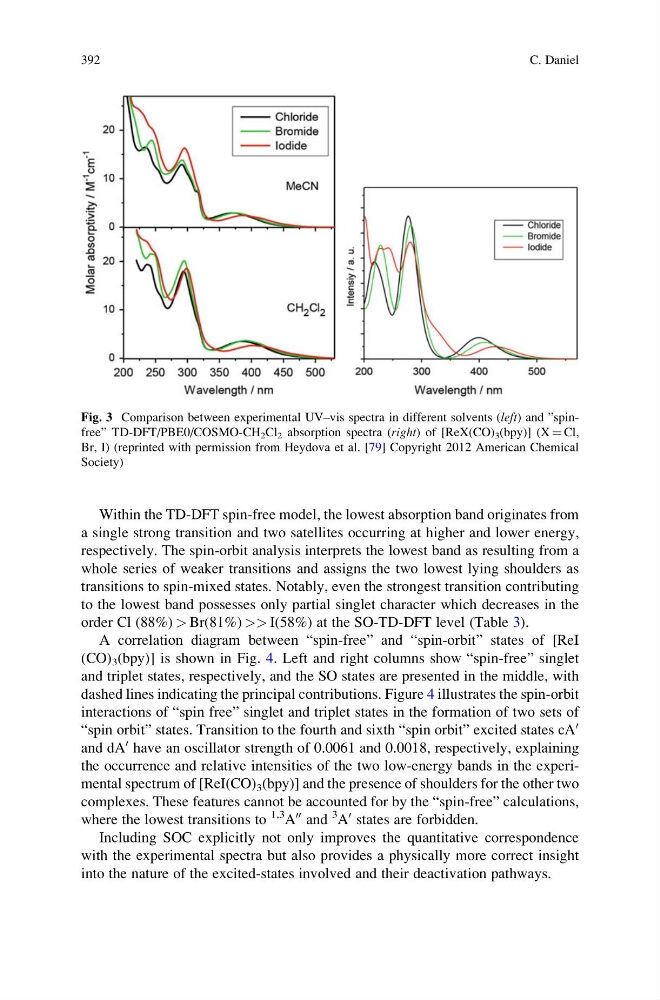
Within the TD-DFT spin-free model, the lowest absorption band originates from
a single strong transition and two satellites occurring at higher and lower energy,
respectively. The spin-orbit analysis interprets the lowest band as resulting from a
whole series of weaker transitions and assigns the two lowest lying shoulders as
transitions to spin-mixed states. Notably, even the strongest transition contributing
to the lowest band possesses only partial singlet character which decreases in the
order Cl (88%) > Br(81%) >> I(58%) at the SO-TD-DFT level (Table 3).
A correlation diagram between “spin-free” and “spin-orbit” states of [ReI
(CO) 3 (bpy)] is shown in Fig. 4. Left and right columns show “spin-free” singlet
and triplet states, respectively, and the SO states are presented in the middle, with
dashed lines indicating the principal contributions. Figure 4 illustrates the spin-orbit
interactions of “spin free” singlet and triplet states in the formation of two sets of
“spin orbit” states. Transition to the fourth and sixth “spin orbit” excited states cA
0
and dA
0 have an oscillator strength of 0.0061 and 0.0018, respectively, explaining
the occurrence and relative intensities of the two low-energy bands in the experimental spectrum of [ReI(CO) 3 (bpy)] and the presence of shoulders for the other two
complexes. These features cannot be accounted for by the “spin-free” calculations,
where the lowest transitions to
1,3 A
00 and
3 A
0 states are forbidden.
Including SOC explicitly not only improves the quantitative correspondence
with the experimental spectra but also provides a physically more correct insight
into the nature of the excited-states involved and their deactivation pathways.
Fig. 3 Comparison between experimental UV–vis spectra in different solvents (left) and ”spinfree” TD-DFT/PBE0/COSMO-CH 2 Cl 2 absorption spectra (right) of [ReX(CO) 3 (bpy)] (X ¼ Cl,
Br, I) (reprinted with permission from Heydova et al. [79] Copyright 2012 American Chemical
Society)
392
C. Daniel
a single strong transition and two satellites occurring at higher and lower energy,
respectively. The spin-orbit analysis interprets the lowest band as resulting from a
whole series of weaker transitions and assigns the two lowest lying shoulders as
transitions to spin-mixed states. Notably, even the strongest transition contributing
to the lowest band possesses only partial singlet character which decreases in the
order Cl (88%) > Br(81%) >> I(58%) at the SO-TD-DFT level (Table 3).
A correlation diagram between “spin-free” and “spin-orbit” states of [ReI
(CO) 3 (bpy)] is shown in Fig. 4. Left and right columns show “spin-free” singlet
and triplet states, respectively, and the SO states are presented in the middle, with
dashed lines indicating the principal contributions. Figure 4 illustrates the spin-orbit
interactions of “spin free” singlet and triplet states in the formation of two sets of
“spin orbit” states. Transition to the fourth and sixth “spin orbit” excited states cA
0
and dA
0 have an oscillator strength of 0.0061 and 0.0018, respectively, explaining
the occurrence and relative intensities of the two low-energy bands in the experimental spectrum of [ReI(CO) 3 (bpy)] and the presence of shoulders for the other two
complexes. These features cannot be accounted for by the “spin-free” calculations,
where the lowest transitions to
1,3 A
00 and
3 A
0 states are forbidden.
Including SOC explicitly not only improves the quantitative correspondence
with the experimental spectra but also provides a physically more correct insight
into the nature of the excited-states involved and their deactivation pathways.
Fig. 3 Comparison between experimental UV–vis spectra in different solvents (left) and ”spinfree” TD-DFT/PBE0/COSMO-CH 2 Cl 2 absorption spectra (right) of [ReX(CO) 3 (bpy)] (X ¼ Cl,
Br, I) (reprinted with permission from Heydova et al. [79] Copyright 2012 American Chemical
Society)
392
C. Daniel