

(Fig. 3), they give a very different interpretation of the absorption bands and only
the SO treatment can account for all the observed spectral features, namely the
low-energy shoulders.
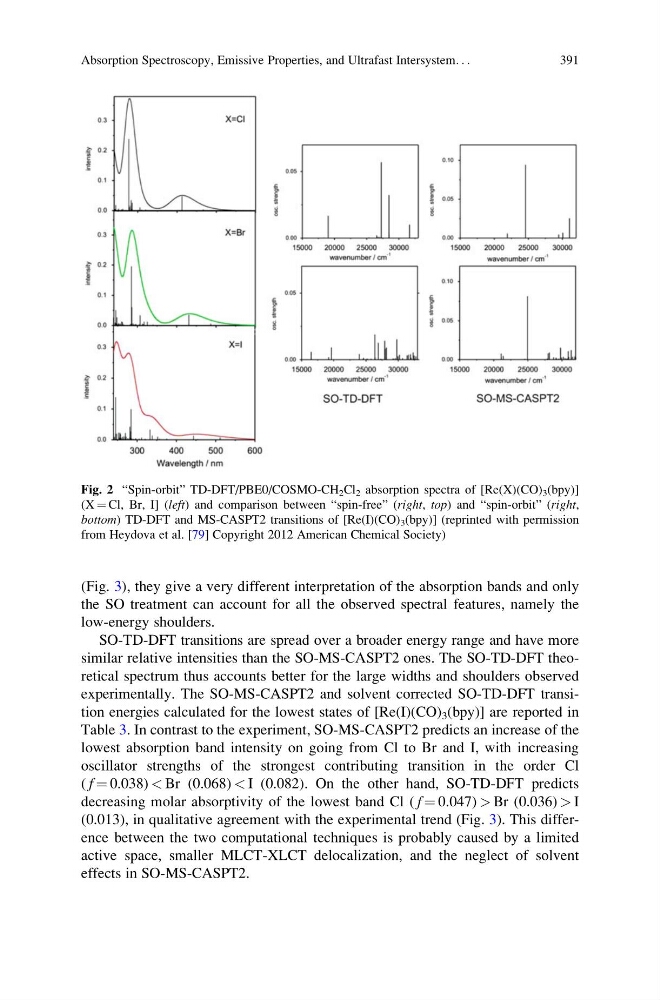
SO-TD-DFT transitions are spread over a broader energy range and have more
similar relative intensities than the SO-MS-CASPT2 ones. The SO-TD-DFT theoretical spectrum thus accounts better for the large widths and shoulders observed
experimentally. The SO-MS-CASPT2 and solvent corrected SO-TD-DFT transition energies calculated for the lowest states of [Re(I)(CO) 3 (bpy)] are reported in
Table 3. In contrast to the experiment, SO-MS-CASPT2 predicts an increase of the
lowest absorption band intensity on going from Cl to Br and I, with increasing
oscillator strengths of the strongest contributing transition in the order Cl
( f ¼ 0.038) < Br (0.068) < I (0.082). On the other hand, SO-TD-DFT predicts
decreasing molar absorptivity of the lowest band Cl ( f ¼ 0.047) > Br (0.036) > I
(0.013), in qualitative agreement with the experimental trend (Fig. 3). This difference between the two computational techniques is probably caused by a limited
active space, smaller MLCT-XLCT delocalization, and the neglect of solvent
effects in SO-MS-CASPT2.
Fig. 2 “Spin-orbit” TD-DFT/PBE0/COSMO-CH 2 Cl 2 absorption spectra of [Re(X)(CO) 3 (bpy)]
(X ¼ Cl, Br, I] (left) and comparison between “spin-free” (right, top) and “spin-orbit” (right,
bottom) TD-DFT and MS-CASPT2 transitions of [Re(I)(CO) 3 (bpy)] (reprinted with permission
from Heydova et al. [79] Copyright 2012 American Chemical Society)
Absorption Spectroscopy, Emissive Properties, and Ultrafast Intersystem. . .
391
the SO treatment can account for all the observed spectral features, namely the
low-energy shoulders.
SO-TD-DFT transitions are spread over a broader energy range and have more
similar relative intensities than the SO-MS-CASPT2 ones. The SO-TD-DFT theoretical spectrum thus accounts better for the large widths and shoulders observed
experimentally. The SO-MS-CASPT2 and solvent corrected SO-TD-DFT transition energies calculated for the lowest states of [Re(I)(CO) 3 (bpy)] are reported in
Table 3. In contrast to the experiment, SO-MS-CASPT2 predicts an increase of the
lowest absorption band intensity on going from Cl to Br and I, with increasing
oscillator strengths of the strongest contributing transition in the order Cl
( f ¼ 0.038) < Br (0.068) < I (0.082). On the other hand, SO-TD-DFT predicts
decreasing molar absorptivity of the lowest band Cl ( f ¼ 0.047) > Br (0.036) > I
(0.013), in qualitative agreement with the experimental trend (Fig. 3). This difference between the two computational techniques is probably caused by a limited
active space, smaller MLCT-XLCT delocalization, and the neglect of solvent
effects in SO-MS-CASPT2.
Fig. 2 “Spin-orbit” TD-DFT/PBE0/COSMO-CH 2 Cl 2 absorption spectra of [Re(X)(CO) 3 (bpy)]
(X ¼ Cl, Br, I] (left) and comparison between “spin-free” (right, top) and “spin-orbit” (right,
bottom) TD-DFT and MS-CASPT2 transitions of [Re(I)(CO) 3 (bpy)] (reprinted with permission
from Heydova et al. [79] Copyright 2012 American Chemical Society)
Absorption Spectroscopy, Emissive Properties, and Ultrafast Intersystem. . .
391