

From the SOC/TD-DFT theoretical study of the absorption spectra of the
reference [Ir (ppy) 3 ] 1 and CO/Cl substituted [Ir (ppy) 2 (CO)(Cl)] 2 complexes,
several conclusions have been reached.
Whereas the spin-orbit effects are significant for [Ir (ppy) 3 ] 1, they do not modify
drastically the absorption spectrum of [Ir (ppy) 2 (CO)(Cl)] 2. The negligible spinorbit effects, especially the minor splitting of the lowest T 1 state of mixed XLCT/
MLCT character in the CO/Cl substituted complexes, is responsible for distinct
emission properties which differ from those of the reference complex [Ir (ppy) 3 ]
characterized by low-lying MLCT states.
This investigation of two molecules representative of Ir(III) phenyl pyridine
complexes with specific emissive properties confirms the experimental trends and
brings a detailed assignment of the absorption spectra including spin-orbit effects
by adding new elements to the recent theoretical studies performed on the reference [Ir(ppy) 3 ] complex [115–119]. Introduction of spin-orbit interactions highlights the complexity of the absorption spectroscopy in third-row transition metal
complexes and gives a new interpretation of the emissive properties in this class of
molecules. This last point is emphasized in Sect. 4 dedicated to emission
spectroscopy.
3.2 Electronic Spectroscopy of Re(I) Complexes
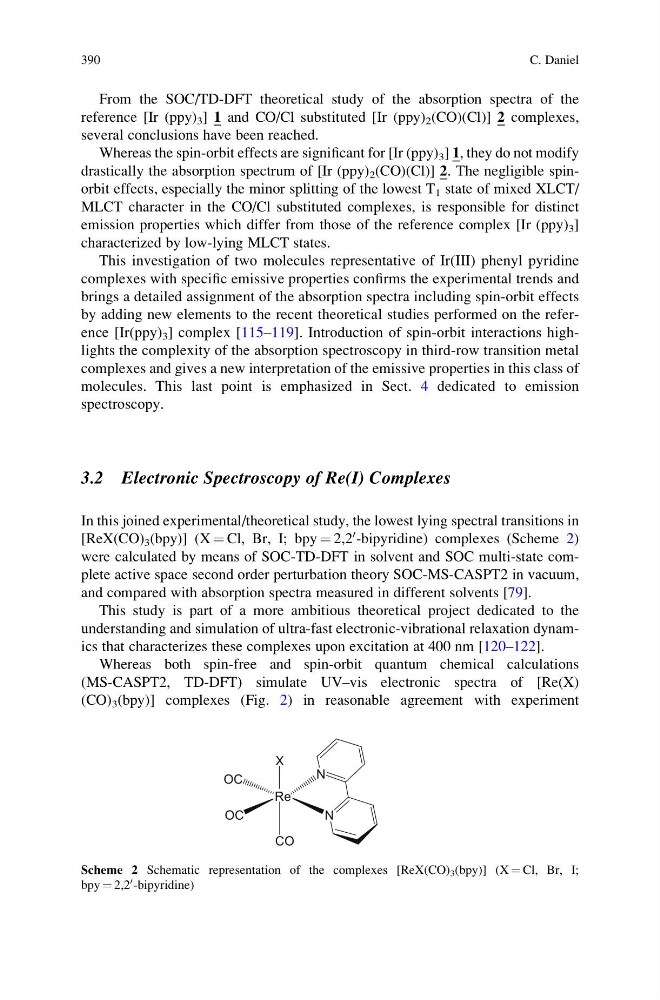
In this joined experimental/theoretical study, the lowest lying spectral transitions in
[ReX(CO) 3 (bpy)] (X ¼ Cl, Br, I; bpy ¼ 2,2
0 -bipyridine) complexes (Scheme 2)
were calculated by means of SOC-TD-DFT in solvent and SOC multi-state complete active space second order perturbation theory SOC-MS-CASPT2 in vacuum,
and compared with absorption spectra measured in different solvents [79].
This study is part of a more ambitious theoretical project dedicated to the
understanding and simulation of ultra-fast electronic-vibrational relaxation dynamics that characterizes these complexes upon excitation at 400 nm [120–122].
Whereas both spin-free and spin-orbit quantum chemical calculations
(MS-CASPT2, TD-DFT) simulate UV–vis electronic spectra of [Re(X)
(CO) 3 (bpy)] complexes (Fig. 2) in reasonable agreement with experiment
Re
OC
OC
CO
N
N
X
Scheme 2 Schematic representation of the complexes [ReX(CO) 3 (bpy)] (X ¼ Cl, Br, I;
bpy ¼ 2,2
0 -bipyridine)
390
C. Daniel
reference [Ir (ppy) 3 ] 1 and CO/Cl substituted [Ir (ppy) 2 (CO)(Cl)] 2 complexes,
several conclusions have been reached.
Whereas the spin-orbit effects are significant for [Ir (ppy) 3 ] 1, they do not modify
drastically the absorption spectrum of [Ir (ppy) 2 (CO)(Cl)] 2. The negligible spinorbit effects, especially the minor splitting of the lowest T 1 state of mixed XLCT/
MLCT character in the CO/Cl substituted complexes, is responsible for distinct
emission properties which differ from those of the reference complex [Ir (ppy) 3 ]
characterized by low-lying MLCT states.
This investigation of two molecules representative of Ir(III) phenyl pyridine
complexes with specific emissive properties confirms the experimental trends and
brings a detailed assignment of the absorption spectra including spin-orbit effects
by adding new elements to the recent theoretical studies performed on the reference [Ir(ppy) 3 ] complex [115–119]. Introduction of spin-orbit interactions highlights the complexity of the absorption spectroscopy in third-row transition metal
complexes and gives a new interpretation of the emissive properties in this class of
molecules. This last point is emphasized in Sect. 4 dedicated to emission
spectroscopy.
3.2 Electronic Spectroscopy of Re(I) Complexes
In this joined experimental/theoretical study, the lowest lying spectral transitions in
[ReX(CO) 3 (bpy)] (X ¼ Cl, Br, I; bpy ¼ 2,2
0 -bipyridine) complexes (Scheme 2)
were calculated by means of SOC-TD-DFT in solvent and SOC multi-state complete active space second order perturbation theory SOC-MS-CASPT2 in vacuum,
and compared with absorption spectra measured in different solvents [79].
This study is part of a more ambitious theoretical project dedicated to the
understanding and simulation of ultra-fast electronic-vibrational relaxation dynamics that characterizes these complexes upon excitation at 400 nm [120–122].
Whereas both spin-free and spin-orbit quantum chemical calculations
(MS-CASPT2, TD-DFT) simulate UV–vis electronic spectra of [Re(X)
(CO) 3 (bpy)] complexes (Fig. 2) in reasonable agreement with experiment
Re
OC
OC
CO
N
N
X
Scheme 2 Schematic representation of the complexes [ReX(CO) 3 (bpy)] (X ¼ Cl, Br, I;
bpy ¼ 2,2
0 -bipyridine)
390
C. Daniel