

^
H
1
ð Þ
¼ ^
V þ ^
M xc :
ð65Þ
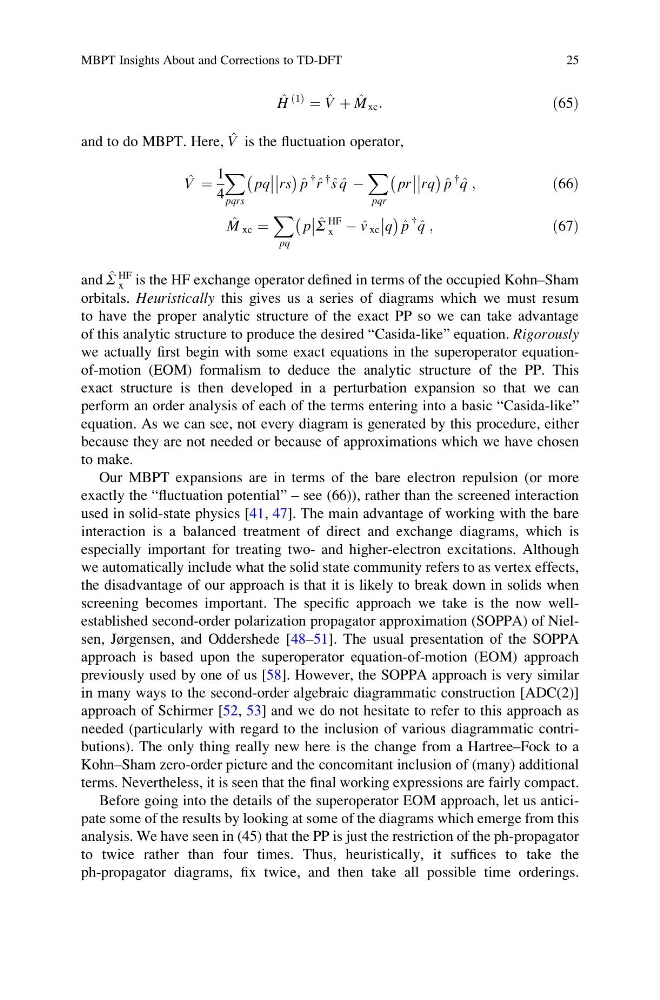
and to do MBPT. Here, ^
V is the fluctuation operator,
^
V ¼
1
4
X
pqrs
pq
rs
À
Á ^
p
{
^
r
{
^
s ^
q À
X
pqr
pr
rq
À
Á ^
p
{
^
q ;
ð66Þ
^
M xc ¼
X
pq
p
^
Σ
HF
x À ^
v xc
q
À
Á ^
p
{
^
q ;
ð67Þ
and ^
Σ
HF
x is the HF exchange operator defined in terms of the occupied Kohn–Sham
orbitals. Heuristically this gives us a series of diagrams which we must resum
to have the proper analytic structure of the exact PP so we can take advantage
of this analytic structure to produce the desired “Casida-like” equation. Rigorously
we actually first begin with some exact equations in the superoperator equationof-motion (EOM) formalism to deduce the analytic structure of the PP. This
exact structure is then developed in a perturbation expansion so that we can
perform an order analysis of each of the terms entering into a basic “Casida-like”
equation. As we can see, not every diagram is generated by this procedure, either
because they are not needed or because of approximations which we have chosen
to make.
Our MBPT expansions are in terms of the bare electron repulsion (or more
exactly the “fluctuation potential” – see (66)), rather than the screened interaction
used in solid-state physics [41, 47]. The main advantage of working with the bare
interaction is a balanced treatment of direct and exchange diagrams, which is
especially important for treating two- and higher-electron excitations. Although
we automatically include what the solid state community refers to as vertex effects,
the disadvantage of our approach is that it is likely to break down in solids when
screening becomes important. The specific approach we take is the now wellestablished second-order polarization propagator approximation (SOPPA) of Nielsen, Jørgensen, and Oddershede [48–51]. The usual presentation of the SOPPA
approach is based upon the superoperator equation-of-motion (EOM) approach
previously used by one of us [58]. However, the SOPPA approach is very similar
in many ways to the second-order algebraic diagrammatic construction [ADC(2)]
approach of Schirmer [52, 53] and we do not hesitate to refer to this approach as
needed (particularly with regard to the inclusion of various diagrammatic contributions). The only thing really new here is the change from a Hartree–Fock to a
Kohn–Sham zero-order picture and the concomitant inclusion of (many) additional
terms. Nevertheless, it is seen that the final working expressions are fairly compact.
Before going into the details of the superoperator EOM approach, let us anticipate some of the results by looking at some of the diagrams which emerge from this
analysis. We have seen in (45) that the PP is just the restriction of the ph-propagator
to twice rather than four times. Thus, heuristically, it suffices to take the
ph-propagator diagrams, fix twice, and then take all possible time orderings.
MBPT Insights About and Corrections to TD-DFT
25
H
1
ð Þ
¼ ^
V þ ^
M xc :
ð65Þ
and to do MBPT. Here, ^
V is the fluctuation operator,
^
V ¼
1
4
X
pqrs
pq
rs
À
Á ^
p
{
^
r
{
^
s ^
q À
X
pqr
pr
rq
À
Á ^
p
{
^
q ;
ð66Þ
^
M xc ¼
X
pq
p
^
Σ
HF
x À ^
v xc
q
À
Á ^
p
{
^
q ;
ð67Þ
and ^
Σ
HF
x is the HF exchange operator defined in terms of the occupied Kohn–Sham
orbitals. Heuristically this gives us a series of diagrams which we must resum
to have the proper analytic structure of the exact PP so we can take advantage
of this analytic structure to produce the desired “Casida-like” equation. Rigorously
we actually first begin with some exact equations in the superoperator equationof-motion (EOM) formalism to deduce the analytic structure of the PP. This
exact structure is then developed in a perturbation expansion so that we can
perform an order analysis of each of the terms entering into a basic “Casida-like”
equation. As we can see, not every diagram is generated by this procedure, either
because they are not needed or because of approximations which we have chosen
to make.
Our MBPT expansions are in terms of the bare electron repulsion (or more
exactly the “fluctuation potential” – see (66)), rather than the screened interaction
used in solid-state physics [41, 47]. The main advantage of working with the bare
interaction is a balanced treatment of direct and exchange diagrams, which is
especially important for treating two- and higher-electron excitations. Although
we automatically include what the solid state community refers to as vertex effects,
the disadvantage of our approach is that it is likely to break down in solids when
screening becomes important. The specific approach we take is the now wellestablished second-order polarization propagator approximation (SOPPA) of Nielsen, Jørgensen, and Oddershede [48–51]. The usual presentation of the SOPPA
approach is based upon the superoperator equation-of-motion (EOM) approach
previously used by one of us [58]. However, the SOPPA approach is very similar
in many ways to the second-order algebraic diagrammatic construction [ADC(2)]
approach of Schirmer [52, 53] and we do not hesitate to refer to this approach as
needed (particularly with regard to the inclusion of various diagrammatic contributions). The only thing really new here is the change from a Hartree–Fock to a
Kohn–Sham zero-order picture and the concomitant inclusion of (many) additional
terms. Nevertheless, it is seen that the final working expressions are fairly compact.
Before going into the details of the superoperator EOM approach, let us anticipate some of the results by looking at some of the diagrams which emerge from this
analysis. We have seen in (45) that the PP is just the restriction of the ph-propagator
to twice rather than four times. Thus, heuristically, it suffices to take the
ph-propagator diagrams, fix twice, and then take all possible time orderings.
MBPT Insights About and Corrections to TD-DFT
25