

excitations whereas solid-state physics emphasizes use of a screened interaction.
Although no rigorous way is yet known for combining screening and antisymmetrization, an interesting pragmatic suggestion may be found in [57].
3.4 Superoperator Equation-of-Motion (EOM) Polarization
Propagator (PP) Approach
We now concentrate on the PP and show how to obtain a “Casida-like” equation for
excitation energies and transition moments. This does not as yet give us correction
terms to AA LR-TD-DFT but it does give us some important tools to help us build
correction terms. The basic idea in this section is to take the exact or approximate
Kohn–Sham system of independent electrons as the zero-order picture,
^
H
0
ð Þ
¼ ^ h KS ;
ð64Þ
to add the perturbation,
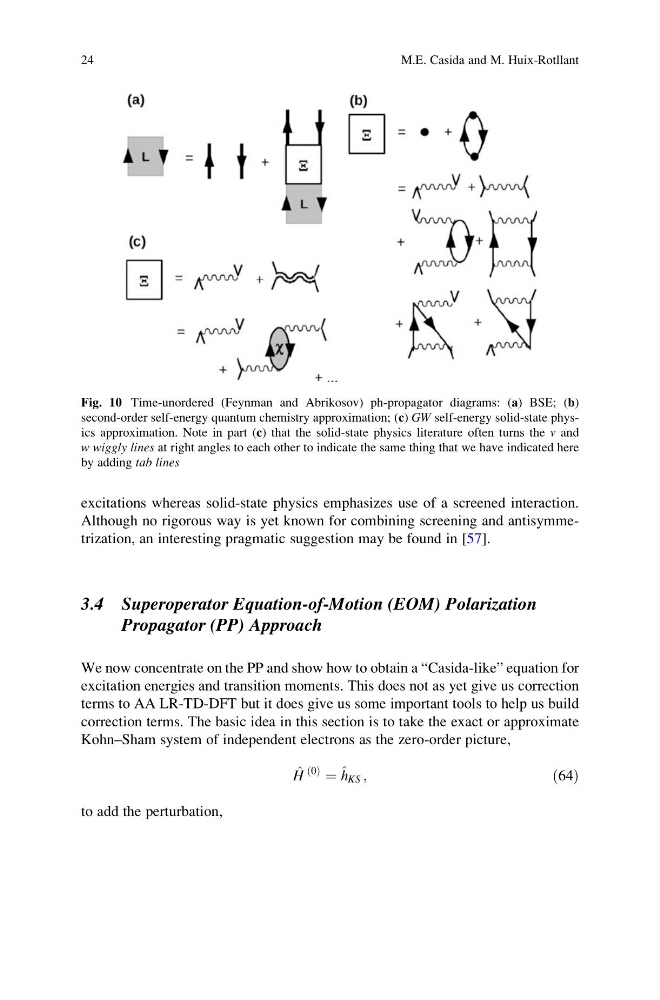
Fig. 10 Time-unordered (Feynman and Abrikosov) ph-propagator diagrams: (a) BSE; (b)
second-order self-energy quantum chemistry approximation; (c) GW self-energy solid-state physics approximation. Note in part (c) that the solid-state physics literature often turns the v and
w wiggly lines at right angles to each other to indicate the same thing that we have indicated here
by adding tab lines
24
M.E. Casida and M. Huix-Rotllant
Although no rigorous way is yet known for combining screening and antisymmetrization, an interesting pragmatic suggestion may be found in [57].
3.4 Superoperator Equation-of-Motion (EOM) Polarization
Propagator (PP) Approach
We now concentrate on the PP and show how to obtain a “Casida-like” equation for
excitation energies and transition moments. This does not as yet give us correction
terms to AA LR-TD-DFT but it does give us some important tools to help us build
correction terms. The basic idea in this section is to take the exact or approximate
Kohn–Sham system of independent electrons as the zero-order picture,
^
H
0
ð Þ
¼ ^ h KS ;
ð64Þ
to add the perturbation,
Fig. 10 Time-unordered (Feynman and Abrikosov) ph-propagator diagrams: (a) BSE; (b)
second-order self-energy quantum chemistry approximation; (c) GW self-energy solid-state physics approximation. Note in part (c) that the solid-state physics literature often turns the v and
w wiggly lines at right angles to each other to indicate the same thing that we have indicated here
by adding tab lines
24
M.E. Casida and M. Huix-Rotllant