

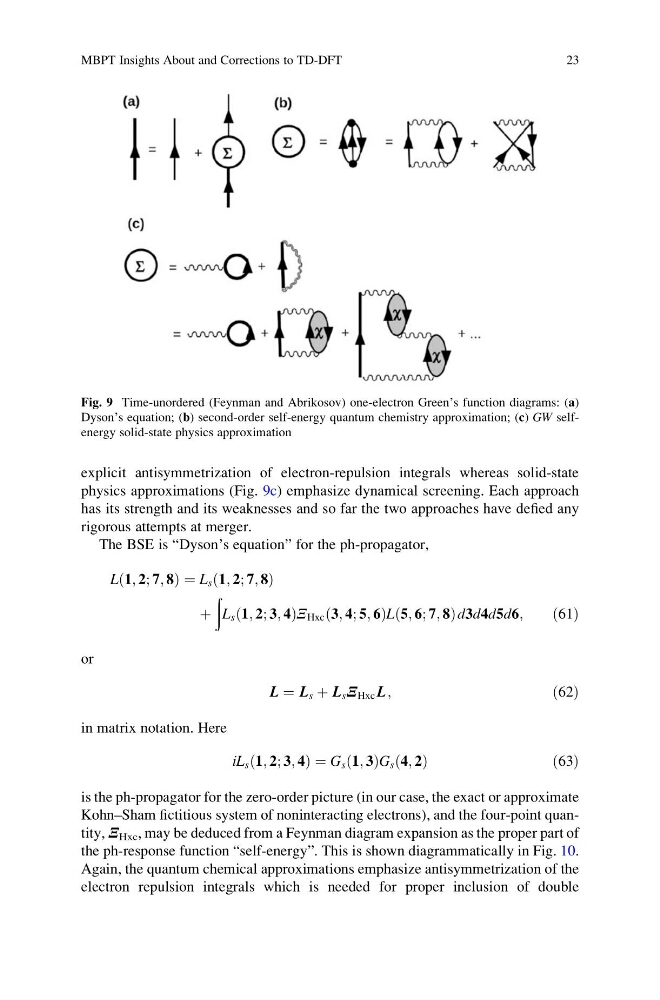
explicit antisymmetrization of electron-repulsion integrals whereas solid-state
physics approximations (Fig. 9c) emphasize dynamical screening. Each approach
has its strength and its weaknesses and so far the two approaches have defied any
rigorous attempts at merger.
The BSE is “Dyson’s equation” for the ph-propagator,
L 1; 2; 7; 8
ð
Þ¼L s 1; 2; 7; 8
ð
Þ
þ
ð
L s 1; 2; 3; 4
ð
Þ Ξ Hxc 3; 4; 5; 6
ð
Þ L 5; 6; 7; 8
ð
Þd3d4d5d6;
ð61Þ
or
L ¼ L s þ L s Ξ Hxc L ;
ð62Þ
in matrix notation. Here
iL s 1; 2; 3; 4
ð
Þ¼G s 1; 3
ð ÞG s 4; 2
ð Þ
ð63Þ
is the ph-propagator for the zero-order picture (in our case, the exact or approximate
Kohn–Sham fictitious system of noninteracting electrons), and the four-point quantity, Ξ Hxc , may be deduced from a Feynman diagram expansion as the proper part of
the ph-response function “self-energy”. This is shown diagrammatically in Fig. 10.
Again, the quantum chemical approximations emphasize antisymmetrization of the
electron repulsion integrals which is needed for proper inclusion of double
Fig. 9 Time-unordered (Feynman and Abrikosov) one-electron Green’s function diagrams: (a)
Dyson’s equation; (b) second-order self-energy quantum chemistry approximation; (c) GW selfenergy solid-state physics approximation
MBPT Insights About and Corrections to TD-DFT
23
physics approximations (Fig. 9c) emphasize dynamical screening. Each approach
has its strength and its weaknesses and so far the two approaches have defied any
rigorous attempts at merger.
The BSE is “Dyson’s equation” for the ph-propagator,
L 1; 2; 7; 8
ð
Þ¼L s 1; 2; 7; 8
ð
Þ
þ
ð
L s 1; 2; 3; 4
ð
Þ Ξ Hxc 3; 4; 5; 6
ð
Þ L 5; 6; 7; 8
ð
Þd3d4d5d6;
ð61Þ
or
L ¼ L s þ L s Ξ Hxc L ;
ð62Þ
in matrix notation. Here
iL s 1; 2; 3; 4
ð
Þ¼G s 1; 3
ð ÞG s 4; 2
ð Þ
ð63Þ
is the ph-propagator for the zero-order picture (in our case, the exact or approximate
Kohn–Sham fictitious system of noninteracting electrons), and the four-point quantity, Ξ Hxc , may be deduced from a Feynman diagram expansion as the proper part of
the ph-response function “self-energy”. This is shown diagrammatically in Fig. 10.
Again, the quantum chemical approximations emphasize antisymmetrization of the
electron repulsion integrals which is needed for proper inclusion of double
Fig. 9 Time-unordered (Feynman and Abrikosov) one-electron Green’s function diagrams: (a)
Dyson’s equation; (b) second-order self-energy quantum chemistry approximation; (c) GW selfenergy solid-state physics approximation
MBPT Insights About and Corrections to TD-DFT
23