

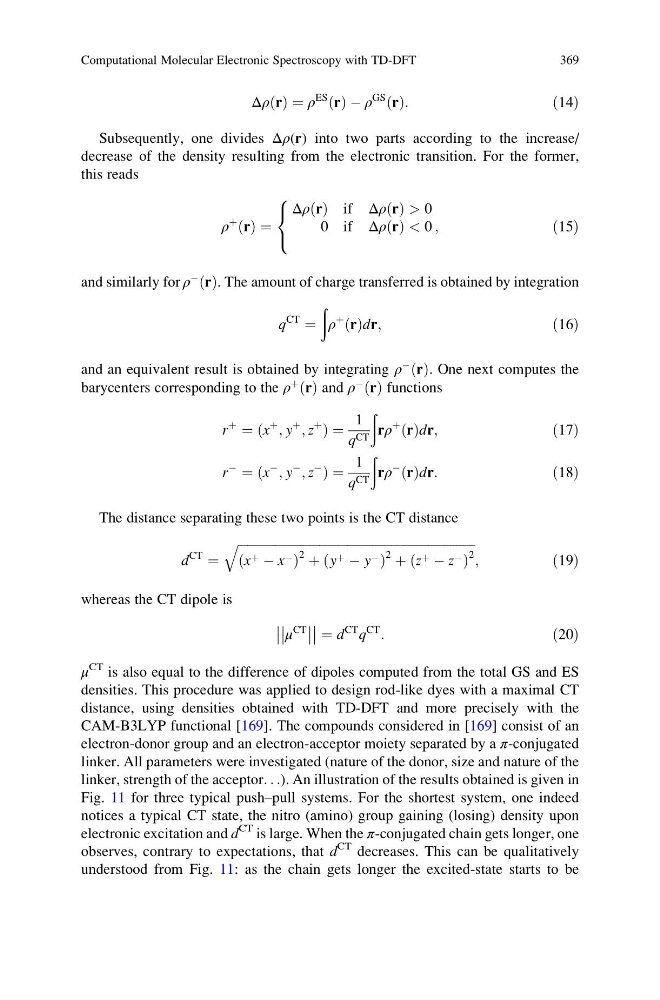
Δρ r
ð Þ ¼ ρ
ES r
ð Þ À ρ
GS r
ð Þ:
ð14Þ
Subsequently, one divides Δρ(r) into two parts according to the increase/
decrease of the density resulting from the electronic transition. For the former,
this reads
ρ
þ r
ð Þ ¼
Δρ r
ð Þ if Δρ r
ð Þ > 0
0 if Δρ r
ð Þ < 0
8
<
:
;
ð15Þ
and similarly for ρ
À r
ð Þ. The amount of charge transferred is obtained by integration
q
CT
¼
ð
ρ
þ r
ð Þdr;
ð16Þ
and an equivalent result is obtained by integrating ρ
À r
ð Þ. One next computes the
barycenters corresponding to the ρ
þ r
ð Þ and ρ
À r
ð Þ functions
r
þ
¼ x
þ
; y
þ
; z
þ
ð
Þ¼
1
q CT
ð
rρ
þ r
ð Þdr;
ð17Þ
r
À
¼ x
À
; y
À
; z
À
ð
Þ¼
1
q CT
ð
rρ
À r
ð Þdr:
ð18Þ
The distance separating these two points is the CT distance
d
CT
¼
ffiffiffiffiffiffiffiffiffiffiffiffiffiffiffiffiffiffiffiffiffiffiffiffiffiffiffiffiffiffiffiffiffiffiffiffiffiffiffiffiffiffiffiffiffiffiffiffiffiffiffiffiffiffiffiffiffiffiffiffiffiffiffiffiffiffiffiffiffiffiffiffiffiffiffiffi
x þ À x À
ð
Þ
2 þ y þ À y À
ð
Þ
2 þ z þ À z À
ð
Þ
2
q
;
ð19Þ
whereas the CT dipole is
μ
CT
¼ d
CT q
CT
:
ð20Þ
μ
CT is also equal to the difference of dipoles computed from the total GS and ES
densities. This procedure was applied to design rod-like dyes with a maximal CT
distance, using densities obtained with TD-DFT and more precisely with the
CAM-B3LYP functional [169]. The compounds considered in [169] consist of an
electron-donor group and an electron-acceptor moiety separated by a π-conjugated
linker. All parameters were investigated (nature of the donor, size and nature of the
linker, strength of the acceptor. . .). An illustration of the results obtained is given in
Fig. 11 for three typical push–pull systems. For the shortest system, one indeed
notices a typical CT state, the nitro (amino) group gaining (losing) density upon
electronic excitation and d
CT is large. When the π-conjugated chain gets longer, one
observes, contrary to expectations, that d
CT decreases. This can be qualitatively
understood from Fig. 11: as the chain gets longer the excited-state starts to be
Computational Molecular Electronic Spectroscopy with TD-DFT
369
ð Þ ¼ ρ
ES r
ð Þ À ρ
GS r
ð Þ:
ð14Þ
Subsequently, one divides Δρ(r) into two parts according to the increase/
decrease of the density resulting from the electronic transition. For the former,
this reads
ρ
þ r
ð Þ ¼
Δρ r
ð Þ if Δρ r
ð Þ > 0
0 if Δρ r
ð Þ < 0
8
<
:
;
ð15Þ
and similarly for ρ
À r
ð Þ. The amount of charge transferred is obtained by integration
q
CT
¼
ð
ρ
þ r
ð Þdr;
ð16Þ
and an equivalent result is obtained by integrating ρ
À r
ð Þ. One next computes the
barycenters corresponding to the ρ
þ r
ð Þ and ρ
À r
ð Þ functions
r
þ
¼ x
þ
; y
þ
; z
þ
ð
Þ¼
1
q CT
ð
rρ
þ r
ð Þdr;
ð17Þ
r
À
¼ x
À
; y
À
; z
À
ð
Þ¼
1
q CT
ð
rρ
À r
ð Þdr:
ð18Þ
The distance separating these two points is the CT distance
d
CT
¼
ffiffiffiffiffiffiffiffiffiffiffiffiffiffiffiffiffiffiffiffiffiffiffiffiffiffiffiffiffiffiffiffiffiffiffiffiffiffiffiffiffiffiffiffiffiffiffiffiffiffiffiffiffiffiffiffiffiffiffiffiffiffiffiffiffiffiffiffiffiffiffiffiffiffiffiffi
x þ À x À
ð
Þ
2 þ y þ À y À
ð
Þ
2 þ z þ À z À
ð
Þ
2
q
;
ð19Þ
whereas the CT dipole is
μ
CT
¼ d
CT q
CT
:
ð20Þ
μ
CT is also equal to the difference of dipoles computed from the total GS and ES
densities. This procedure was applied to design rod-like dyes with a maximal CT
distance, using densities obtained with TD-DFT and more precisely with the
CAM-B3LYP functional [169]. The compounds considered in [169] consist of an
electron-donor group and an electron-acceptor moiety separated by a π-conjugated
linker. All parameters were investigated (nature of the donor, size and nature of the
linker, strength of the acceptor. . .). An illustration of the results obtained is given in
Fig. 11 for three typical push–pull systems. For the shortest system, one indeed
notices a typical CT state, the nitro (amino) group gaining (losing) density upon
electronic excitation and d
CT is large. When the π-conjugated chain gets longer, one
observes, contrary to expectations, that d
CT decreases. This can be qualitatively
understood from Fig. 11: as the chain gets longer the excited-state starts to be
Computational Molecular Electronic Spectroscopy with TD-DFT
369