

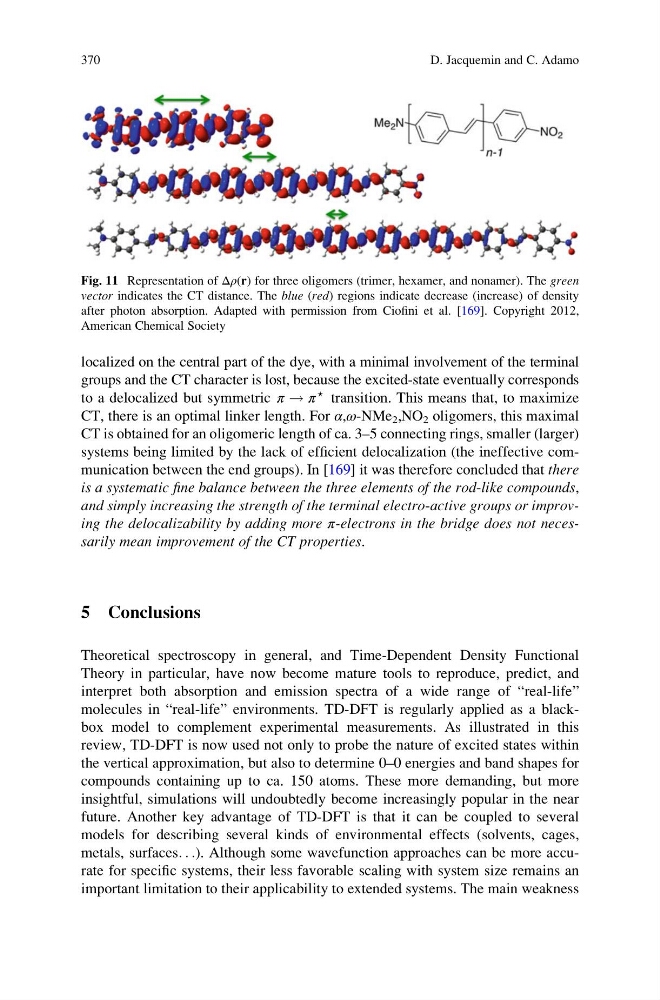
localized on the central part of the dye, with a minimal involvement of the terminal
groups and the CT character is lost, because the excited-state eventually corresponds
to a delocalized but symmetric π ! π
⋆ transition. This means that, to maximize
CT, there is an optimal linker length. For α,ω-NMe 2 ,NO 2 oligomers, this maximal
CT is obtained for an oligomeric length of ca. 3–5 connecting rings, smaller (larger)
systems being limited by the lack of efficient delocalization (the ineffective communication between the end groups). In [169] it was therefore concluded that there
is a systematic fine balance between the three elements of the rod-like compounds,
and simply increasing the strength of the terminal electro-active groups or improving the delocalizability by adding more π-electrons in the bridge does not necessarily mean improvement of the CT properties.
5 Conclusions
Theoretical spectroscopy in general, and Time-Dependent Density Functional
Theory in particular, have now become mature tools to reproduce, predict, and
interpret both absorption and emission spectra of a wide range of “real-life”
molecules in “real-life” environments. TD-DFT is regularly applied as a blackbox model to complement experimental measurements. As illustrated in this
review, TD-DFT is now used not only to probe the nature of excited states within
the vertical approximation, but also to determine 0–0 energies and band shapes for
compounds containing up to ca. 150 atoms. These more demanding, but more
insightful, simulations will undoubtedly become increasingly popular in the near
future. Another key advantage of TD-DFT is that it can be coupled to several
models for describing several kinds of environmental effects (solvents, cages,
metals, surfaces. . .). Although some wavefunction approaches can be more accurate for specific systems, their less favorable scaling with system size remains an
important limitation to their applicability to extended systems. The main weakness
Fig. 11 Representation of Δρ(r) for three oligomers (trimer, hexamer, and nonamer). The green
vector indicates the CT distance. The blue (red) regions indicate decrease (increase) of density
after photon absorption. Adapted with permission from Ciofini et al. [169]. Copyright 2012,
American Chemical Society
370
D. Jacquemin and C. Adamo
groups and the CT character is lost, because the excited-state eventually corresponds
to a delocalized but symmetric π ! π
⋆ transition. This means that, to maximize
CT, there is an optimal linker length. For α,ω-NMe 2 ,NO 2 oligomers, this maximal
CT is obtained for an oligomeric length of ca. 3–5 connecting rings, smaller (larger)
systems being limited by the lack of efficient delocalization (the ineffective communication between the end groups). In [169] it was therefore concluded that there
is a systematic fine balance between the three elements of the rod-like compounds,
and simply increasing the strength of the terminal electro-active groups or improving the delocalizability by adding more π-electrons in the bridge does not necessarily mean improvement of the CT properties.
5 Conclusions
Theoretical spectroscopy in general, and Time-Dependent Density Functional
Theory in particular, have now become mature tools to reproduce, predict, and
interpret both absorption and emission spectra of a wide range of “real-life”
molecules in “real-life” environments. TD-DFT is regularly applied as a blackbox model to complement experimental measurements. As illustrated in this
review, TD-DFT is now used not only to probe the nature of excited states within
the vertical approximation, but also to determine 0–0 energies and band shapes for
compounds containing up to ca. 150 atoms. These more demanding, but more
insightful, simulations will undoubtedly become increasingly popular in the near
future. Another key advantage of TD-DFT is that it can be coupled to several
models for describing several kinds of environmental effects (solvents, cages,
metals, surfaces. . .). Although some wavefunction approaches can be more accurate for specific systems, their less favorable scaling with system size remains an
important limitation to their applicability to extended systems. The main weakness
Fig. 11 Representation of Δρ(r) for three oligomers (trimer, hexamer, and nonamer). The green
vector indicates the CT distance. The blue (red) regions indicate decrease (increase) of density
after photon absorption. Adapted with permission from Ciofini et al. [169]. Copyright 2012,
American Chemical Society
370
D. Jacquemin and C. Adamo