

polarizable continuum model inspired from PCM. This second scheme, denoted
Electronic Response of the Surroundings, yields, for a negligible computational
cost, a shift of À0.09 eV, in good agreement with both experiment and full TD-DFT
calculation.
4.6 Charge-Transfer Optimization
Photoinduced charge-transfer excited states play a key role in several applications,
notably in dye sensitized solar cells (DSSC) [159–163]. In DSSC, the absorption of
light by a dye anchored on a semi-conducting surface, typically a metallic oxide,
induces a CT on the dye which eventually leads to charge separation, the electron
(or the hole) being injected into the semi-conductor. Charge transfer is therefore the
key step initiating the light-to-electricity conversion process [164]. To quantify CT,
several schemes have been proposed [56, 165–168] and we present here the d
CT
index [165, 166]. This approach uses the ground- and excited-states electronic
densities (ρ
GS and ρ
ES ) to provide a CT distance (d
CT ), the amount of charge
transferred (q
CT ), and CT dipole (μ
CT ). First one computes the difference of
densities between the excited and ground states:
O
O
N
N
N
NH
HN
O
O
N
NH
HN
O
O
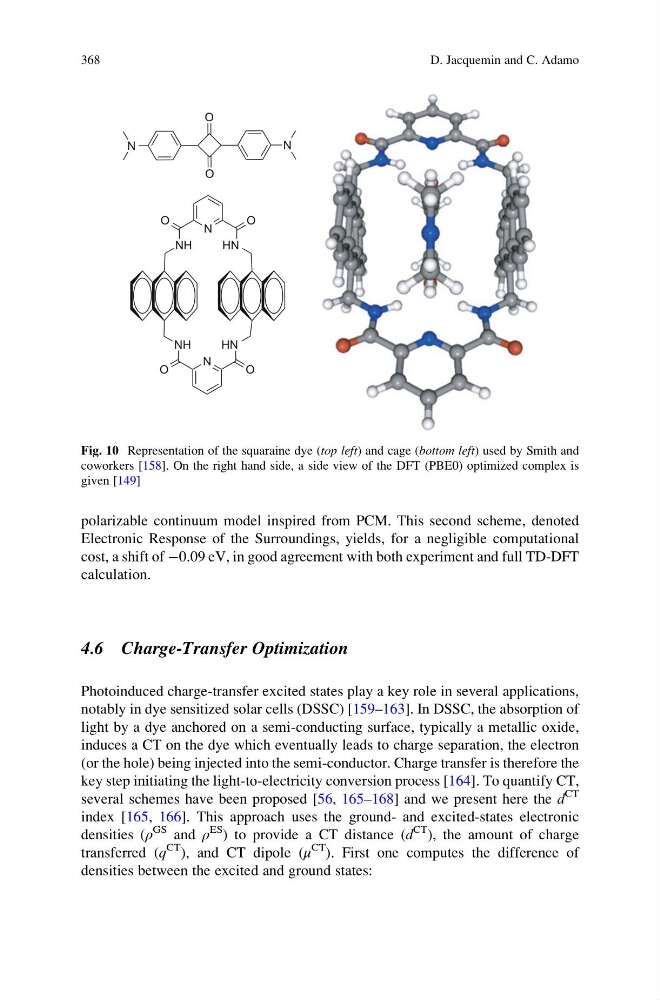
Fig. 10 Representation of the squaraine dye (top left) and cage (bottom left) used by Smith and
coworkers [158]. On the right hand side, a side view of the DFT (PBE0) optimized complex is
given [149]
368
D. Jacquemin and C. Adamo
Electronic Response of the Surroundings, yields, for a negligible computational
cost, a shift of À0.09 eV, in good agreement with both experiment and full TD-DFT
calculation.
4.6 Charge-Transfer Optimization
Photoinduced charge-transfer excited states play a key role in several applications,
notably in dye sensitized solar cells (DSSC) [159–163]. In DSSC, the absorption of
light by a dye anchored on a semi-conducting surface, typically a metallic oxide,
induces a CT on the dye which eventually leads to charge separation, the electron
(or the hole) being injected into the semi-conductor. Charge transfer is therefore the
key step initiating the light-to-electricity conversion process [164]. To quantify CT,
several schemes have been proposed [56, 165–168] and we present here the d
CT
index [165, 166]. This approach uses the ground- and excited-states electronic
densities (ρ
GS and ρ
ES ) to provide a CT distance (d
CT ), the amount of charge
transferred (q
CT ), and CT dipole (μ
CT ). First one computes the difference of
densities between the excited and ground states:
O
O
N
N
N
NH
HN
O
O
N
NH
HN
O
O
Fig. 10 Representation of the squaraine dye (top left) and cage (bottom left) used by Smith and
coworkers [158]. On the right hand side, a side view of the DFT (PBE0) optimized complex is
given [149]
368
D. Jacquemin and C. Adamo