

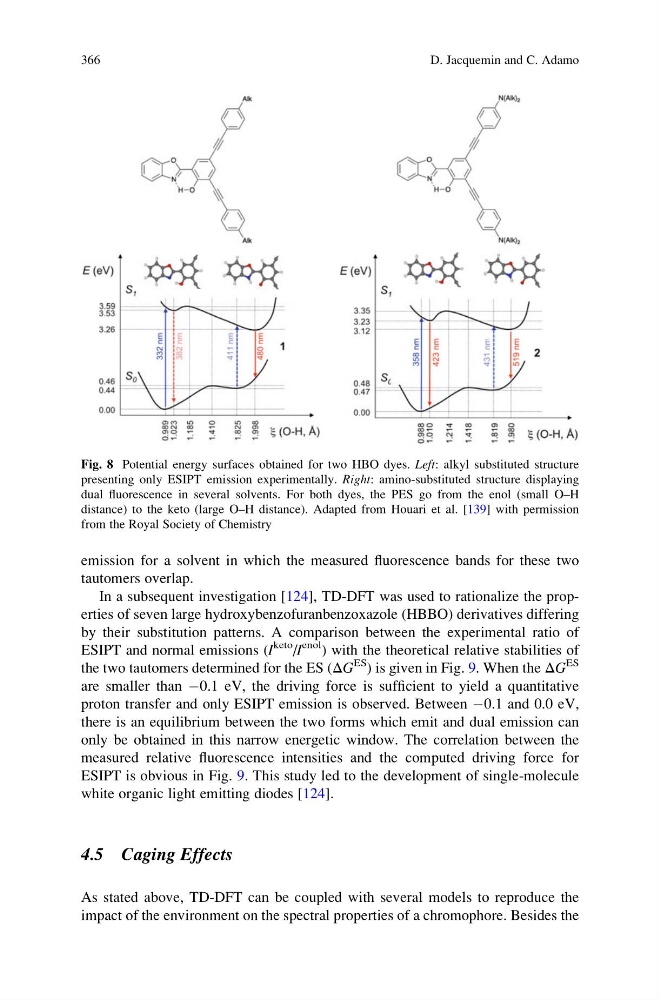
emission for a solvent in which the measured fluorescence bands for these two
tautomers overlap.
In a subsequent investigation [124], TD-DFT was used to rationalize the properties of seven large hydroxybenzofuranbenzoxazole (HBBO) derivatives differing
by their substitution patterns. A comparison between the experimental ratio of
ESIPT and normal emissions (I
keto /I
enol ) with the theoretical relative stabilities of
the two tautomers determined for the ES (ΔG
ES
) is given in Fig. 9. When the ΔG
ES
are smaller than À0.1 eV, the driving force is sufficient to yield a quantitative
proton transfer and only ESIPT emission is observed. Between À0.1 and 0.0 eV,
there is an equilibrium between the two forms which emit and dual emission can
only be obtained in this narrow energetic window. The correlation between the
measured relative fluorescence intensities and the computed driving force for
ESIPT is obvious in Fig. 9. This study led to the development of single-molecule
white organic light emitting diodes [124].
4.5 Caging Effects
As stated above, TD-DFT can be coupled with several models to reproduce the
impact of the environment on the spectral properties of a chromophore. Besides the
Fig. 8 Potential energy surfaces obtained for two HBO dyes. Left: alkyl substituted structure
presenting only ESIPT emission experimentally. Right: amino-substituted structure displaying
dual fluorescence in several solvents. For both dyes, the PES go from the enol (small O–H
distance) to the keto (large O–H distance). Adapted from Houari et al. [139] with permission
from the Royal Society of Chemistry
366
D. Jacquemin and C. Adamo
tautomers overlap.
In a subsequent investigation [124], TD-DFT was used to rationalize the properties of seven large hydroxybenzofuranbenzoxazole (HBBO) derivatives differing
by their substitution patterns. A comparison between the experimental ratio of
ESIPT and normal emissions (I
keto /I
enol ) with the theoretical relative stabilities of
the two tautomers determined for the ES (ΔG
ES
) is given in Fig. 9. When the ΔG
ES
are smaller than À0.1 eV, the driving force is sufficient to yield a quantitative
proton transfer and only ESIPT emission is observed. Between À0.1 and 0.0 eV,
there is an equilibrium between the two forms which emit and dual emission can
only be obtained in this narrow energetic window. The correlation between the
measured relative fluorescence intensities and the computed driving force for
ESIPT is obvious in Fig. 9. This study led to the development of single-molecule
white organic light emitting diodes [124].
4.5 Caging Effects
As stated above, TD-DFT can be coupled with several models to reproduce the
impact of the environment on the spectral properties of a chromophore. Besides the
Fig. 8 Potential energy surfaces obtained for two HBO dyes. Left: alkyl substituted structure
presenting only ESIPT emission experimentally. Right: amino-substituted structure displaying
dual fluorescence in several solvents. For both dyes, the PES go from the enol (small O–H
distance) to the keto (large O–H distance). Adapted from Houari et al. [139] with permission
from the Royal Society of Chemistry
366
D. Jacquemin and C. Adamo