

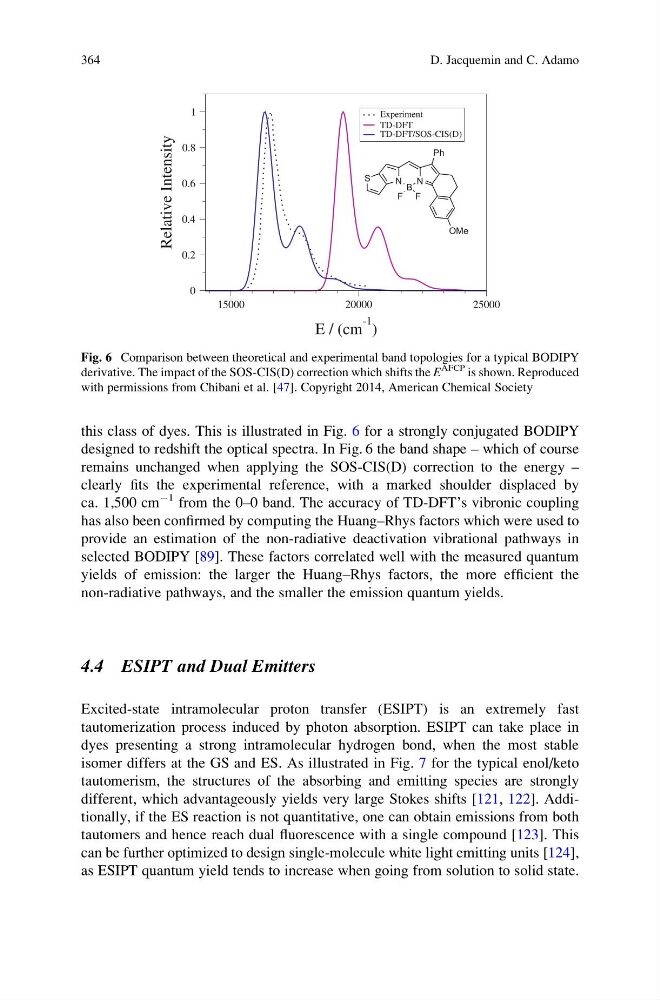
this class of dyes. This is illustrated in Fig. 6 for a strongly conjugated BODIPY
designed to redshift the optical spectra. In Fig. 6 the band shape – which of course
remains unchanged when applying the SOS-CIS(D) correction to the energy –
clearly fits the experimental reference, with a marked shoulder displaced by
ca. 1,500 cm
À1 from the 0–0 band. The accuracy of TD-DFT’s vibronic coupling
has also been confirmed by computing the Huang–Rhys factors which were used to
provide an estimation of the non-radiative deactivation vibrational pathways in
selected BODIPY [89]. These factors correlated well with the measured quantum
yields of emission: the larger the Huang–Rhys factors, the more efficient the
non-radiative pathways, and the smaller the emission quantum yields.
4.4 ESIPT and Dual Emitters
Excited-state intramolecular proton transfer (ESIPT) is an extremely fast
tautomerization process induced by photon absorption. ESIPT can take place in
dyes presenting a strong intramolecular hydrogen bond, when the most stable
isomer differs at the GS and ES. As illustrated in Fig. 7 for the typical enol/keto
tautomerism, the structures of the absorbing and emitting species are strongly
different, which advantageously yields very large Stokes shifts [121, 122]. Additionally, if the ES reaction is not quantitative, one can obtain emissions from both
tautomers and hence reach dual fluorescence with a single compound [123]. This
can be further optimized to design single-molecule white light emitting units [124],
as ESIPT quantum yield tends to increase when going from solution to solid state.
Fig. 6 Comparison between theoretical and experimental band topologies for a typical BODIPY
derivative. The impact of the SOS-CIS(D) correction which shifts the E
AFCP is shown. Reproduced
with permissions from Chibani et al. [47]. Copyright 2014, American Chemical Society
364
D. Jacquemin and C. Adamo
designed to redshift the optical spectra. In Fig. 6 the band shape – which of course
remains unchanged when applying the SOS-CIS(D) correction to the energy –
clearly fits the experimental reference, with a marked shoulder displaced by
ca. 1,500 cm
À1 from the 0–0 band. The accuracy of TD-DFT’s vibronic coupling
has also been confirmed by computing the Huang–Rhys factors which were used to
provide an estimation of the non-radiative deactivation vibrational pathways in
selected BODIPY [89]. These factors correlated well with the measured quantum
yields of emission: the larger the Huang–Rhys factors, the more efficient the
non-radiative pathways, and the smaller the emission quantum yields.
4.4 ESIPT and Dual Emitters
Excited-state intramolecular proton transfer (ESIPT) is an extremely fast
tautomerization process induced by photon absorption. ESIPT can take place in
dyes presenting a strong intramolecular hydrogen bond, when the most stable
isomer differs at the GS and ES. As illustrated in Fig. 7 for the typical enol/keto
tautomerism, the structures of the absorbing and emitting species are strongly
different, which advantageously yields very large Stokes shifts [121, 122]. Additionally, if the ES reaction is not quantitative, one can obtain emissions from both
tautomers and hence reach dual fluorescence with a single compound [123]. This
can be further optimized to design single-molecule white light emitting units [124],
as ESIPT quantum yield tends to increase when going from solution to solid state.
Fig. 6 Comparison between theoretical and experimental band topologies for a typical BODIPY
derivative. The impact of the SOS-CIS(D) correction which shifts the E
AFCP is shown. Reproduced
with permissions from Chibani et al. [47]. Copyright 2014, American Chemical Society
364
D. Jacquemin and C. Adamo