

4.3 Fluoroborate Derivatives
BODIPY and other similar derivatives relying on a fluoroborate group to ensure the
chemical stability of the dyes constitute one of the most important classes of
organic emitters [116–118]. Indeed, they present sharp fluorescence emission
bands and large quantum yields. A large panel of chemical groups can be added
around the central chromogens so as to modify the absorption and emission
energies. These fluorophores present ES of cyanine nature, which is known to be
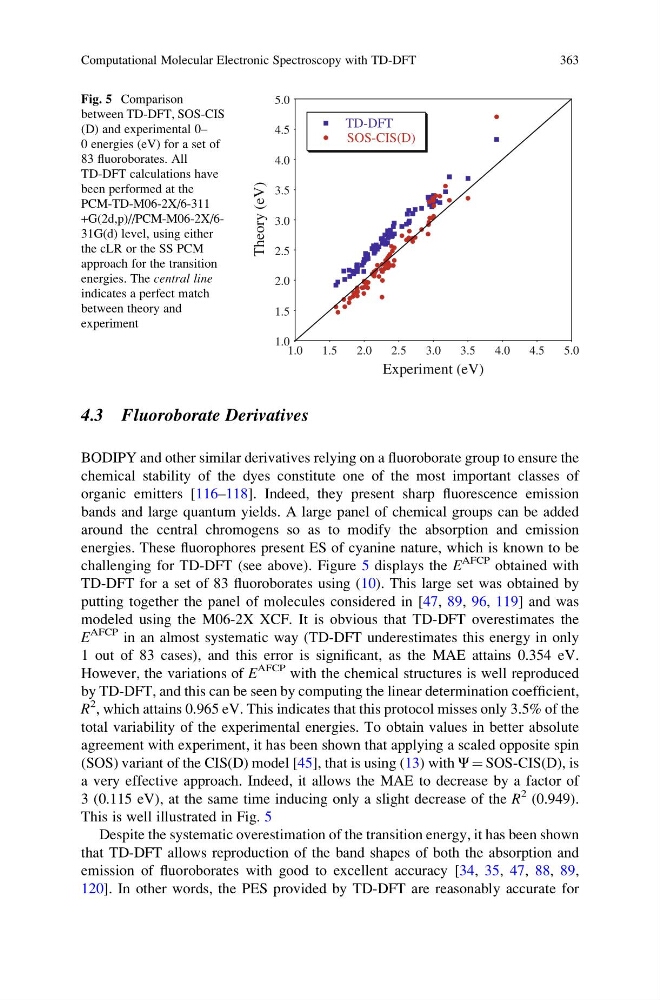
challenging for TD-DFT (see above). Figure 5 displays the E
AFCP obtained with
TD-DFT for a set of 83 fluoroborates using (10). This large set was obtained by
putting together the panel of molecules considered in [47, 89, 96, 119] and was
modeled using the M06-2X XCF. It is obvious that TD-DFT overestimates the
E
AFCP in an almost systematic way (TD-DFT underestimates this energy in only
1 out of 83 cases), and this error is significant, as the MAE attains 0.354 eV.
However, the variations of E
AFCP with the chemical structures is well reproduced
by TD-DFT, and this can be seen by computing the linear determination coefficient,
R
2 , which attains 0.965 eV. This indicates that this protocol misses only 3.5% of the
total variability of the experimental energies. To obtain values in better absolute
agreement with experiment, it has been shown that applying a scaled opposite spin
(SOS) variant of the CIS(D) model [45], that is using (13) with Ψ ¼ SOS-CIS(D), is
a very effective approach. Indeed, it allows the MAE to decrease by a factor of
3 (0.115 eV), at the same time inducing only a slight decrease of the R
2 (0.949).
This is well illustrated in Fig. 5
Despite the systematic overestimation of the transition energy, it has been shown
that TD-DFT allows reproduction of the band shapes of both the absorption and
emission of fluoroborates with good to excellent accuracy [34, 35, 47, 88, 89,
120]. In other words, the PES provided by TD-DFT are reasonably accurate for
1.0
1.5
2.0
2.5
3.0
3.5
4.0
4.5
5.0
1.0
1.5
2.0
2.5
3.0
3.5
4.0
4.5
5.0
TD-DFT
SOS-CIS(D)
Theory (eV)
Experiment (eV)
Fig. 5 Comparison
between TD-DFT, SOS-CIS
(D) and experimental 0–
0 energies (eV) for a set of
83 fluoroborates. All
TD-DFT calculations have
been performed at the
PCM-TD-M06-2X/6-311
+G(2d,p)//PCM-M06-2X/631G(d) level, using either
the cLR or the SS PCM
approach for the transition
energies. The central line
indicates a perfect match
between theory and
experiment
Computational Molecular Electronic Spectroscopy with TD-DFT
363
BODIPY and other similar derivatives relying on a fluoroborate group to ensure the
chemical stability of the dyes constitute one of the most important classes of
organic emitters [116–118]. Indeed, they present sharp fluorescence emission
bands and large quantum yields. A large panel of chemical groups can be added
around the central chromogens so as to modify the absorption and emission
energies. These fluorophores present ES of cyanine nature, which is known to be
challenging for TD-DFT (see above). Figure 5 displays the E
AFCP obtained with
TD-DFT for a set of 83 fluoroborates using (10). This large set was obtained by
putting together the panel of molecules considered in [47, 89, 96, 119] and was
modeled using the M06-2X XCF. It is obvious that TD-DFT overestimates the
E
AFCP in an almost systematic way (TD-DFT underestimates this energy in only
1 out of 83 cases), and this error is significant, as the MAE attains 0.354 eV.
However, the variations of E
AFCP with the chemical structures is well reproduced
by TD-DFT, and this can be seen by computing the linear determination coefficient,
R
2 , which attains 0.965 eV. This indicates that this protocol misses only 3.5% of the
total variability of the experimental energies. To obtain values in better absolute
agreement with experiment, it has been shown that applying a scaled opposite spin
(SOS) variant of the CIS(D) model [45], that is using (13) with Ψ ¼ SOS-CIS(D), is
a very effective approach. Indeed, it allows the MAE to decrease by a factor of
3 (0.115 eV), at the same time inducing only a slight decrease of the R
2 (0.949).
This is well illustrated in Fig. 5
Despite the systematic overestimation of the transition energy, it has been shown
that TD-DFT allows reproduction of the band shapes of both the absorption and
emission of fluoroborates with good to excellent accuracy [34, 35, 47, 88, 89,
120]. In other words, the PES provided by TD-DFT are reasonably accurate for
1.0
1.5
2.0
2.5
3.0
3.5
4.0
4.5
5.0
1.0
1.5
2.0
2.5
3.0
3.5
4.0
4.5
5.0
TD-DFT
SOS-CIS(D)
Theory (eV)
Experiment (eV)
Fig. 5 Comparison
between TD-DFT, SOS-CIS
(D) and experimental 0–
0 energies (eV) for a set of
83 fluoroborates. All
TD-DFT calculations have
been performed at the
PCM-TD-M06-2X/6-311
+G(2d,p)//PCM-M06-2X/631G(d) level, using either
the cLR or the SS PCM
approach for the transition
energies. The central line
indicates a perfect match
between theory and
experiment
Computational Molecular Electronic Spectroscopy with TD-DFT
363