

approaches, demonstrated that TD-DFT generally provides accurate ΔE
ZPVE
[17]. To reach the 0–0 energies, one adds the two previous terms:
E
0À0
¼ E
adia
þ ΔE
ZPVE
:
ð6Þ
We note that ΔE
ZPVE is almost systematically negative, as the PES of the ES tends
to be flatter than its GS counterpart and, consequently, E
0À0 is generally smaller
than E
adia . As stated above, E
0À0 can be directly compared to the absorptionfluorescence crossing point for solvated molecules, and it subsequently offers a
much more solid basis for theory–experiment comparisons than E
vertÀa
, which often
has no straightforward experimental counterpart.
2.2 Condensed Phase
When considering an environment surrounding the molecule of interest (the compound undergoing the electronic transition), it is crucial to determine how the
medium reacts to the change of electronic state of the photo-active compound.
Irrespective of the nature of the environment, one distinguishes the equilibrium
(eq) and non-equilibrium (neq) regimes [26]. In the former, a full (electrons and
nuclei) medium relaxation takes place, and such a regime is adapted to determine
“slow properties”, e.g., both R
ES and E
ZPVE (R
ES
). Essentially, it implies that the
dye-environment interactions can be accounted for in a similar way as in the GS. In
the latter neq limit, only the electronic cloud of the medium can adapt to the new
electronic configuration of the chromophore, and this scheme is useful to model
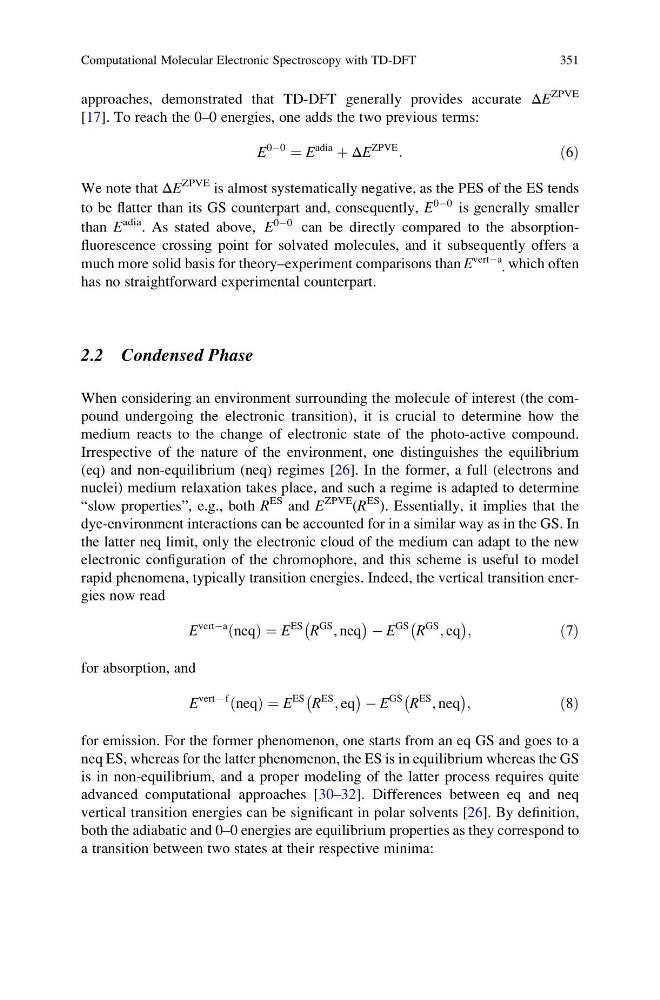
rapid phenomena, typically transition energies. Indeed, the vertical transition energies now read
E
vertÀa neq
ð Þ ¼ E
ES R
GS , neq
À
Á À E
GS R
GS
; eq
À
Á ;
ð7Þ
for absorption, and
E
vertÀ f neq
ð Þ ¼ E
ES R
ES
; eq
À
Á À E
GS R
ES , neq
À
Á ;
ð8Þ
for emission. For the former phenomenon, one starts from an eq GS and goes to a
neq ES, whereas for the latter phenomenon, the ES is in equilibrium whereas the GS
is in non-equilibrium, and a proper modeling of the latter process requires quite
advanced computational approaches [30–32]. Differences between eq and neq
vertical transition energies can be significant in polar solvents [26]. By definition,
both the adiabatic and 0–0 energies are equilibrium properties as they correspond to
a transition between two states at their respective minima:
Computational Molecular Electronic Spectroscopy with TD-DFT
351
ZPVE
[17]. To reach the 0–0 energies, one adds the two previous terms:
E
0À0
¼ E
adia
þ ΔE
ZPVE
:
ð6Þ
We note that ΔE
ZPVE is almost systematically negative, as the PES of the ES tends
to be flatter than its GS counterpart and, consequently, E
0À0 is generally smaller
than E
adia . As stated above, E
0À0 can be directly compared to the absorptionfluorescence crossing point for solvated molecules, and it subsequently offers a
much more solid basis for theory–experiment comparisons than E
vertÀa
, which often
has no straightforward experimental counterpart.
2.2 Condensed Phase
When considering an environment surrounding the molecule of interest (the compound undergoing the electronic transition), it is crucial to determine how the
medium reacts to the change of electronic state of the photo-active compound.
Irrespective of the nature of the environment, one distinguishes the equilibrium
(eq) and non-equilibrium (neq) regimes [26]. In the former, a full (electrons and
nuclei) medium relaxation takes place, and such a regime is adapted to determine
“slow properties”, e.g., both R
ES and E
ZPVE (R
ES
). Essentially, it implies that the
dye-environment interactions can be accounted for in a similar way as in the GS. In
the latter neq limit, only the electronic cloud of the medium can adapt to the new
electronic configuration of the chromophore, and this scheme is useful to model
rapid phenomena, typically transition energies. Indeed, the vertical transition energies now read
E
vertÀa neq
ð Þ ¼ E
ES R
GS , neq
À
Á À E
GS R
GS
; eq
À
Á ;
ð7Þ
for absorption, and
E
vertÀ f neq
ð Þ ¼ E
ES R
ES
; eq
À
Á À E
GS R
ES , neq
À
Á ;
ð8Þ
for emission. For the former phenomenon, one starts from an eq GS and goes to a
neq ES, whereas for the latter phenomenon, the ES is in equilibrium whereas the GS
is in non-equilibrium, and a proper modeling of the latter process requires quite
advanced computational approaches [30–32]. Differences between eq and neq
vertical transition energies can be significant in polar solvents [26]. By definition,
both the adiabatic and 0–0 energies are equilibrium properties as they correspond to
a transition between two states at their respective minima:
Computational Molecular Electronic Spectroscopy with TD-DFT
351