

E
vertÀ f
¼ E
ES R
ES
À Á À E
GS R
ES
À Á :
ð2Þ
We note that the second quantity implies a force minimization process
performed at the ES to define R
ES , and can be obtained efficiently with a wide
panel of quantum chemistry codes which include analytical TD-DFT gradients
(e.g., Gaussian, Turbomole, Q-Chem, and NWChem to cite a few) [18–20]. The
adiabatic energy can be obtained as a simple by-product of the two previous
equations,
E
adia
¼ E
ES R
ES
À Á À E
GS R
GS
À
Á ;
ð3Þ
or, alternatively by combining vertical transition energies with the geometrical
reorganization energies,
E
adia
¼
1
2
E
vertÀ f
þ E
vertÀa
Â
à þ
1
2
E
reorgÀGS
À E
reorgÀES
Â
Ã
:
ð4Þ
In this latter equation the first term tends to be dominant, and, in a first crude
approximation the second term can be neglected. Indeed, the second term is the
difference of reorganization energies between the two considered states, which is
significant only when there is a strong difference between R
GS and R
ES . Next, one
needs to determine the difference of zero-point vibrational energy (ZPVE) between
the ES and GS,
ΔE
ZPVE
¼ E
ZPVE R
ES
À Á À E
ZPVE R
GS
À
Á ;
ð5Þ
a computationally demanding term, as second derivatives (Hessian) of the ES PES
need to be computed, either analytically [21, 22] or numerically. For small molecules, at least, comparisons with the results obtained using wavefunction
Energy
Geometry
E
vert-a
E
vert-f
GS
ES
E
adia
E
0-0
E
ZPVE (R
ES )
E
ZPVE (R
GS )
E
ES
(R
GS
)
E
ES
(R
ES
)
E
GS
(R
ES
)
E
GS
(R
GS
)
R
GS R
ES
E
reorg-ES
E
reorg-GS
E
reorg-GS
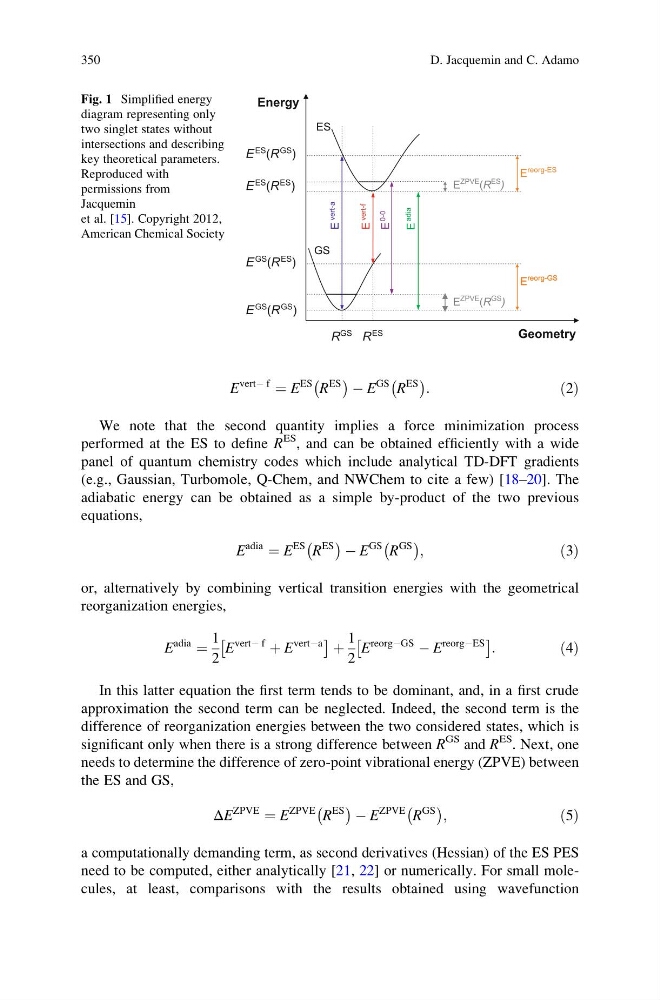
Fig. 1 Simplified energy
diagram representing only
two singlet states without
intersections and describing
key theoretical parameters.
Reproduced with
permissions from
Jacquemin
et al. [15]. Copyright 2012,
American Chemical Society
350
D. Jacquemin and C. Adamo
vertÀ f
¼ E
ES R
ES
À Á À E
GS R
ES
À Á :
ð2Þ
We note that the second quantity implies a force minimization process
performed at the ES to define R
ES , and can be obtained efficiently with a wide
panel of quantum chemistry codes which include analytical TD-DFT gradients
(e.g., Gaussian, Turbomole, Q-Chem, and NWChem to cite a few) [18–20]. The
adiabatic energy can be obtained as a simple by-product of the two previous
equations,
E
adia
¼ E
ES R
ES
À Á À E
GS R
GS
À
Á ;
ð3Þ
or, alternatively by combining vertical transition energies with the geometrical
reorganization energies,
E
adia
¼
1
2
E
vertÀ f
þ E
vertÀa
Â
à þ
1
2
E
reorgÀGS
À E
reorgÀES
Â
Ã
:
ð4Þ
In this latter equation the first term tends to be dominant, and, in a first crude
approximation the second term can be neglected. Indeed, the second term is the
difference of reorganization energies between the two considered states, which is
significant only when there is a strong difference between R
GS and R
ES . Next, one
needs to determine the difference of zero-point vibrational energy (ZPVE) between
the ES and GS,
ΔE
ZPVE
¼ E
ZPVE R
ES
À Á À E
ZPVE R
GS
À
Á ;
ð5Þ
a computationally demanding term, as second derivatives (Hessian) of the ES PES
need to be computed, either analytically [21, 22] or numerically. For small molecules, at least, comparisons with the results obtained using wavefunction
Energy
Geometry
E
vert-a
E
vert-f
GS
ES
E
adia
E
0-0
E
ZPVE (R
ES )
E
ZPVE (R
GS )
E
ES
(R
GS
)
E
ES
(R
ES
)
E
GS
(R
ES
)
E
GS
(R
GS
)
R
GS R
ES
E
reorg-ES
E
reorg-GS
E
reorg-GS
Fig. 1 Simplified energy
diagram representing only
two singlet states without
intersections and describing
key theoretical parameters.
Reproduced with
permissions from
Jacquemin
et al. [15]. Copyright 2012,
American Chemical Society
350
D. Jacquemin and C. Adamo