

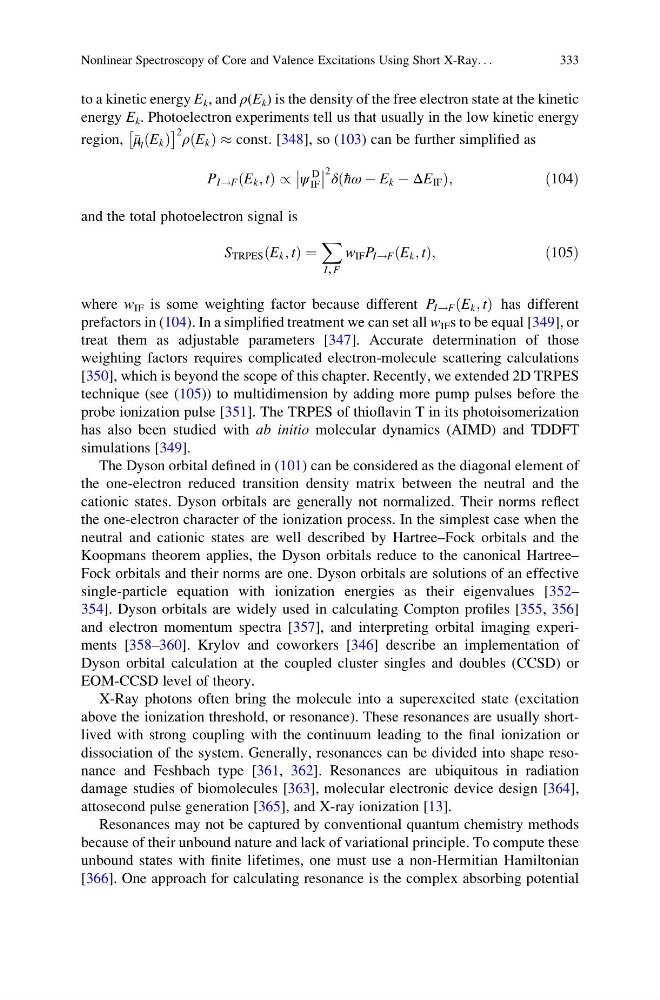
to a kinetic energy E k , and ρ(E k ) is the density of the free electron state at the kinetic
energy E k . Photoelectron experiments tell us that usually in the low kinetic energy
region,
μ η E k
ð Þ
Â
à 2 ρ E k
ð Þ % const: [348], so (103) can be further simplified as
P I!F E k ; t
ð
Þ / ψ
D
IF
2 δ hω À E k À ΔE IF
ð
Þ ;
ð104Þ
and the total photoelectron signal is
S TRPES E k ; t
ð
Þ ¼
X
I, F
w IF P I!F E k ; t
ð
Þ;
ð105Þ
where w IF is some weighting factor because different P I!F E k ; t
ð
Þ has different
prefactors in (104). In a simplified treatment we can set all w IF s to be equal [349], or
treat them as adjustable parameters [347]. Accurate determination of those
weighting factors requires complicated electron-molecule scattering calculations
[350], which is beyond the scope of this chapter. Recently, we extended 2D TRPES
technique (see (105)) to multidimension by adding more pump pulses before the
probe ionization pulse [351]. The TRPES of thioflavin T in its photoisomerization
has also been studied with ab initio molecular dynamics (AIMD) and TDDFT
simulations [349].
The Dyson orbital defined in (101) can be considered as the diagonal element of
the one-electron reduced transition density matrix between the neutral and the
cationic states. Dyson orbitals are generally not normalized. Their norms reflect
the one-electron character of the ionization process. In the simplest case when the
neutral and cationic states are well described by Hartree–Fock orbitals and the
Koopmans theorem applies, the Dyson orbitals reduce to the canonical Hartree–
Fock orbitals and their norms are one. Dyson orbitals are solutions of an effective
single-particle equation with ionization energies as their eigenvalues [352–
354]. Dyson orbitals are widely used in calculating Compton profiles [355, 356]
and electron momentum spectra [357], and interpreting orbital imaging experiments [358–360]. Krylov and coworkers [346] describe an implementation of
Dyson orbital calculation at the coupled cluster singles and doubles (CCSD) or
EOM-CCSD level of theory.
X-Ray photons often bring the molecule into a superexcited state (excitation
above the ionization threshold, or resonance). These resonances are usually shortlived with strong coupling with the continuum leading to the final ionization or
dissociation of the system. Generally, resonances can be divided into shape resonance and Feshbach type [361, 362]. Resonances are ubiquitous in radiation
damage studies of biomolecules [363], molecular electronic device design [364],
attosecond pulse generation [365], and X-ray ionization [13].
Resonances may not be captured by conventional quantum chemistry methods
because of their unbound nature and lack of variational principle. To compute these
unbound states with finite lifetimes, one must use a non-Hermitian Hamiltonian
[366]. One approach for calculating resonance is the complex absorbing potential
Nonlinear Spectroscopy of Core and Valence Excitations Using Short X-Ray. . .
333
energy E k . Photoelectron experiments tell us that usually in the low kinetic energy
region,
μ η E k
ð Þ
Â
à 2 ρ E k
ð Þ % const: [348], so (103) can be further simplified as
P I!F E k ; t
ð
Þ / ψ
D
IF
2 δ hω À E k À ΔE IF
ð
Þ ;
ð104Þ
and the total photoelectron signal is
S TRPES E k ; t
ð
Þ ¼
X
I, F
w IF P I!F E k ; t
ð
Þ;
ð105Þ
where w IF is some weighting factor because different P I!F E k ; t
ð
Þ has different
prefactors in (104). In a simplified treatment we can set all w IF s to be equal [349], or
treat them as adjustable parameters [347]. Accurate determination of those
weighting factors requires complicated electron-molecule scattering calculations
[350], which is beyond the scope of this chapter. Recently, we extended 2D TRPES
technique (see (105)) to multidimension by adding more pump pulses before the
probe ionization pulse [351]. The TRPES of thioflavin T in its photoisomerization
has also been studied with ab initio molecular dynamics (AIMD) and TDDFT
simulations [349].
The Dyson orbital defined in (101) can be considered as the diagonal element of
the one-electron reduced transition density matrix between the neutral and the
cationic states. Dyson orbitals are generally not normalized. Their norms reflect
the one-electron character of the ionization process. In the simplest case when the
neutral and cationic states are well described by Hartree–Fock orbitals and the
Koopmans theorem applies, the Dyson orbitals reduce to the canonical Hartree–
Fock orbitals and their norms are one. Dyson orbitals are solutions of an effective
single-particle equation with ionization energies as their eigenvalues [352–
354]. Dyson orbitals are widely used in calculating Compton profiles [355, 356]
and electron momentum spectra [357], and interpreting orbital imaging experiments [358–360]. Krylov and coworkers [346] describe an implementation of
Dyson orbital calculation at the coupled cluster singles and doubles (CCSD) or
EOM-CCSD level of theory.
X-Ray photons often bring the molecule into a superexcited state (excitation
above the ionization threshold, or resonance). These resonances are usually shortlived with strong coupling with the continuum leading to the final ionization or
dissociation of the system. Generally, resonances can be divided into shape resonance and Feshbach type [361, 362]. Resonances are ubiquitous in radiation
damage studies of biomolecules [363], molecular electronic device design [364],
attosecond pulse generation [365], and X-ray ionization [13].
Resonances may not be captured by conventional quantum chemistry methods
because of their unbound nature and lack of variational principle. To compute these
unbound states with finite lifetimes, one must use a non-Hermitian Hamiltonian
[366]. One approach for calculating resonance is the complex absorbing potential
Nonlinear Spectroscopy of Core and Valence Excitations Using Short X-Ray. . .
333