

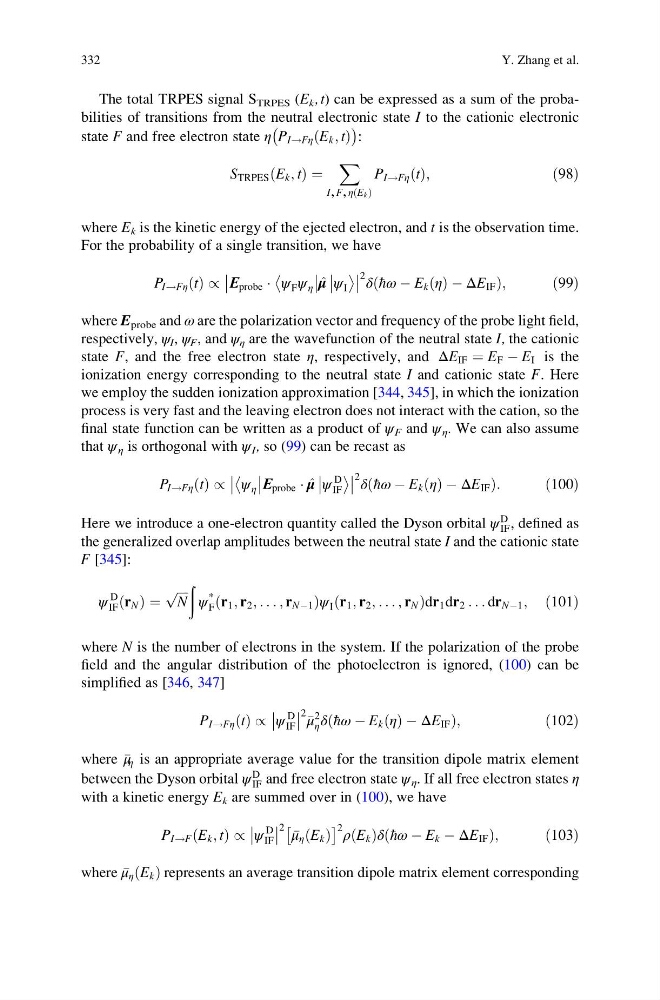
The total TRPES signal S TRPES (E k , t) can be expressed as a sum of the probabilities of transitions from the neutral electronic state I to the cationic electronic
state F and free electron state η P I!Fη E k ; t
ð
Þ
À
Á
:
S TRPES E k ; t
ð
Þ ¼
X
I, F, η E k
ð Þ
P I!Fη t
ð Þ;
ð98Þ
where E k is the kinetic energy of the ejected electron, and t is the observation time.
For the probability of a single transition, we have
P I!Fη t
ð Þ / E probe Á ψ F ψ η
^
μ
ψ I
2 δ hω À E k η
ð Þ À ΔE IF
ð
Þ ;
ð99Þ
where E probe and ω are the polarization vector and frequency of the probe light field,
respectively, ψ I , ψ F , and ψ η are the wavefunction of the neutral state I, the cationic
state F, and the free electron state η, respectively, and ΔE IF ¼ E F À E I is the
ionization energy corresponding to the neutral state I and cationic state F. Here
we employ the sudden ionization approximation [344, 345], in which the ionization
process is very fast and the leaving electron does not interact with the cation, so the
final state function can be written as a product of ψ F and ψ η . We can also assume
that ψ η is orthogonal with ψ I , so (99) can be recast as
P I!Fη t
ð Þ / ψ η
E probe Á ^
μ
ψ
D
IF
2 δ hω À E k η
ð Þ À ΔE IF
ð
Þ :
ð100Þ
Here we introduce a one-electron quantity called the Dyson orbital ψ
D
IF , defined as
the generalized overlap amplitudes between the neutral state I and the cationic state
F [345]:
ψ
D
IF r N
ð Þ ¼
ffiffiffi ffi
N
p ð
ψ
*
F r 1 ; r 2 ; . . . ; r NÀ1
ð
Þ ψ I r 1 ; r 2 ; . . . ; r N
ð
Þ dr 1 dr 2 . . . dr NÀ1 ; ð101Þ
where N is the number of electrons in the system. If the polarization of the probe
field and the angular distribution of the photoelectron is ignored, (100) can be
simplified as [346, 347]
P I!Fη t
ð Þ / ψ
D
IF
2
μ
2
η δ hω À E k η
ð Þ À ΔE IF
ð
Þ ;
ð102Þ
where
μ η is an appropriate average value for the transition dipole matrix element
between the Dyson orbital ψ
D
IF and free electron state ψ η . If all free electron states η
with a kinetic energy E k are summed over in (100), we have
P I!F E k ; t
ð
Þ / ψ
D
IF
2
μ η E k
ð Þ
Â
à 2 ρ E k
ð Þδ hω À E k À ΔE IF
ð
Þ ;
ð103Þ
where
μ η E k
ð Þ represents an average transition dipole matrix element corresponding
332
Y. Zhang et al.
state F and free electron state η P I!Fη E k ; t
ð
Þ
À
Á
:
S TRPES E k ; t
ð
Þ ¼
X
I, F, η E k
ð Þ
P I!Fη t
ð Þ;
ð98Þ
where E k is the kinetic energy of the ejected electron, and t is the observation time.
For the probability of a single transition, we have
P I!Fη t
ð Þ / E probe Á ψ F ψ η
^
μ
ψ I
2 δ hω À E k η
ð Þ À ΔE IF
ð
Þ ;
ð99Þ
where E probe and ω are the polarization vector and frequency of the probe light field,
respectively, ψ I , ψ F , and ψ η are the wavefunction of the neutral state I, the cationic
state F, and the free electron state η, respectively, and ΔE IF ¼ E F À E I is the
ionization energy corresponding to the neutral state I and cationic state F. Here
we employ the sudden ionization approximation [344, 345], in which the ionization
process is very fast and the leaving electron does not interact with the cation, so the
final state function can be written as a product of ψ F and ψ η . We can also assume
that ψ η is orthogonal with ψ I , so (99) can be recast as
P I!Fη t
ð Þ / ψ η
E probe Á ^
μ
ψ
D
IF
2 δ hω À E k η
ð Þ À ΔE IF
ð
Þ :
ð100Þ
Here we introduce a one-electron quantity called the Dyson orbital ψ
D
IF , defined as
the generalized overlap amplitudes between the neutral state I and the cationic state
F [345]:
ψ
D
IF r N
ð Þ ¼
ffiffiffi ffi
N
p ð
ψ
*
F r 1 ; r 2 ; . . . ; r NÀ1
ð
Þ ψ I r 1 ; r 2 ; . . . ; r N
ð
Þ dr 1 dr 2 . . . dr NÀ1 ; ð101Þ
where N is the number of electrons in the system. If the polarization of the probe
field and the angular distribution of the photoelectron is ignored, (100) can be
simplified as [346, 347]
P I!Fη t
ð Þ / ψ
D
IF
2
μ
2
η δ hω À E k η
ð Þ À ΔE IF
ð
Þ ;
ð102Þ
where
μ η is an appropriate average value for the transition dipole matrix element
between the Dyson orbital ψ
D
IF and free electron state ψ η . If all free electron states η
with a kinetic energy E k are summed over in (100), we have
P I!F E k ; t
ð
Þ / ψ
D
IF
2
μ η E k
ð Þ
Â
à 2 ρ E k
ð Þδ hω À E k À ΔE IF
ð
Þ ;
ð103Þ
where
μ η E k
ð Þ represents an average transition dipole matrix element corresponding
332
Y. Zhang et al.