

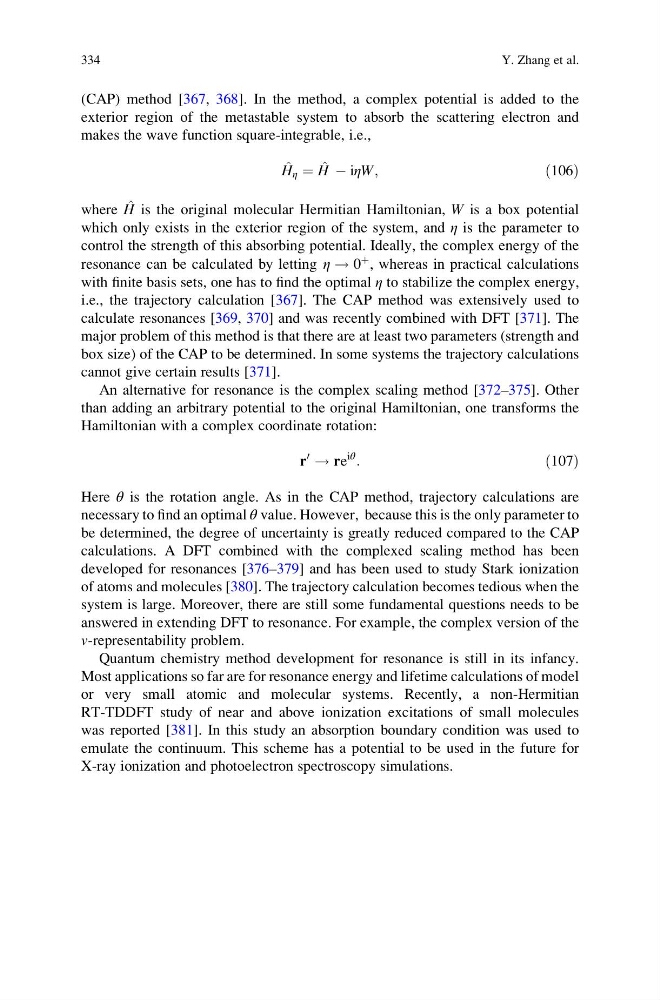
(CAP) method [367, 368]. In the method, a complex potential is added to the
exterior region of the metastable system to absorb the scattering electron and
makes the wave function square-integrable, i.e.,
^
H η ¼ ^
H À iηW;
ð106Þ
where ^
H is the original molecular Hermitian Hamiltonian, W is a box potential
which only exists in the exterior region of the system, and η is the parameter to
control the strength of this absorbing potential. Ideally, the complex energy of the
resonance can be calculated by letting η ! 0
þ , whereas in practical calculations
with finite basis sets, one has to find the optimal η to stabilize the complex energy,
i.e., the trajectory calculation [367]. The CAP method was extensively used to
calculate resonances [369, 370] and was recently combined with DFT [371]. The
major problem of this method is that there are at least two parameters (strength and
box size) of the CAP to be determined. In some systems the trajectory calculations
cannot give certain results [371].
An alternative for resonance is the complex scaling method [372–375]. Other
than adding an arbitrary potential to the original Hamiltonian, one transforms the
Hamiltonian with a complex coordinate rotation:
r
0
! re
iθ
:
ð107Þ
Here θ is the rotation angle. As in the CAP method, trajectory calculations are
necessary to find an optimal θ value. However, because this is the only parameter to
be determined, the degree of uncertainty is greatly reduced compared to the CAP
calculations. A DFT combined with the complexed scaling method has been
developed for resonances [376–379] and has been used to study Stark ionization
of atoms and molecules [380]. The trajectory calculation becomes tedious when the
system is large. Moreover, there are still some fundamental questions needs to be
answered in extending DFT to resonance. For example, the complex version of the
v-representability problem.
Quantum chemistry method development for resonance is still in its infancy.
Most applications so far are for resonance energy and lifetime calculations of model
or very small atomic and molecular systems. Recently, a non-Hermitian
RT-TDDFT study of near and above ionization excitations of small molecules
was reported [381]. In this study an absorption boundary condition was used to
emulate the continuum. This scheme has a potential to be used in the future for
X-ray ionization and photoelectron spectroscopy simulations.
334
Y. Zhang et al.
exterior region of the metastable system to absorb the scattering electron and
makes the wave function square-integrable, i.e.,
^
H η ¼ ^
H À iηW;
ð106Þ
where ^
H is the original molecular Hermitian Hamiltonian, W is a box potential
which only exists in the exterior region of the system, and η is the parameter to
control the strength of this absorbing potential. Ideally, the complex energy of the
resonance can be calculated by letting η ! 0
þ , whereas in practical calculations
with finite basis sets, one has to find the optimal η to stabilize the complex energy,
i.e., the trajectory calculation [367]. The CAP method was extensively used to
calculate resonances [369, 370] and was recently combined with DFT [371]. The
major problem of this method is that there are at least two parameters (strength and
box size) of the CAP to be determined. In some systems the trajectory calculations
cannot give certain results [371].
An alternative for resonance is the complex scaling method [372–375]. Other
than adding an arbitrary potential to the original Hamiltonian, one transforms the
Hamiltonian with a complex coordinate rotation:
r
0
! re
iθ
:
ð107Þ
Here θ is the rotation angle. As in the CAP method, trajectory calculations are
necessary to find an optimal θ value. However, because this is the only parameter to
be determined, the degree of uncertainty is greatly reduced compared to the CAP
calculations. A DFT combined with the complexed scaling method has been
developed for resonances [376–379] and has been used to study Stark ionization
of atoms and molecules [380]. The trajectory calculation becomes tedious when the
system is large. Moreover, there are still some fundamental questions needs to be
answered in extending DFT to resonance. For example, the complex version of the
v-representability problem.
Quantum chemistry method development for resonance is still in its infancy.
Most applications so far are for resonance energy and lifetime calculations of model
or very small atomic and molecular systems. Recently, a non-Hermitian
RT-TDDFT study of near and above ionization excitations of small molecules
was reported [381]. In this study an absorption boundary condition was used to
emulate the continuum. This scheme has a potential to be used in the future for
X-ray ionization and photoelectron spectroscopy simulations.
334
Y. Zhang et al.