

^
~
H 0 ¼
X
i j
~
ε i j ^
c
{
i ^
c j þ
X
ijkl
~
U ijkl ^
c
{
i ^
c
{
j ^
c k ^
c l ;
ð92Þ
where we have defined the auxiliary parameters
~
ε i j
X
a
ε a t
*
ai t a j ~
U ijkl
X
abcd
U abcd t
*
ai t
*
b j t ck t dl :
ð93Þ
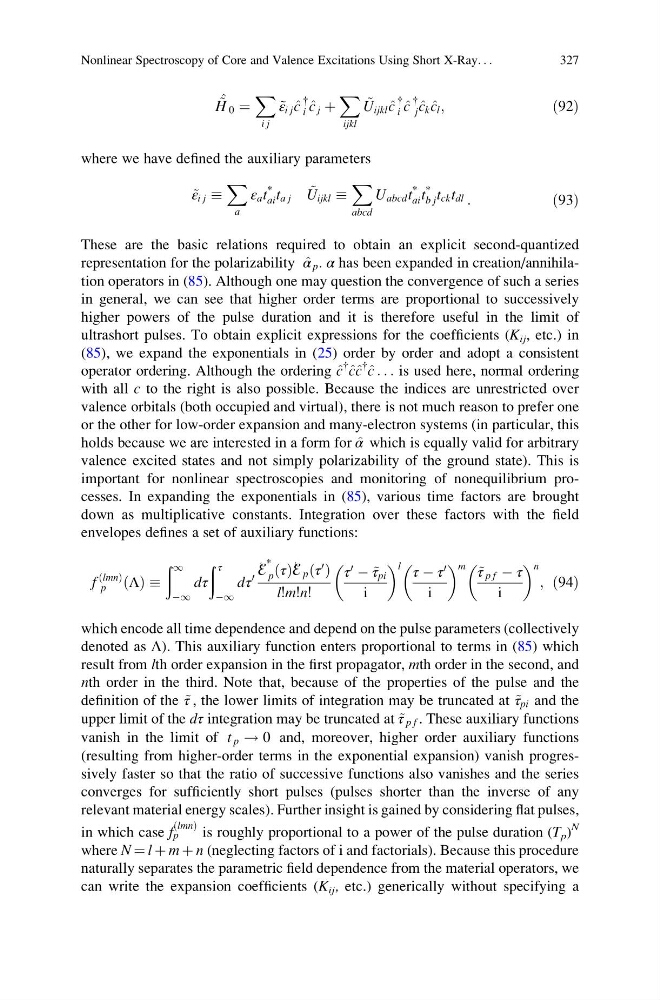
These are the basic relations required to obtain an explicit second-quantized
representation for the polarizability ^
α p . α has been expanded in creation/annihilation operators in (85). Although one may question the convergence of such a series
in general, we can see that higher order terms are proportional to successively
higher powers of the pulse duration and it is therefore useful in the limit of
ultrashort pulses. To obtain explicit expressions for the coefficients (K ij , etc.) in
(85), we expand the exponentials in (25) order by order and adopt a consistent
operator ordering. Although the ordering ^
c
{
^
c^ c
{
^
c . . . is used here, normal ordering
with all c to the right is also possible. Because the indices are unrestricted over
valence orbitals (both occupied and virtual), there is not much reason to prefer one
or the other for low-order expansion and many-electron systems (in particular, this
holds because we are interested in a form for ^
α which is equally valid for arbitrary
valence excited states and not simply polarizability of the ground state). This is
important for nonlinear spectroscopies and monitoring of nonequilibrium processes. In expanding the exponentials in (85), various time factors are brought
down as multiplicative constants. Integration over these factors with the field
envelopes defines a set of auxiliary functions:
f
lmn
ð
Þ
p
Λ
ð Þ
ð 1
À1
dτ
ð τ
À1
dτ
0
ℰ
*
p τ
ð Þℰ p τ
0
ð Þ
l!m!n!
τ
0
À ~
τ pi
i
l τ À τ
0
i
m ~
τ p f À τ
i
n
; ð94Þ
which encode all time dependence and depend on the pulse parameters (collectively
denoted as Λ). This auxiliary function enters proportional to terms in (85) which
result from lth order expansion in the first propagator, mth order in the second, and
nth order in the third. Note that, because of the properties of the pulse and the
definition of the ~
τ , the lower limits of integration may be truncated at ~
τ pi and the
upper limit of the dτ integration may be truncated at ~
τ p f . These auxiliary functions
vanish in the limit of t p ! 0 and, moreover, higher order auxiliary functions
(resulting from higher-order terms in the exponential expansion) vanish progressively faster so that the ratio of successive functions also vanishes and the series
converges for sufficiently short pulses (pulses shorter than the inverse of any
relevant material energy scales). Further insight is gained by considering flat pulses,
in which case f
ðlmnÞ
p
is roughly proportional to a power of the pulse duration (T p )
N
where N ¼ l þ m þ n (neglecting factors of i and factorials). Because this procedure
naturally separates the parametric field dependence from the material operators, we
can write the expansion coefficients (K ij , etc.) generically without specifying a
Nonlinear Spectroscopy of Core and Valence Excitations Using Short X-Ray. . .
327
~
H 0 ¼
X
i j
~
ε i j ^
c
{
i ^
c j þ
X
ijkl
~
U ijkl ^
c
{
i ^
c
{
j ^
c k ^
c l ;
ð92Þ
where we have defined the auxiliary parameters
~
ε i j
X
a
ε a t
*
ai t a j ~
U ijkl
X
abcd
U abcd t
*
ai t
*
b j t ck t dl :
ð93Þ
These are the basic relations required to obtain an explicit second-quantized
representation for the polarizability ^
α p . α has been expanded in creation/annihilation operators in (85). Although one may question the convergence of such a series
in general, we can see that higher order terms are proportional to successively
higher powers of the pulse duration and it is therefore useful in the limit of
ultrashort pulses. To obtain explicit expressions for the coefficients (K ij , etc.) in
(85), we expand the exponentials in (25) order by order and adopt a consistent
operator ordering. Although the ordering ^
c
{
^
c^ c
{
^
c . . . is used here, normal ordering
with all c to the right is also possible. Because the indices are unrestricted over
valence orbitals (both occupied and virtual), there is not much reason to prefer one
or the other for low-order expansion and many-electron systems (in particular, this
holds because we are interested in a form for ^
α which is equally valid for arbitrary
valence excited states and not simply polarizability of the ground state). This is
important for nonlinear spectroscopies and monitoring of nonequilibrium processes. In expanding the exponentials in (85), various time factors are brought
down as multiplicative constants. Integration over these factors with the field
envelopes defines a set of auxiliary functions:
f
lmn
ð
Þ
p
Λ
ð Þ
ð 1
À1
dτ
ð τ
À1
dτ
0
ℰ
*
p τ
ð Þℰ p τ
0
ð Þ
l!m!n!
τ
0
À ~
τ pi
i
l τ À τ
0
i
m ~
τ p f À τ
i
n
; ð94Þ
which encode all time dependence and depend on the pulse parameters (collectively
denoted as Λ). This auxiliary function enters proportional to terms in (85) which
result from lth order expansion in the first propagator, mth order in the second, and
nth order in the third. Note that, because of the properties of the pulse and the
definition of the ~
τ , the lower limits of integration may be truncated at ~
τ pi and the
upper limit of the dτ integration may be truncated at ~
τ p f . These auxiliary functions
vanish in the limit of t p ! 0 and, moreover, higher order auxiliary functions
(resulting from higher-order terms in the exponential expansion) vanish progressively faster so that the ratio of successive functions also vanishes and the series
converges for sufficiently short pulses (pulses shorter than the inverse of any
relevant material energy scales). Further insight is gained by considering flat pulses,
in which case f
ðlmnÞ
p
is roughly proportional to a power of the pulse duration (T p )
N
where N ¼ l þ m þ n (neglecting factors of i and factorials). Because this procedure
naturally separates the parametric field dependence from the material operators, we
can write the expansion coefficients (K ij , etc.) generically without specifying a
Nonlinear Spectroscopy of Core and Valence Excitations Using Short X-Ray. . .
327