

pulse envelope. To simplify these expressions, we define μ i j
X
κ
μ
*
iκ μ jκ . A
straightforward but lengthy calculation then yields the first few terms in (85):
α
p
ð Þ
0 ¼
X
i
μ ii þ f
010
ð
Þ
p
Λ
ð Þ
X
i
μ ii ~
ε ii ;
ð95Þ
K
p
ð Þ
i j ¼ Àμ i j þ f
100
ð
Þ
p
þ f
001
ð
Þ
p
X
l
μ ll
!
ε i δ i j þ
X
l
U illj
!
À f
010
ð
Þ
p
X
k
μ jk ~
ε ik þ μ ki ~
ε k j
À
Á þ
X
kl
μ kl ~
U kijl
! ;
ð96Þ
L
p
ð Þ
ijkl ¼ À
X
m
f
001
ð
Þ
p
μ i j U kmml þ f
010
ð
Þ
p
μ jm ~
U iklm þ μ mk ~
U mijl
À
Á þ f
100
ð
Þ
p
μ lk U immj
n
o
;
ð97Þ
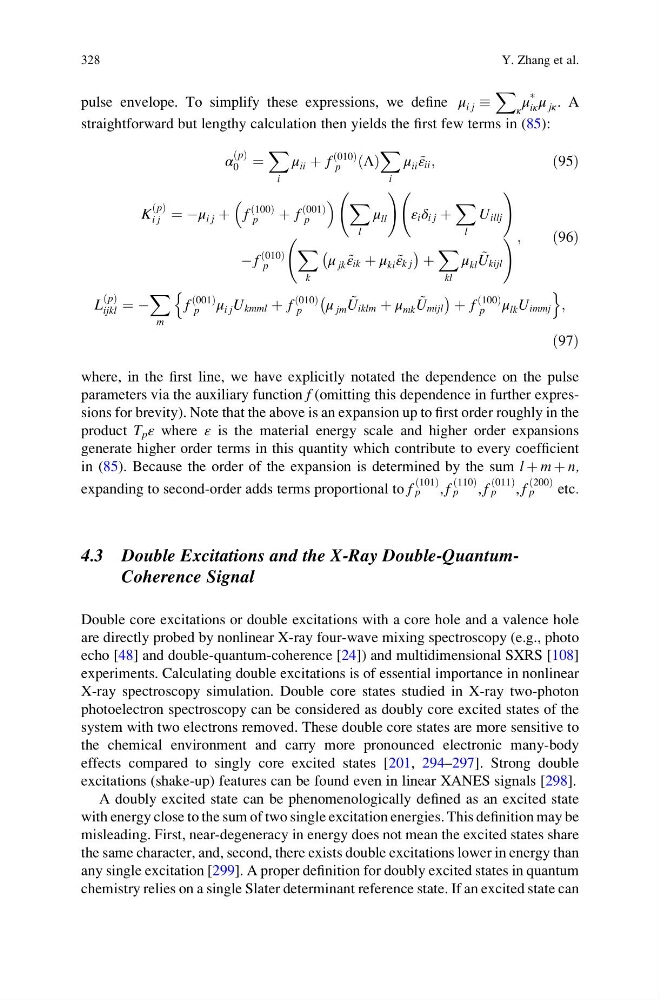
where, in the first line, we have explicitly notated the dependence on the pulse
parameters via the auxiliary function f (omitting this dependence in further expressions for brevity). Note that the above is an expansion up to first order roughly in the
product T p ε where ε is the material energy scale and higher order expansions
generate higher order terms in this quantity which contribute to every coefficient
in (85). Because the order of the expansion is determined by the sum l þ m þ n,
expanding to second-order adds terms proportional to f
ð101Þ
p
, f
ð110Þ
p
, f
ð011Þ
p
, f
ð200Þ
p
etc.
4.3 Double Excitations and the X-Ray Double-QuantumCoherence Signal
Double core excitations or double excitations with a core hole and a valence hole
are directly probed by nonlinear X-ray four-wave mixing spectroscopy (e.g., photo
echo [48] and double-quantum-coherence [24]) and multidimensional SXRS [108]
experiments. Calculating double excitations is of essential importance in nonlinear
X-ray spectroscopy simulation. Double core states studied in X-ray two-photon
photoelectron spectroscopy can be considered as doubly core excited states of the
system with two electrons removed. These double core states are more sensitive to
the chemical environment and carry more pronounced electronic many-body
effects compared to singly core excited states [201, 294–297]. Strong double
excitations (shake-up) features can be found even in linear XANES signals [298].
A doubly excited state can be phenomenologically defined as an excited state
with energy close to the sum of two single excitation energies. This definition may be
misleading. First, near-degeneracy in energy does not mean the excited states share
the same character, and, second, there exists double excitations lower in energy than
any single excitation [299]. A proper definition for doubly excited states in quantum
chemistry relies on a single Slater determinant reference state. If an excited state can
328
Y. Zhang et al.
X
κ
μ
*
iκ μ jκ . A
straightforward but lengthy calculation then yields the first few terms in (85):
α
p
ð Þ
0 ¼
X
i
μ ii þ f
010
ð
Þ
p
Λ
ð Þ
X
i
μ ii ~
ε ii ;
ð95Þ
K
p
ð Þ
i j ¼ Àμ i j þ f
100
ð
Þ
p
þ f
001
ð
Þ
p
X
l
μ ll
!
ε i δ i j þ
X
l
U illj
!
À f
010
ð
Þ
p
X
k
μ jk ~
ε ik þ μ ki ~
ε k j
À
Á þ
X
kl
μ kl ~
U kijl
! ;
ð96Þ
L
p
ð Þ
ijkl ¼ À
X
m
f
001
ð
Þ
p
μ i j U kmml þ f
010
ð
Þ
p
μ jm ~
U iklm þ μ mk ~
U mijl
À
Á þ f
100
ð
Þ
p
μ lk U immj
n
o
;
ð97Þ
where, in the first line, we have explicitly notated the dependence on the pulse
parameters via the auxiliary function f (omitting this dependence in further expressions for brevity). Note that the above is an expansion up to first order roughly in the
product T p ε where ε is the material energy scale and higher order expansions
generate higher order terms in this quantity which contribute to every coefficient
in (85). Because the order of the expansion is determined by the sum l þ m þ n,
expanding to second-order adds terms proportional to f
ð101Þ
p
, f
ð110Þ
p
, f
ð011Þ
p
, f
ð200Þ
p
etc.
4.3 Double Excitations and the X-Ray Double-QuantumCoherence Signal
Double core excitations or double excitations with a core hole and a valence hole
are directly probed by nonlinear X-ray four-wave mixing spectroscopy (e.g., photo
echo [48] and double-quantum-coherence [24]) and multidimensional SXRS [108]
experiments. Calculating double excitations is of essential importance in nonlinear
X-ray spectroscopy simulation. Double core states studied in X-ray two-photon
photoelectron spectroscopy can be considered as doubly core excited states of the
system with two electrons removed. These double core states are more sensitive to
the chemical environment and carry more pronounced electronic many-body
effects compared to singly core excited states [201, 294–297]. Strong double
excitations (shake-up) features can be found even in linear XANES signals [298].
A doubly excited state can be phenomenologically defined as an excited state
with energy close to the sum of two single excitation energies. This definition may be
misleading. First, near-degeneracy in energy does not mean the excited states share
the same character, and, second, there exists double excitations lower in energy than
any single excitation [299]. A proper definition for doubly excited states in quantum
chemistry relies on a single Slater determinant reference state. If an excited state can
328
Y. Zhang et al.