

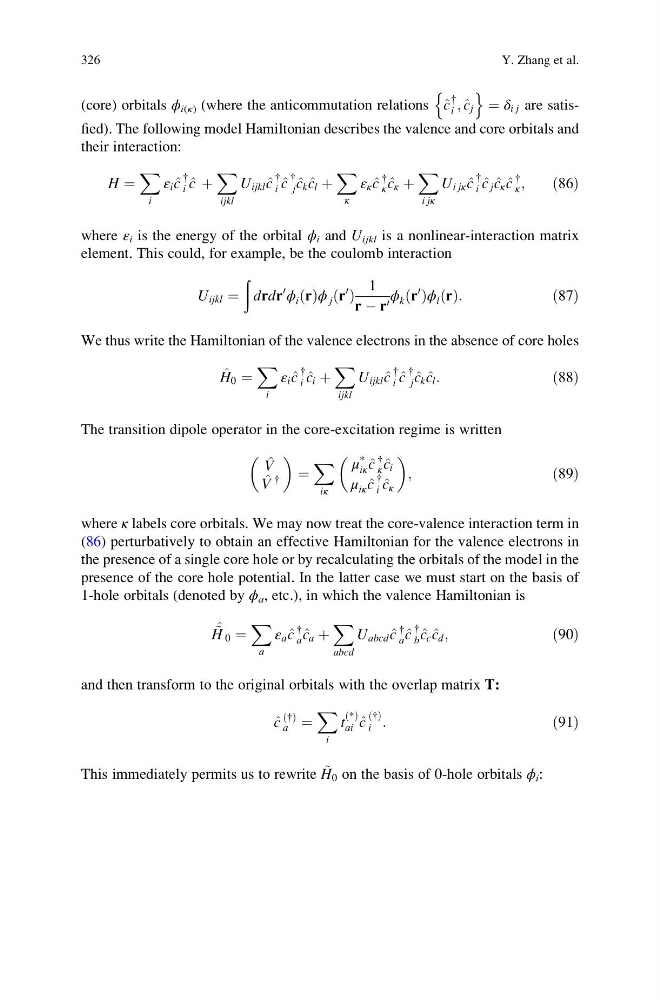
(core) orbitals ϕ i(κ) (where the anticommutation relations ^ c
{
i ; ^ c j
n
o
¼ δ i j are satisfied). The following model Hamiltonian describes the valence and core orbitals and
their interaction:
H ¼
X
i
ε i ^
c
{
i ^
c þ
X
ijkl
U ijkl ^
c
{
i ^
c
{
j ^
c k ^
c l þ
X
κ
ε κ ^
c
{
κ ^
c κ þ
X
i jκ
U i jκ ^
c
{
i ^
c j ^
c κ ^
c
{
κ ;
ð86Þ
where ε i is the energy of the orbital ϕ i and U ijkl is a nonlinear-interaction matrix
element. This could, for example, be the coulomb interaction
U ijkl ¼
ð
drdr
0
ϕ i r
ð Þϕ j r
0
ð Þ
1
r À r 0 ϕ k r
0
ð Þϕ l r
ð Þ:
ð87Þ
We thus write the Hamiltonian of the valence electrons in the absence of core holes
^
H 0 ¼
X
i
ε i ^
c
{
i ^
c i þ
X
ijkl
U ijkl ^
c
{
i ^
c
{
j ^
c k ^
c l :
ð88Þ
The transition dipole operator in the core-excitation regime is written
^
V
^
V
{
¼
X
iκ
μ
*
iκ ^
c
{
κ ^
c i
μ iκ ^
c
{
i ^
c κ
;
ð89Þ
where κ labels core orbitals. We may now treat the core-valence interaction term in
(86) perturbatively to obtain an effective Hamiltonian for the valence electrons in
the presence of a single core hole or by recalculating the orbitals of the model in the
presence of the core hole potential. In the latter case we must start on the basis of
1-hole orbitals (denoted by ϕ a , etc.), in which the valence Hamiltonian is
^
~
H 0 ¼
X
a
ε a ^
c
{
a ^
c a þ
X
abcd
U abcd ^
c
{
a ^
c
{
b ^
c c ^
c d ;
ð90Þ
and then transform to the original orbitals with the overlap matrix T:
^
c
{
ð Þ
a ¼
X
i
t
*
ð Þ
ai ^
c
{
ð Þ
i :
ð91Þ
This immediately permits us to rewrite ~
H 0 on the basis of 0-hole orbitals ϕ i :
326
Y. Zhang et al.
{
i ; ^ c j
n
o
¼ δ i j are satisfied). The following model Hamiltonian describes the valence and core orbitals and
their interaction:
H ¼
X
i
ε i ^
c
{
i ^
c þ
X
ijkl
U ijkl ^
c
{
i ^
c
{
j ^
c k ^
c l þ
X
κ
ε κ ^
c
{
κ ^
c κ þ
X
i jκ
U i jκ ^
c
{
i ^
c j ^
c κ ^
c
{
κ ;
ð86Þ
where ε i is the energy of the orbital ϕ i and U ijkl is a nonlinear-interaction matrix
element. This could, for example, be the coulomb interaction
U ijkl ¼
ð
drdr
0
ϕ i r
ð Þϕ j r
0
ð Þ
1
r À r 0 ϕ k r
0
ð Þϕ l r
ð Þ:
ð87Þ
We thus write the Hamiltonian of the valence electrons in the absence of core holes
^
H 0 ¼
X
i
ε i ^
c
{
i ^
c i þ
X
ijkl
U ijkl ^
c
{
i ^
c
{
j ^
c k ^
c l :
ð88Þ
The transition dipole operator in the core-excitation regime is written
^
V
^
V
{
¼
X
iκ
μ
*
iκ ^
c
{
κ ^
c i
μ iκ ^
c
{
i ^
c κ
;
ð89Þ
where κ labels core orbitals. We may now treat the core-valence interaction term in
(86) perturbatively to obtain an effective Hamiltonian for the valence electrons in
the presence of a single core hole or by recalculating the orbitals of the model in the
presence of the core hole potential. In the latter case we must start on the basis of
1-hole orbitals (denoted by ϕ a , etc.), in which the valence Hamiltonian is
^
~
H 0 ¼
X
a
ε a ^
c
{
a ^
c a þ
X
abcd
U abcd ^
c
{
a ^
c
{
b ^
c c ^
c d ;
ð90Þ
and then transform to the original orbitals with the overlap matrix T:
^
c
{
ð Þ
a ¼
X
i
t
*
ð Þ
ai ^
c
{
ð Þ
i :
ð91Þ
This immediately permits us to rewrite ~
H 0 on the basis of 0-hole orbitals ϕ i :
326
Y. Zhang et al.