

^
α v ¼ ^
α v0 þ
X
i
∂ ^
α v
∂ ^
Q i
^
Q i þ
X
i j
∂
2 ^
α v
∂ ^
Q i ∂ ^
Q j
^
Q i ^
Q j þ Á Á Á;
ð83Þ
where
^
Q i ¼
ffiffiffiffiffiffiffiffiffiffiffi ffi
h
2m i ω i
r
^
a
{
i þ ^
a i
:
ð84Þ
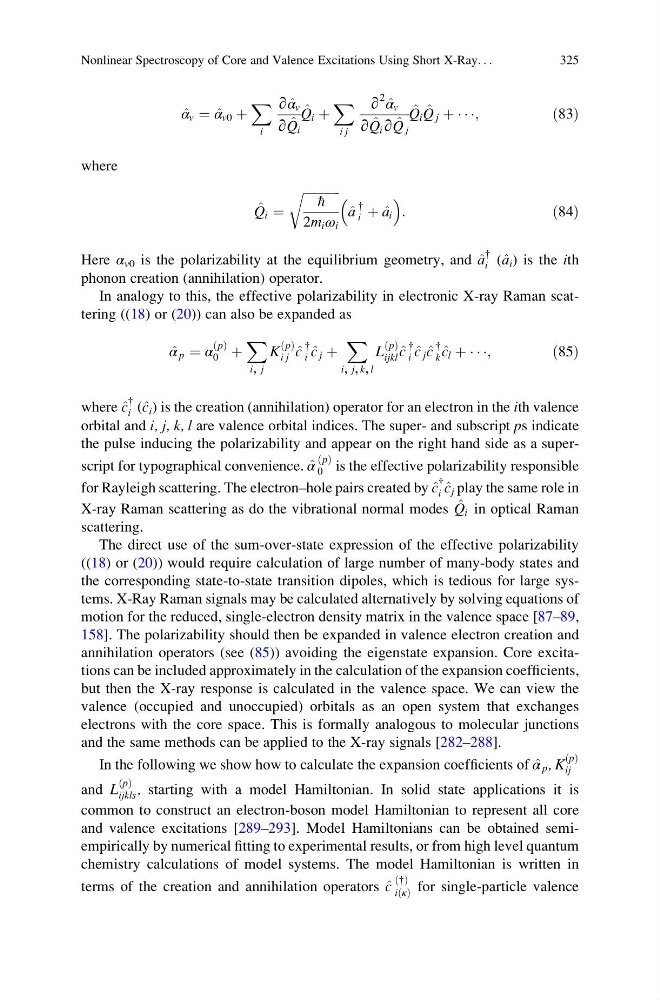
Here α v0 is the polarizability at the equilibrium geometry, and ^
a
{
i (^ a i ) is the ith
phonon creation (annihilation) operator.
In analogy to this, the effective polarizability in electronic X-ray Raman scattering ((18) or (20)) can also be expanded as
^
α p ¼ α
p
ð Þ
0 þ
X
i, j
K
p
ð Þ
i j ^
c
{
i ^
c j þ
X
i, j, k, l
L
p
ð Þ
ijkl ^
c
{
i ^
c j ^
c
{
k ^
c l þ Á Á Á;
ð85Þ
where ^
c
{
i (^ c i ) is the creation (annihilation) operator for an electron in the ith valence
orbital and i, j, k, l are valence orbital indices. The super- and subscript ps indicate
the pulse inducing the polarizability and appear on the right hand side as a superscript for typographical convenience. ^
α
p
ð Þ
0 is the effective polarizability responsible
for Rayleigh scattering. The electron–hole pairs created by ^
c
{
i ^
c j play the same role in
X-ray Raman scattering as do the vibrational normal modes ^
Q i in optical Raman
scattering.
The direct use of the sum-over-state expression of the effective polarizability
((18) or (20)) would require calculation of large number of many-body states and
the corresponding state-to-state transition dipoles, which is tedious for large systems. X-Ray Raman signals may be calculated alternatively by solving equations of
motion for the reduced, single-electron density matrix in the valence space [87–89,
158]. The polarizability should then be expanded in valence electron creation and
annihilation operators (see (85)) avoiding the eigenstate expansion. Core excitations can be included approximately in the calculation of the expansion coefficients,
but then the X-ray response is calculated in the valence space. We can view the
valence (occupied and unoccupied) orbitals as an open system that exchanges
electrons with the core space. This is formally analogous to molecular junctions
and the same methods can be applied to the X-ray signals [282–288].
In the following we show how to calculate the expansion coefficients of ^
α p , K
ðpÞ
ij
and L
ðpÞ
ijkls , starting with a model Hamiltonian. In solid state applications it is
common to construct an electron-boson model Hamiltonian to represent all core
and valence excitations [289–293]. Model Hamiltonians can be obtained semiempirically by numerical fitting to experimental results, or from high level quantum
chemistry calculations of model systems. The model Hamiltonian is written in
terms of the creation and annihilation operators ^
c
ð{Þ
iðκÞ for single-particle valence
Nonlinear Spectroscopy of Core and Valence Excitations Using Short X-Ray. . .
325
α v ¼ ^
α v0 þ
X
i
∂ ^
α v
∂ ^
Q i
^
Q i þ
X
i j
∂
2 ^
α v
∂ ^
Q i ∂ ^
Q j
^
Q i ^
Q j þ Á Á Á;
ð83Þ
where
^
Q i ¼
ffiffiffiffiffiffiffiffiffiffiffi ffi
h
2m i ω i
r
^
a
{
i þ ^
a i
:
ð84Þ
Here α v0 is the polarizability at the equilibrium geometry, and ^
a
{
i (^ a i ) is the ith
phonon creation (annihilation) operator.
In analogy to this, the effective polarizability in electronic X-ray Raman scattering ((18) or (20)) can also be expanded as
^
α p ¼ α
p
ð Þ
0 þ
X
i, j
K
p
ð Þ
i j ^
c
{
i ^
c j þ
X
i, j, k, l
L
p
ð Þ
ijkl ^
c
{
i ^
c j ^
c
{
k ^
c l þ Á Á Á;
ð85Þ
where ^
c
{
i (^ c i ) is the creation (annihilation) operator for an electron in the ith valence
orbital and i, j, k, l are valence orbital indices. The super- and subscript ps indicate
the pulse inducing the polarizability and appear on the right hand side as a superscript for typographical convenience. ^
α
p
ð Þ
0 is the effective polarizability responsible
for Rayleigh scattering. The electron–hole pairs created by ^
c
{
i ^
c j play the same role in
X-ray Raman scattering as do the vibrational normal modes ^
Q i in optical Raman
scattering.
The direct use of the sum-over-state expression of the effective polarizability
((18) or (20)) would require calculation of large number of many-body states and
the corresponding state-to-state transition dipoles, which is tedious for large systems. X-Ray Raman signals may be calculated alternatively by solving equations of
motion for the reduced, single-electron density matrix in the valence space [87–89,
158]. The polarizability should then be expanded in valence electron creation and
annihilation operators (see (85)) avoiding the eigenstate expansion. Core excitations can be included approximately in the calculation of the expansion coefficients,
but then the X-ray response is calculated in the valence space. We can view the
valence (occupied and unoccupied) orbitals as an open system that exchanges
electrons with the core space. This is formally analogous to molecular junctions
and the same methods can be applied to the X-ray signals [282–288].
In the following we show how to calculate the expansion coefficients of ^
α p , K
ðpÞ
ij
and L
ðpÞ
ijkls , starting with a model Hamiltonian. In solid state applications it is
common to construct an electron-boson model Hamiltonian to represent all core
and valence excitations [289–293]. Model Hamiltonians can be obtained semiempirically by numerical fitting to experimental results, or from high level quantum
chemistry calculations of model systems. The model Hamiltonian is written in
terms of the creation and annihilation operators ^
c
ð{Þ
iðκÞ for single-particle valence
Nonlinear Spectroscopy of Core and Valence Excitations Using Short X-Ray. . .
325