

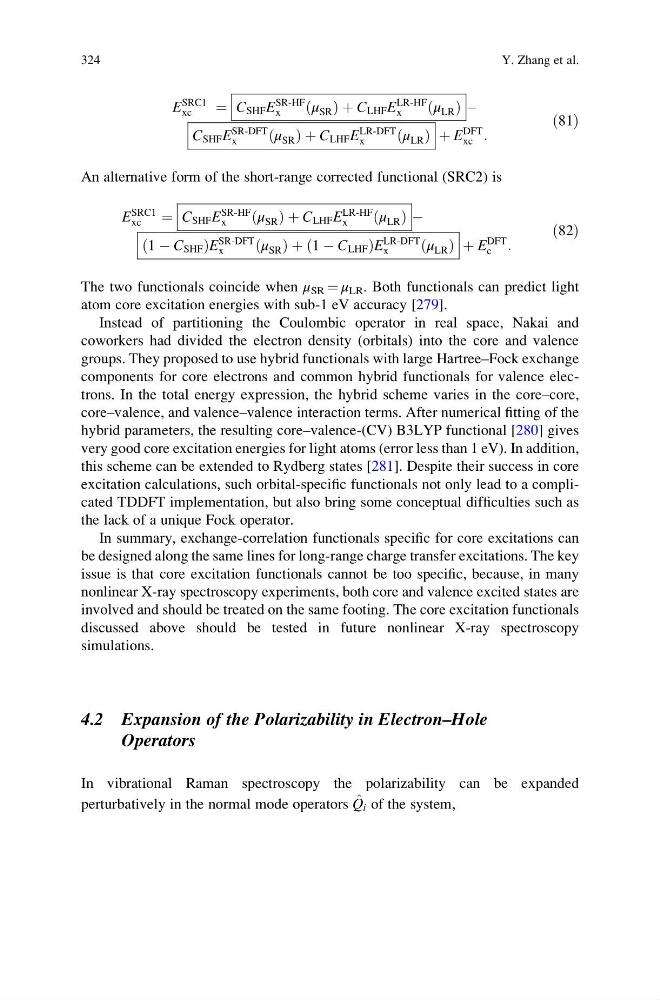
E
SRC1
xc
¼ C SHF E
SR-HF
x
μ SR
ð ÞþC LHF E
LR-HF
x
μ LR
ð Þ À
C SHF E
SR-DFT
x
μ SR
ð ÞþC LHF E
LR-DFT
x
μ LR
ð Þ þE
DFT
xc :
ð81Þ
An alternative form of the short-range corrected functional (SRC2) is
E
SRC1
xc
¼ C SHF E
SR-HF
x
μ SR
ð ÞþC LHF E
LR-HF
x
μ LR
ð Þ À
1 À C SHF
ð
Þ E
SR-DFT
x
μ SR
ð Þþ 1 À C LHF
ð
Þ E
LR-DFT
x
μ LR
ð Þ þE
DFT
c
:
ð82Þ
The two functionals coincide when μ SR ¼ μ LR . Both functionals can predict light
atom core excitation energies with sub-1 eV accuracy [279].
Instead of partitioning the Coulombic operator in real space, Nakai and
coworkers had divided the electron density (orbitals) into the core and valence
groups. They proposed to use hybrid functionals with large Hartree–Fock exchange
components for core electrons and common hybrid functionals for valence electrons. In the total energy expression, the hybrid scheme varies in the core–core,
core–valence, and valence–valence interaction terms. After numerical fitting of the
hybrid parameters, the resulting core–valence-(CV) B3LYP functional [280] gives
very good core excitation energies for light atoms (error less than 1 eV). In addition,
this scheme can be extended to Rydberg states [281]. Despite their success in core
excitation calculations, such orbital-specific functionals not only lead to a complicated TDDFT implementation, but also bring some conceptual difficulties such as
the lack of a unique Fock operator.
In summary, exchange-correlation functionals specific for core excitations can
be designed along the same lines for long-range charge transfer excitations. The key
issue is that core excitation functionals cannot be too specific, because, in many
nonlinear X-ray spectroscopy experiments, both core and valence excited states are
involved and should be treated on the same footing. The core excitation functionals
discussed above should be tested in future nonlinear X-ray spectroscopy
simulations.
4.2 Expansion of the Polarizability in Electron–Hole
Operators
In vibrational Raman spectroscopy the polarizability can be expanded
perturbatively in the normal mode operators ^
Q i of the system,
324
Y. Zhang et al.
SRC1
xc
¼ C SHF E
SR-HF
x
μ SR
ð ÞþC LHF E
LR-HF
x
μ LR
ð Þ À
C SHF E
SR-DFT
x
μ SR
ð ÞþC LHF E
LR-DFT
x
μ LR
ð Þ þE
DFT
xc :
ð81Þ
An alternative form of the short-range corrected functional (SRC2) is
E
SRC1
xc
¼ C SHF E
SR-HF
x
μ SR
ð ÞþC LHF E
LR-HF
x
μ LR
ð Þ À
1 À C SHF
ð
Þ E
SR-DFT
x
μ SR
ð Þþ 1 À C LHF
ð
Þ E
LR-DFT
x
μ LR
ð Þ þE
DFT
c
:
ð82Þ
The two functionals coincide when μ SR ¼ μ LR . Both functionals can predict light
atom core excitation energies with sub-1 eV accuracy [279].
Instead of partitioning the Coulombic operator in real space, Nakai and
coworkers had divided the electron density (orbitals) into the core and valence
groups. They proposed to use hybrid functionals with large Hartree–Fock exchange
components for core electrons and common hybrid functionals for valence electrons. In the total energy expression, the hybrid scheme varies in the core–core,
core–valence, and valence–valence interaction terms. After numerical fitting of the
hybrid parameters, the resulting core–valence-(CV) B3LYP functional [280] gives
very good core excitation energies for light atoms (error less than 1 eV). In addition,
this scheme can be extended to Rydberg states [281]. Despite their success in core
excitation calculations, such orbital-specific functionals not only lead to a complicated TDDFT implementation, but also bring some conceptual difficulties such as
the lack of a unique Fock operator.
In summary, exchange-correlation functionals specific for core excitations can
be designed along the same lines for long-range charge transfer excitations. The key
issue is that core excitation functionals cannot be too specific, because, in many
nonlinear X-ray spectroscopy experiments, both core and valence excited states are
involved and should be treated on the same footing. The core excitation functionals
discussed above should be tested in future nonlinear X-ray spectroscopy
simulations.
4.2 Expansion of the Polarizability in Electron–Hole
Operators
In vibrational Raman spectroscopy the polarizability can be expanded
perturbatively in the normal mode operators ^
Q i of the system,
324
Y. Zhang et al.