

excitation energies [262]. Core excitations share many similarities with long-range
charge transfer excitations, because the transition orbitals involved in these excitations have negligible overlaps. This suggests that a similar strategy may be used
for designing energy functionals for core excitation as is done for long-range charge
transfer excitations. The range-separated functionals [263–277] are good choices.
In these functionals, the long-range part of the exchange energy is evaluated using
Hartree–Fock theory, and in the short-range DFT exchange is used. The 1/r 12
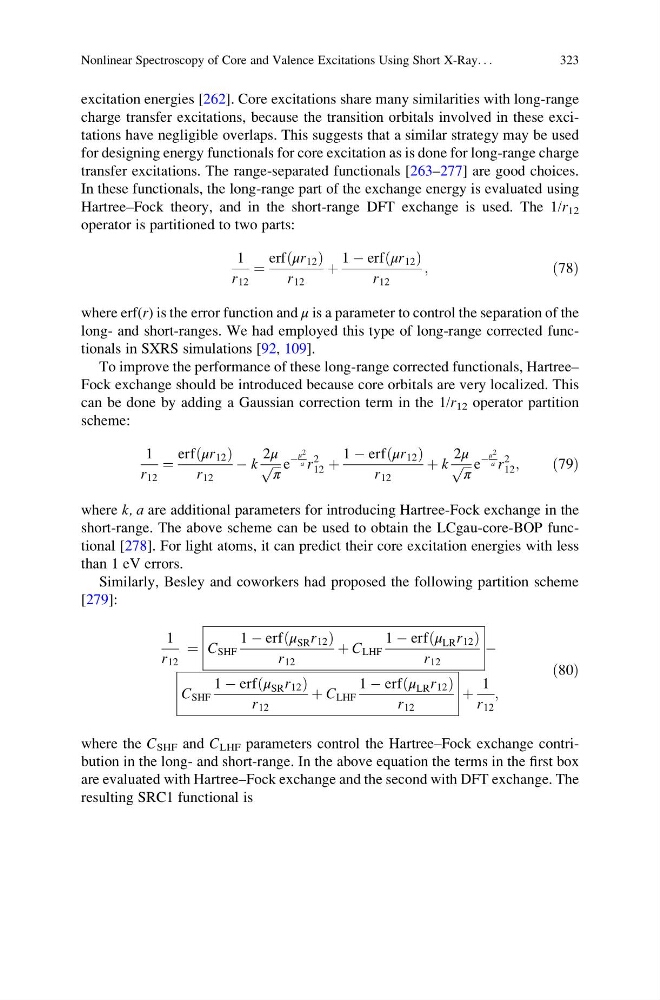
operator is partitioned to two parts:
1
r 12
¼
erf μr 12
ð
Þ
r 12
þ
1 À erf μr 12
ð
Þ
r 12
;
ð78Þ
where erf(r) is the error function and μ is a parameter to control the separation of the
long- and short-ranges. We had employed this type of long-range corrected functionals in SXRS simulations [92, 109].
To improve the performance of these long-range corrected functionals, Hartree–
Fock exchange should be introduced because core orbitals are very localized. This
can be done by adding a Gaussian correction term in the 1/r 12 operator partition
scheme:
1
r 12
¼
erf μr 12
ð
Þ
r 12
À k
2μ
ffiffiffi
π
p e
À
μ 2
a r
2
12 þ
1 À erf μr 12
ð
Þ
r 12
þ k
2μ
ffiffiffi
π
p e
À
μ 2
a r
2
12 ;
ð79Þ
where k, a are additional parameters for introducing Hartree-Fock exchange in the
short-range. The above scheme can be used to obtain the LCgau-core-BOP functional [278]. For light atoms, it can predict their core excitation energies with less
than 1 eV errors.
Similarly, Besley and coworkers had proposed the following partition scheme
[279]:
1
r 12
¼ C SHF
1 À erf μ SR r 12
ð
Þ
r 12
þ C LHF
1 À erf μ LR r 12
ð
Þ
r 12
À
C SHF
1 À erf μ SR r 12
ð
Þ
r 12
þ C LHF
1 À erf μ LR r 12
ð
Þ
r 12
þ
1
r 12
;
ð80Þ
where the C SHF and C LHF parameters control the Hartree–Fock exchange contribution in the long- and short-range. In the above equation the terms in the first box
are evaluated with Hartree–Fock exchange and the second with DFT exchange. The
resulting SRC1 functional is
Nonlinear Spectroscopy of Core and Valence Excitations Using Short X-Ray. . .
323
charge transfer excitations, because the transition orbitals involved in these excitations have negligible overlaps. This suggests that a similar strategy may be used
for designing energy functionals for core excitation as is done for long-range charge
transfer excitations. The range-separated functionals [263–277] are good choices.
In these functionals, the long-range part of the exchange energy is evaluated using
Hartree–Fock theory, and in the short-range DFT exchange is used. The 1/r 12
operator is partitioned to two parts:
1
r 12
¼
erf μr 12
ð
Þ
r 12
þ
1 À erf μr 12
ð
Þ
r 12
;
ð78Þ
where erf(r) is the error function and μ is a parameter to control the separation of the
long- and short-ranges. We had employed this type of long-range corrected functionals in SXRS simulations [92, 109].
To improve the performance of these long-range corrected functionals, Hartree–
Fock exchange should be introduced because core orbitals are very localized. This
can be done by adding a Gaussian correction term in the 1/r 12 operator partition
scheme:
1
r 12
¼
erf μr 12
ð
Þ
r 12
À k
2μ
ffiffiffi
π
p e
À
μ 2
a r
2
12 þ
1 À erf μr 12
ð
Þ
r 12
þ k
2μ
ffiffiffi
π
p e
À
μ 2
a r
2
12 ;
ð79Þ
where k, a are additional parameters for introducing Hartree-Fock exchange in the
short-range. The above scheme can be used to obtain the LCgau-core-BOP functional [278]. For light atoms, it can predict their core excitation energies with less
than 1 eV errors.
Similarly, Besley and coworkers had proposed the following partition scheme
[279]:
1
r 12
¼ C SHF
1 À erf μ SR r 12
ð
Þ
r 12
þ C LHF
1 À erf μ LR r 12
ð
Þ
r 12
À
C SHF
1 À erf μ SR r 12
ð
Þ
r 12
þ C LHF
1 À erf μ LR r 12
ð
Þ
r 12
þ
1
r 12
;
ð80Þ
where the C SHF and C LHF parameters control the Hartree–Fock exchange contribution in the long- and short-range. In the above equation the terms in the first box
are evaluated with Hartree–Fock exchange and the second with DFT exchange. The
resulting SRC1 functional is
Nonlinear Spectroscopy of Core and Valence Excitations Using Short X-Ray. . .
323